The Early Fall Outfit Guide: September to November
How to use this guide
These are editorial styling suggestions, not a one-size-fits-all formula. Adapt each look to your wardrobe, proportions, climate, comfort, budget, and the occasion; the most useful idea is the one you can genuinely wear.
Picture a Tuesday in mid-September: you leave the house at 8 a.m. in a jacket because the air feels crisp, and by 2 p.m. you are carrying that jacket over your arm, slightly annoyed, slightly overheated. Then 6 p.m. arrives and you wish you had it back on. Sound familiar? Early fall is not one season. It is three. September afternoons can still touch summer heat while mornings ask for a jacket; October gives you the golden window where every piece in your closet works; November arrives with real chill, shorter days, and a genuine need for insulation.
Most guides flatten this into a single "fall look," which is why so many transitional outfits fail: you end up overdressed at 2 p.m. or underdressed by 6 p.m., and the colors feel off for the month. This guide treats the season as the arc it actually is. For each month, you get the styling principles that fit its temperatures and light, plus concrete outfit formulas that explain why they work — the proportion, texture contrast, color temperature, and silhouette logic behind every combination. The goal is not a list of items to buy. It is a way of thinking about your existing closet so that getting dressed from September through November stops feeling like guesswork.
September: Dressing for Lingering Warmth
Why is September the hardest month to dress for? The air still holds humidity, the sun carries real warmth, but mornings and evenings drop ten to fifteen degrees below midday. Any outfit built for one temperature fails at another. The answer is not heavier clothing; it is a structure of thin, removable layers over breathable bases.
Every September outfit should be able to lose a layer and still look complete — a jacket over a dress, a cardigan over a tank, a shirt knotted at the waist of a skirt. If the outfit falls apart without its outer layer, it is a November outfit wearing September weather.
Fabric choice matters more than silhouette this month. Cotton twill, chambray, lightweight denim, linen blends, and open-knit cotton all let heat escape while giving you coverage. Save dense weaves, thick corduroy, heavy wool flannel, and bonded fabrics for October. A slip dress in silk or viscose reads as September; the same cut in heavy crepe reads as November. The difference is entirely about how the fabric behaves in the air.
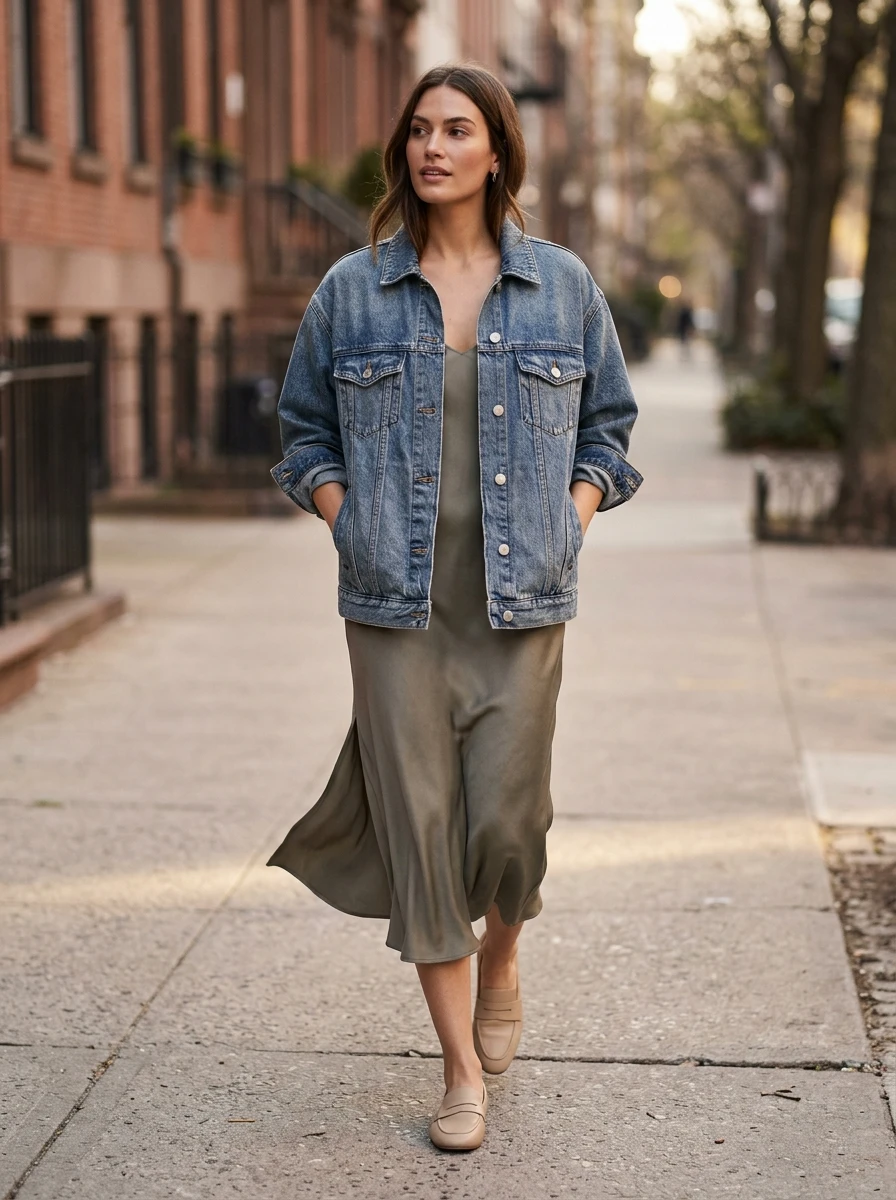
A Slip Dress Borrowed a Jacket
The most reliable September formula is a summer dress with a borrowed jacket. A fluid midi slip dress on its own is too bare for a crisp morning; paired with an oversized denim jacket, it becomes a study in texture contrast. The rigid, matte denim gives the liquid drape of the dress something to push against, which is why the pairing looks intentional rather than thrown together.
Wear it with: leather loafers — closed-toe enough for the season, open-lined enough for warm afternoons. Keep the jacket cropped at the hip so it defines your waistline instead of swallowing it.
Chambray and White Jeans
Another September workhorse: chambray with white jeans. White denim past Labor Day stops being a rule question and becomes a color temperature one. In September, pair white jeans with warm, washed-out tones — chambray blue, soft camel, faded olive — and the brightness reads as late-summer ease instead of a style violation. Tuck a chambray shirt into high-rise white jeans, add a tan leather belt to break the pale column at the waist, and finish with suede loafers.
Colour pairing: keep the palette washed and warm. Bright white against stark black would push the outfit toward winter; soft, sun-faded tones keep it in September.
The whole outfit breathes, but the long sleeves and closed shoes acknowledge that autumn is near.
The Cardigan Worn as a Top
The cardigan as a top is a September trick that looks polished with almost no effort. Button a midweight cardigan all the way up and tuck it into high-rise trousers, and you have removed an entire layer of decision-making: the knit is the top. This works in September because a single knit layer provides exactly the insulation a warm day allows.
Fit note: the proportion logic matters. A fitted cardigan tucked into high-waisted trousers creates a clear waist-to-leg ratio, which keeps the outfit from reading pajama-like. Choose fine-gauge knits over chunky cables this month; the silhouette should be sleek, not insulated.
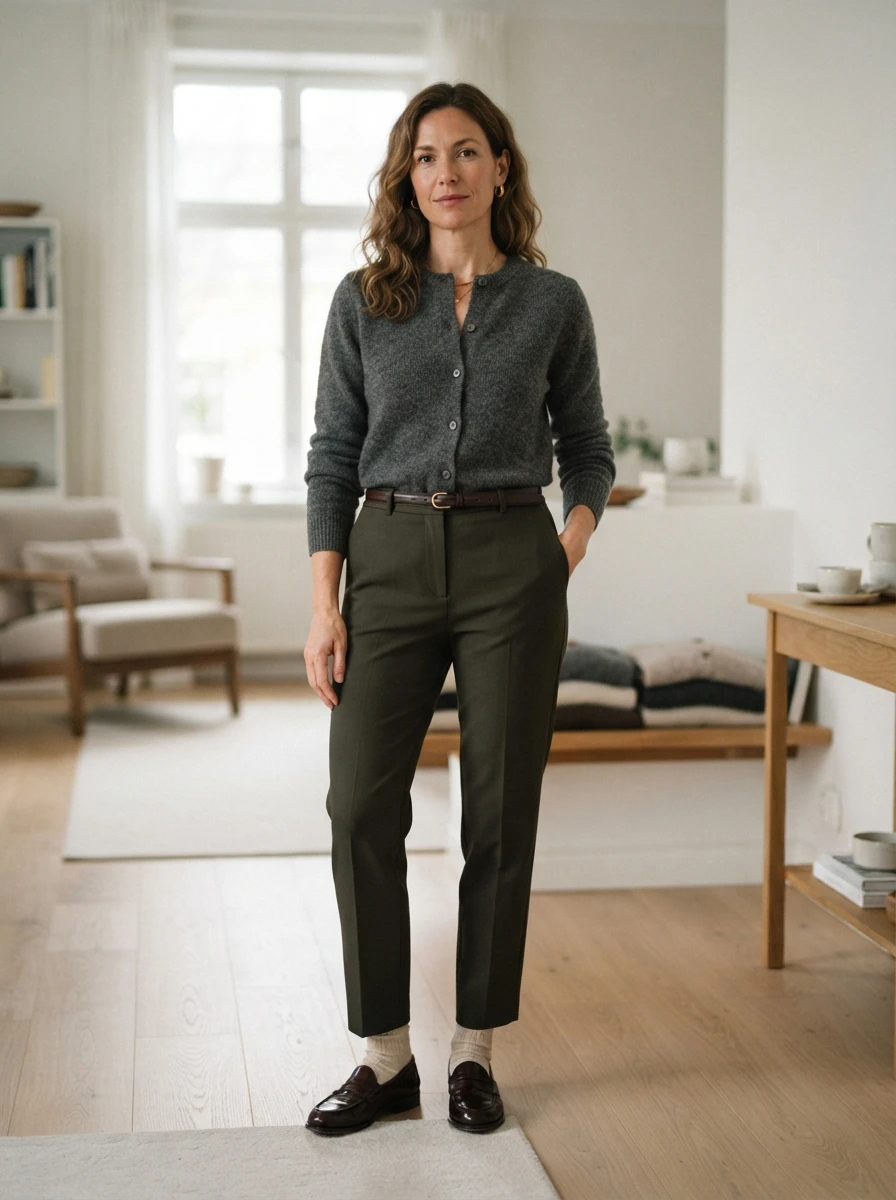
A Maxi Skirt With a Denim Shirt
For the warmest September days, lean on airy coverage: a cotton or linen-blend maxi skirt with a denim shirt tucked in or knotted at the waist. The maxi gives you full leg coverage without any of the heat retention of trousers — air circulates under the skirt, which is why maxi lengths feel cooler than they look. The denim shirt adds torso structure and a touch of warmth where your core actually needs it.
Fabric note: cotton and linen blends are the right call here; a heavy twill or lined maxi would trap heat and defeat the point. This is a genuine transitional silhouette: every piece is light, but nothing exposes you to an unexpected cold snap.
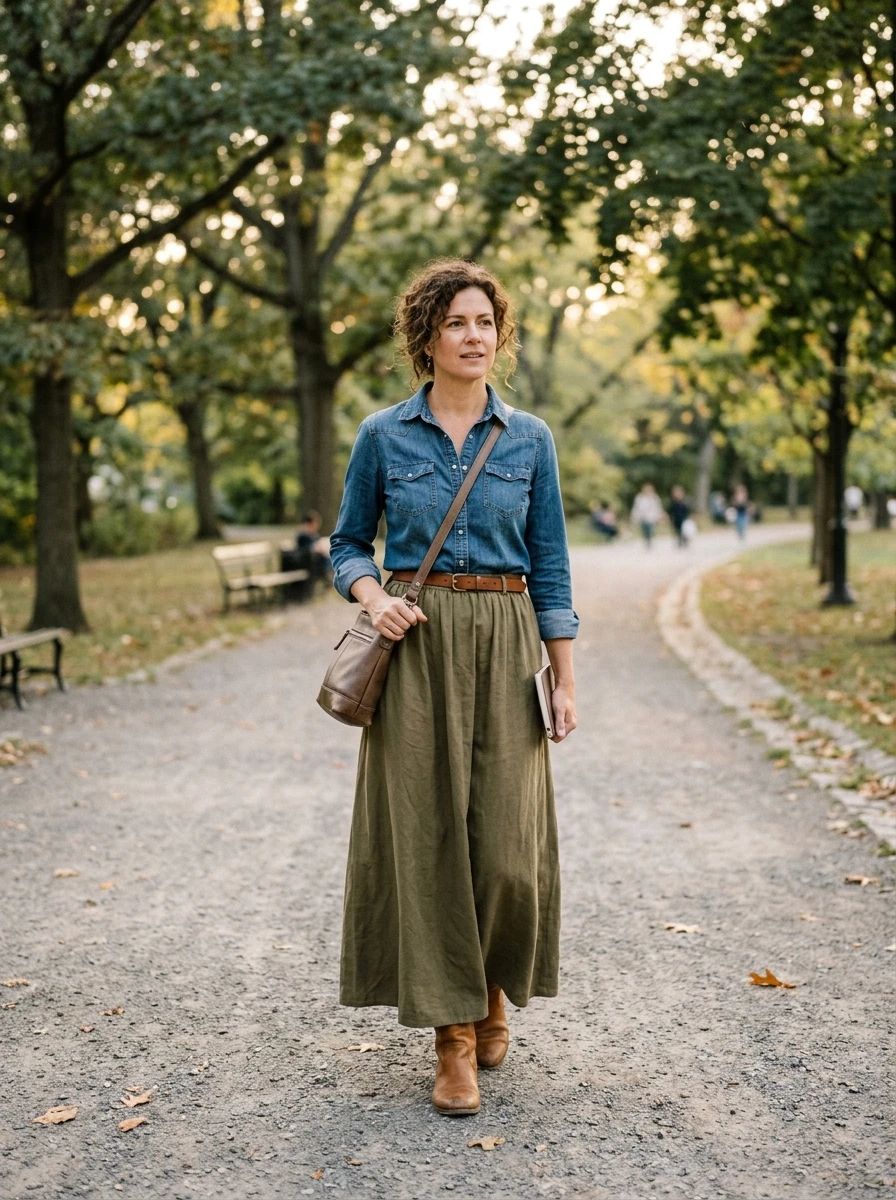
Wide-Leg Trousers and a Fitted Tank
Finally, September is the moment for wide leg trousers with a fitted tank. The contrast in volume is the entire point: loose on the bottom, close on top. If both halves are loose, you disappear into fabric; if both are fitted, you lose the relaxed register the month calls for. A fitted ribbed tank tucked into high-rise, wide-leg linen or Tencel trousers gives you a long, clean line, and a lightweight open cardigan or draped sweater handles the temperature drop after sunset without committing you to a coat.
Care tip: linen and Tencel crease naturally, so hang trousers straight after washing and steam them lightly rather than ironing flat — a soft, lived-in finish suits this outfit better than a pressed crease.
More September Formulas for Early Fall
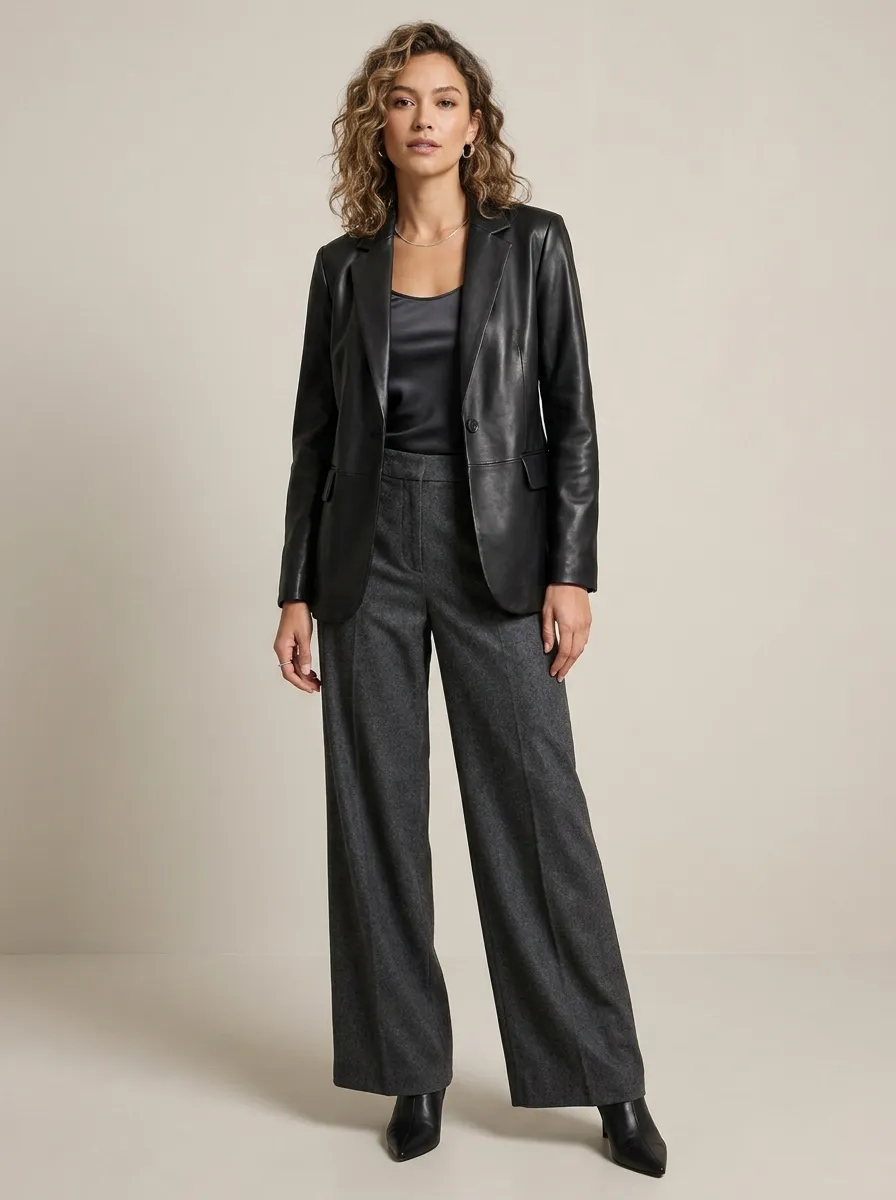
Leather Blazer and Wide Leg Trousers
Swapping a standard blazer for leather changes the outfit's register from corporate to intentional. The mechanism is material tension: the leather's sheen and structure against the soft drape of wide-leg wool trousers. This only works if the trousers are actually fluid — stiff wide legs with a leather blazer stack rigidity on rigidity. For September specifically, this is an evening formula; leather doesn't breathe, so save it for after the afternoon heat breaks.
Sweater Dress and Knee Boots
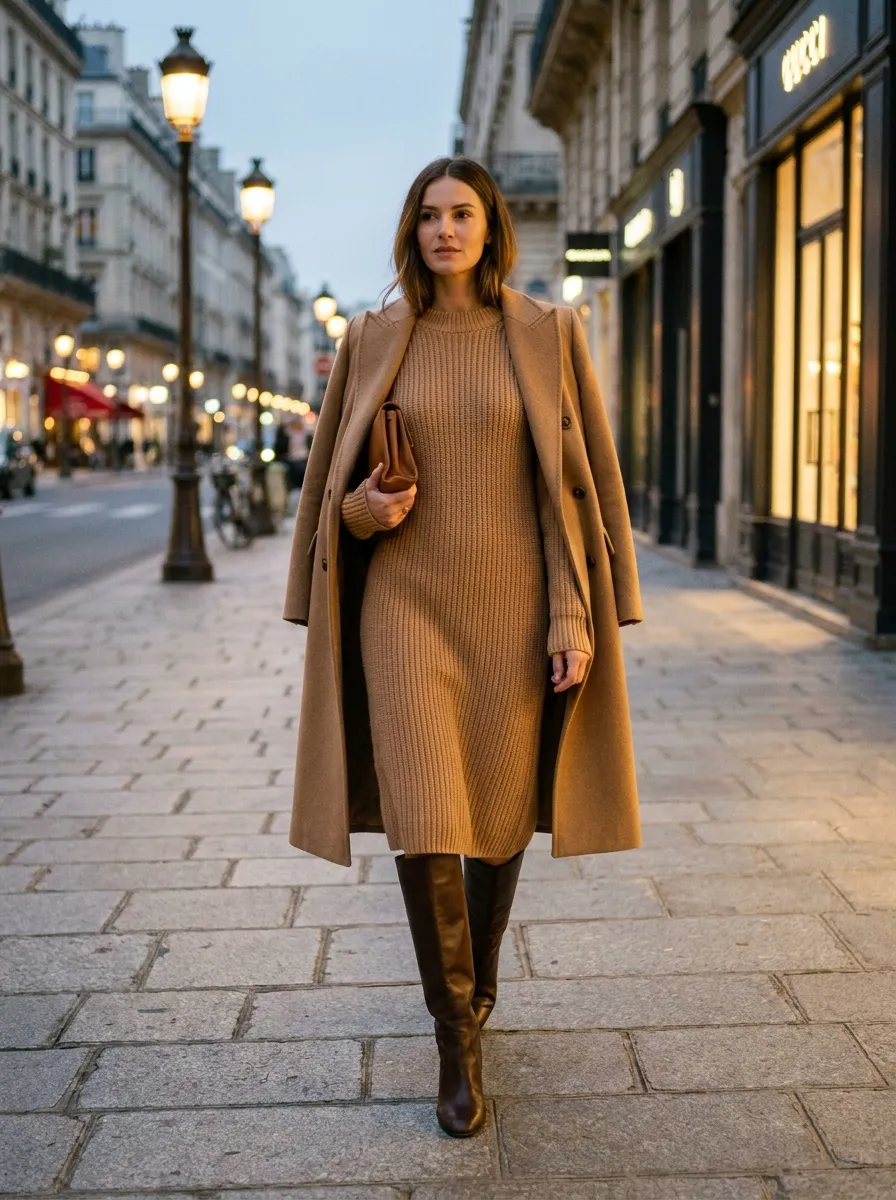
The sweater dress is September's lowest-effort win: one piece, done. The boots are what make it fall instead of just "a dress" — knee-high boots add coverage, structure, and a visual anchor at the bottom of the silhouette. On milder days you can skip tights entirely, which is the real September advantage of this outfit.
Fabric note: the dress's knit needs enough weight to drape; a flimsy sweater dress clings and shows every line. Fold, don't hang — gravity stretches knit dresses out of shape on hangers.
For the wider fall wardrobe, see these fall outfits every woman needs.
Bomber Jacket and Tailored Pants
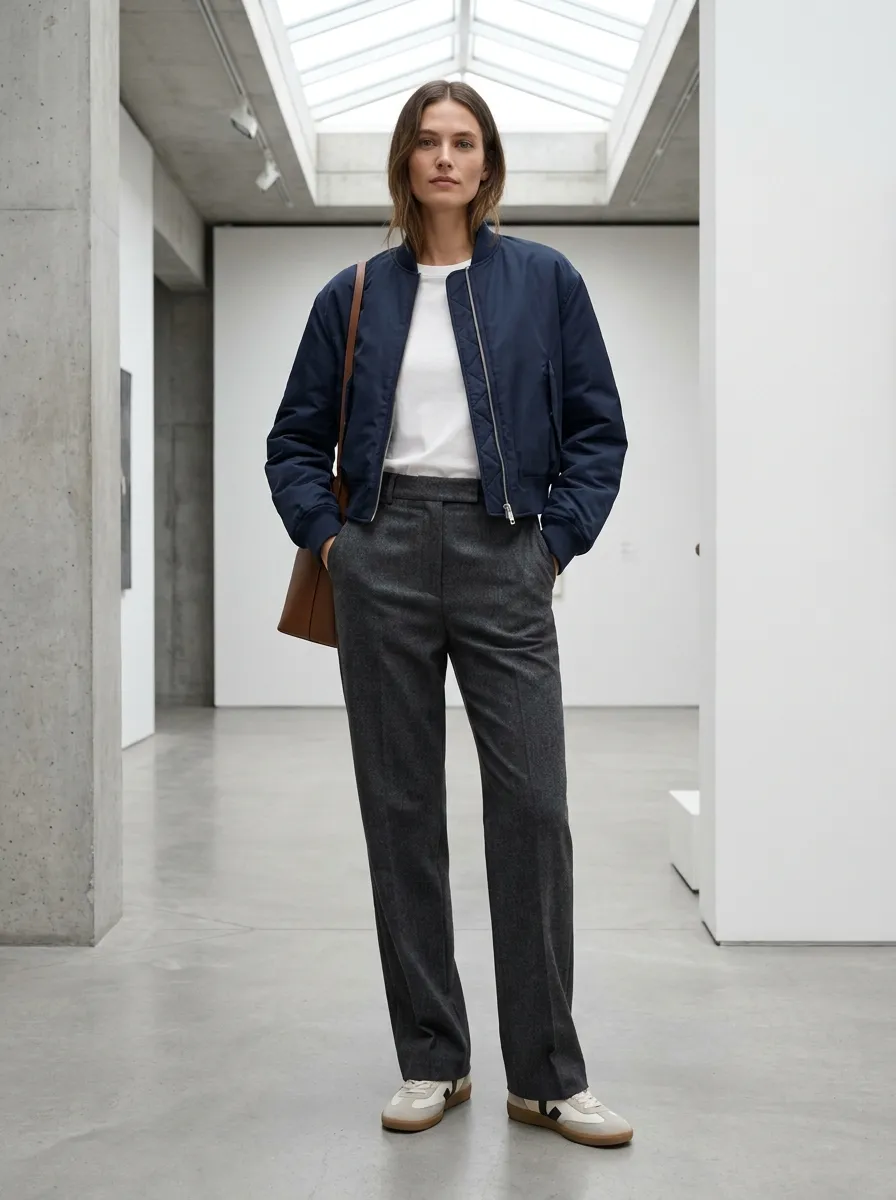
The bomber over tailored trousers combination is the high-low formula applied to outerwear: sporty top, refined bottom. It works when the bomber is slightly cropped, hitting at the waistband of the trousers so the trousers' clean line continues uninterrupted. A long bomber over tailored pants stacks two competing silhouettes.
Wear it with: a plain tee underneath. Keep everything under the bomber simple; the jacket-trouser contrast is already doing enough visual work.
Vest and Wide Leg Denim
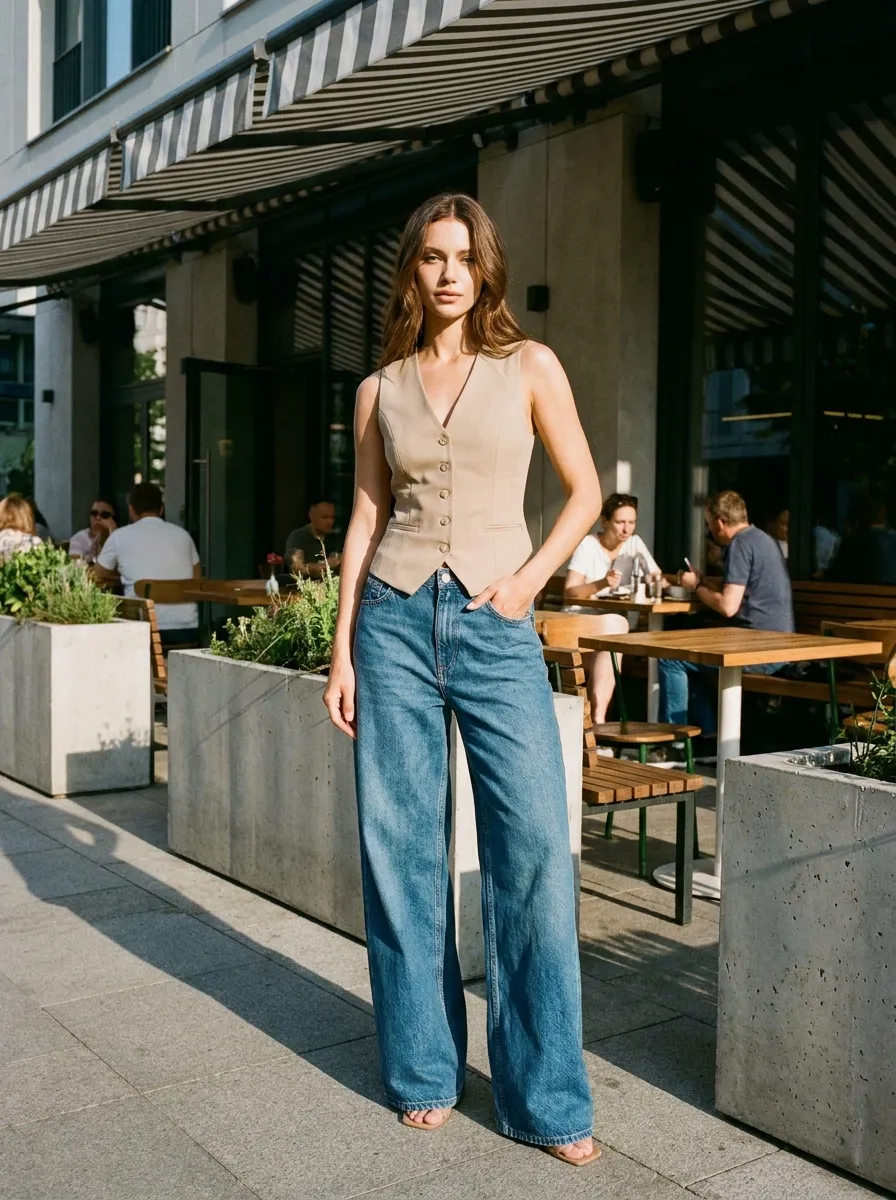
A tailored vest worn as a top is September's sharpest casual move, and it works because the vest brings tailoring — buttons, seaming, structure — to an otherwise relaxed outfit. The wide-leg denim keeps it from reading as formal; that's the balance.
Fit note: the vest must fit closely through the torso; a loose vest looks like a waistcoat borrowed from a suit. Keep a light jacket on hand for evening, because a vest alone won't handle the post-sunset drop.
Quilted Jacket and Slim Jeans
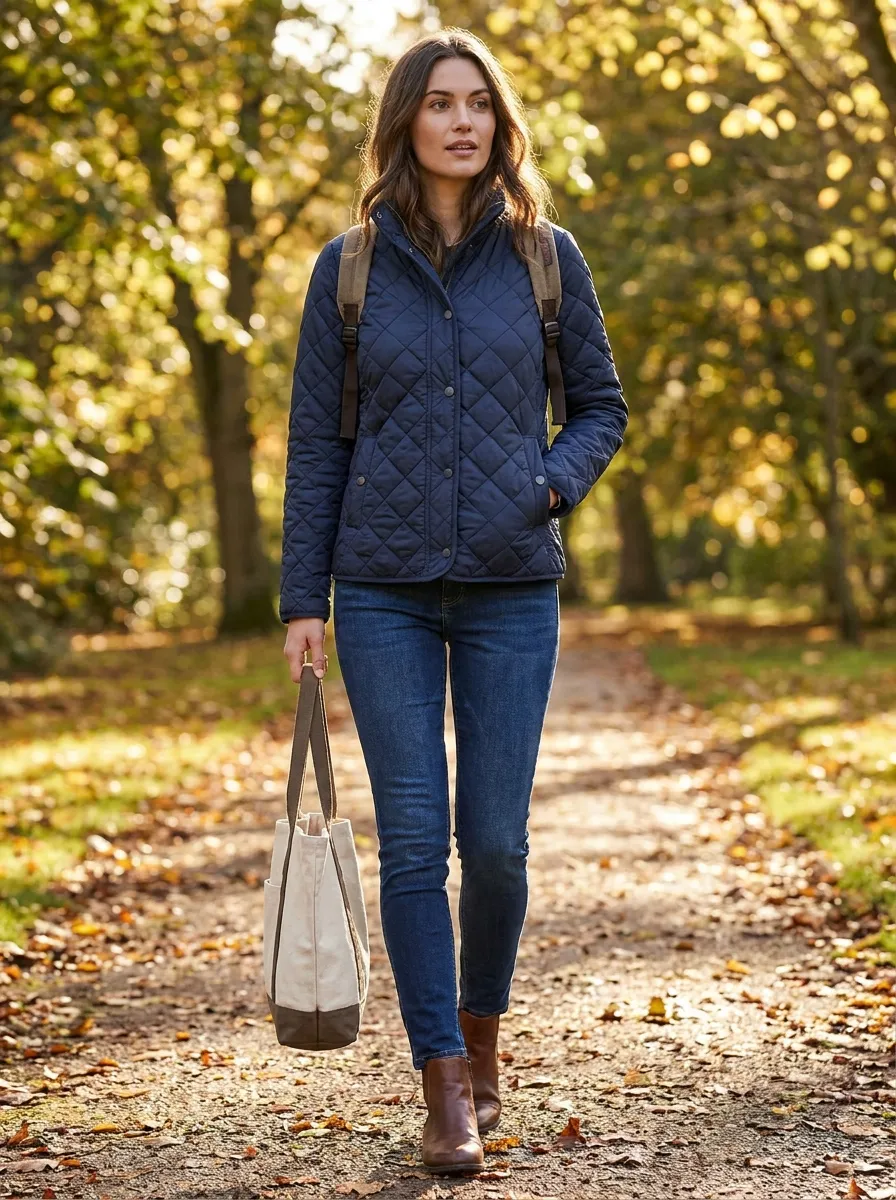
The quilted jacket is September's most practical outerwear: warmer than a denim jacket, lighter than a winter coat, and water-resistant enough for surprise rain. The quilting adds texture, which means the rest of the outfit can stay simple — slim jeans, plain tee, done.
Colour pairing: slim (not skinny) jeans keep the proportion balanced: the jacket has some volume, so the leg needs to be narrow enough to contrast it. Olive and navy are the colors that make this look autumnal rather than generic.
Tailored Shorts And A Blazer
Tailored shorts extend summer while the blazer announces fall — the combination works because the blazer's structure elevates the shorts from casual to deliberate. The shorts must be tailored (clean hem, structured fabric), not athletic or frayed; the blazer does the formal work, and the shorts have to meet it halfway.
Wear it with: opaque tights as temperatures drop, extending this outfit weeks past its apparent season. It's the office-appropriate way to wear shorts in October.

Pencil Skirt And A Mock Neck Top
The pencil skirt with a mock neck top is the office transition uniform: the mock neck's clean line reads as polished while the skirt keeps it professional. The mock neck should be fine-gauge and fitted; the pencil skirt a fall-weight fabric (wool, ponte). It's the outfit for the workplace that runs cold in the morning and warm by afternoon — the top handles both without a layer change.
Colour pairing: in dark neutrals, it's also the most versatile: the same two pieces work for dinner with different shoes.

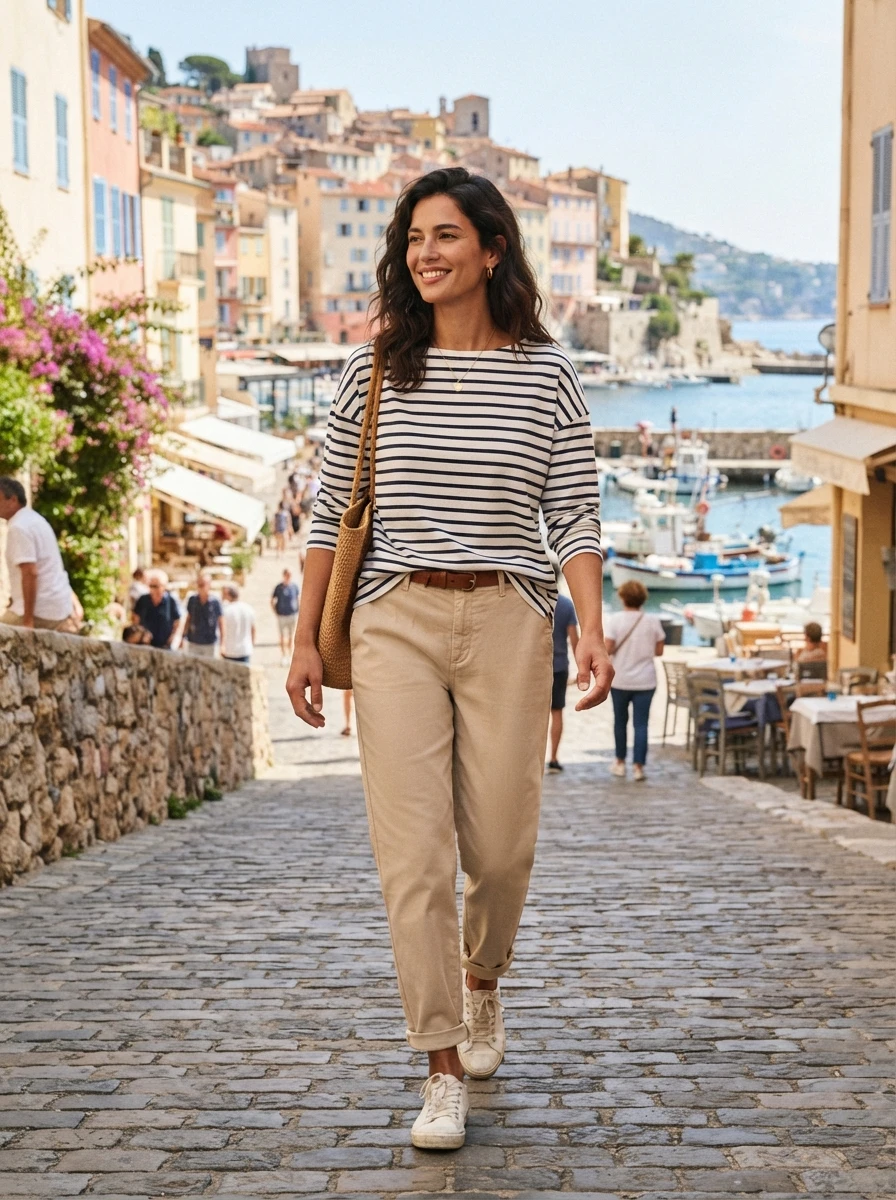
Chinos And A Breton Stripe Top
Chinos with a Breton stripe top is the timeless casual transition outfit — the stripe's nautical heritage works in every season, and the chino's clean line keeps it polished. The top's long sleeves handle the cool morning; the chino's cropped or rolled ankle keeps it light for the afternoon.
Fabric note: in navy and cream, it's the palette that never looks wrong. Add a blazer and it's dinner; alone, it's the weekend uniform. Some combinations don't need seasonal justification; they just work.
October: The Transition Sweet Spot
October is the month fall styling was invented for. Temperatures sit in the range where midweight fabrics are actually comfortable all day, and the visual language of the season — rich textures, layered depth, boots on the ground — finally matches the weather. This is when you bring in the pieces September could not support: trench coats, leather jackets, blazers with real structure, corduroy, and the first proper boots. The guiding principle of October is texture contrast.
One texture across an outfit reads flat; two or three complementary textures — smooth leather against soft knit, crisp cotton twill against brushed flannel, rigid denim against fluid viscose — give the outfit the depth that makes fall dressing look good.
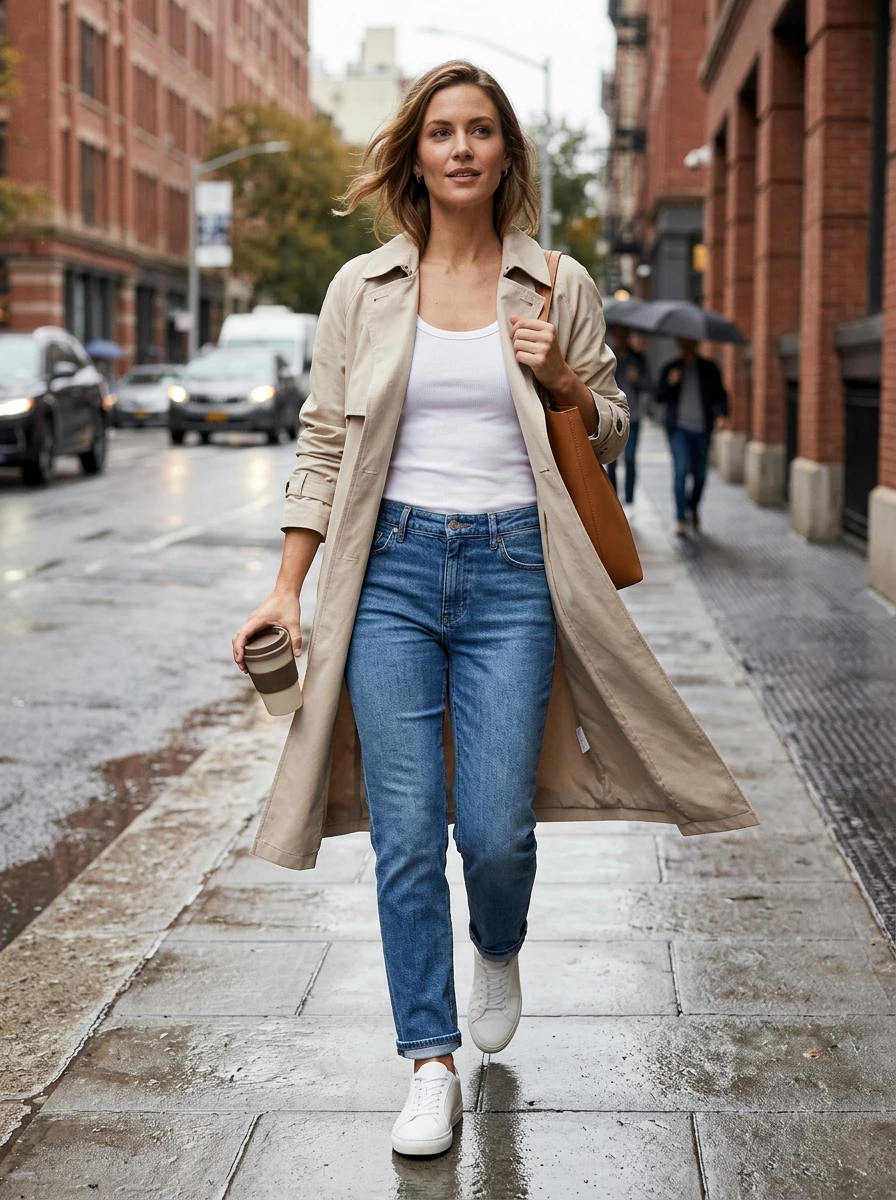
The Trench Coat, Worn Open
The trench coat is October's defining garment, and its power is in the silhouette it creates rather than the warmth it provides. Worn open over a simple base — a white or striped long-sleeve top, straight-leg blue jeans, leather sneakers or ankle boots — a knee-length trench in khaki or olive draws a long vertical line that elongates your frame while the open front reveals the fitted layers beneath.
Fit note: this is why the trench works over almost anything: it adds structure and length without adding bulk, and it reads as intentional over both dresses and denim. In October, the trench is a style decision first and weather protection second.
A Floral Midi Dress Under Leather
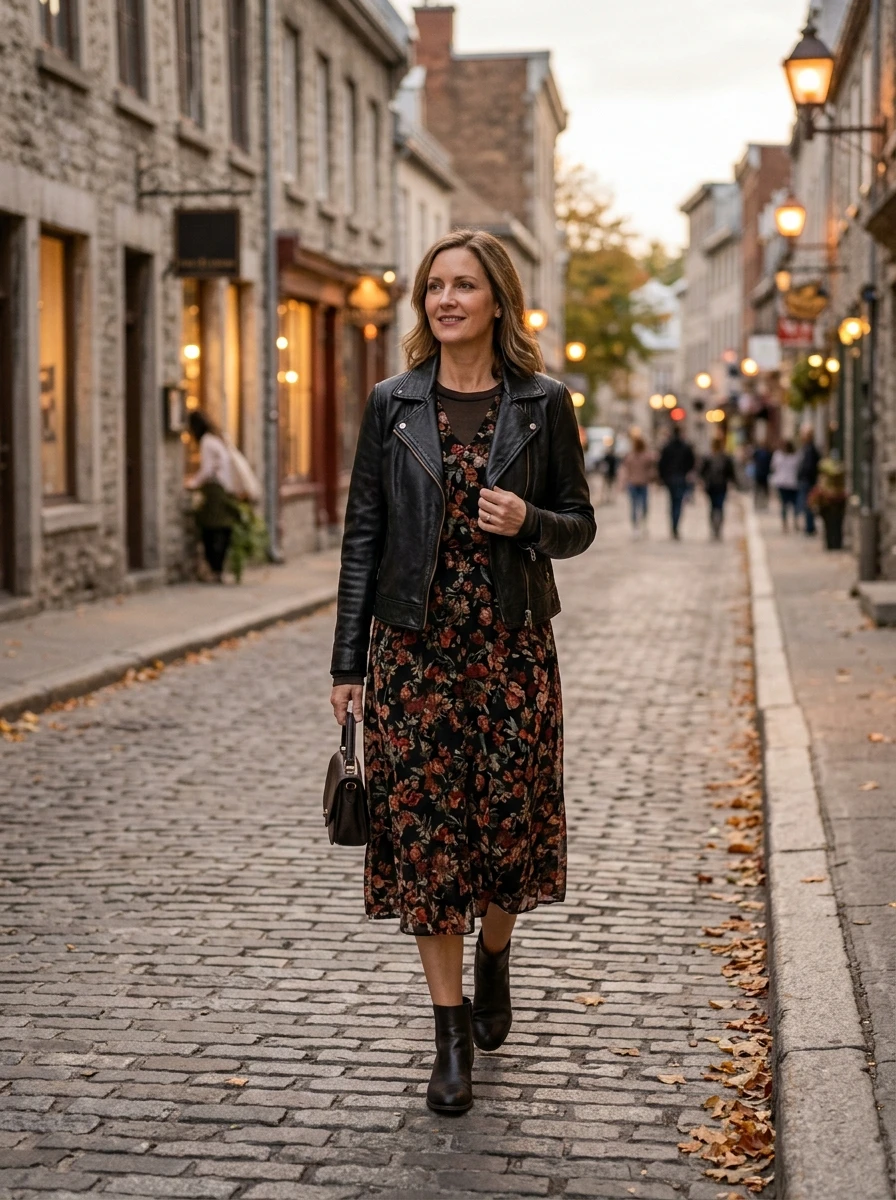
October is also when your summer dresses get their second act. A floral midi dress that felt too bare in September becomes perfect under a leather jacket, and the pairing works for a specific reason: the matte, structured leather disciplines the softness of the print. Without the jacket, the dress reads as summer; with it, the outfit reads as autumn. The contrast between tough and delicate is the whole aesthetic.
Wear it with: a thin long-sleeve tee or fitted turtleneck underneath if the dress is sleeveless, for real warmth. The visible layer at the neckline and wrists actually strengthens the fall impression rather than weakening the dress.
A Plaid Blazer Over Jeans
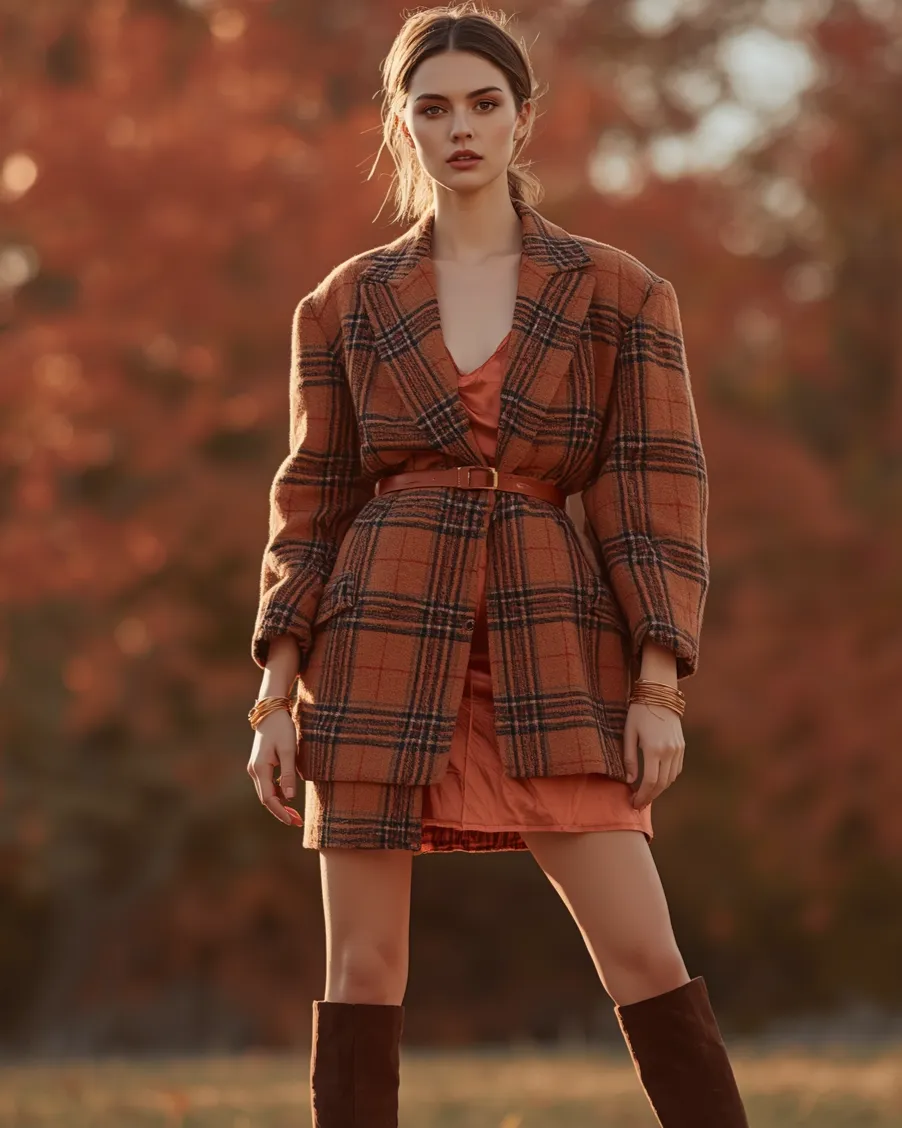
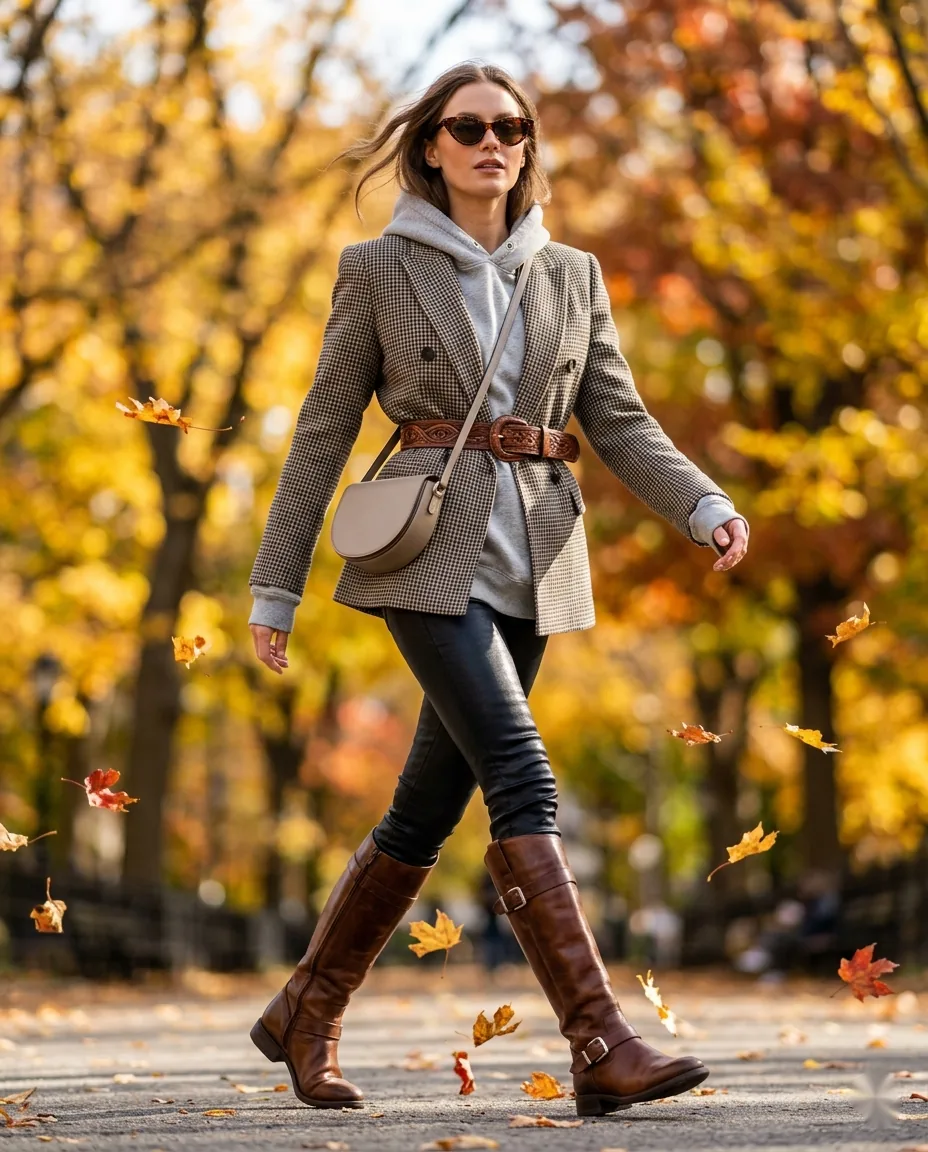
The plaid blazer over jeans is an October classic because it solves the season's central proportion question. A tailored blazer with real shoulder structure over straight-leg denim and a simple tee gives you polish on top and ease on the bottom, appropriate for an office, a dinner, or a weekend market without changing a thing.
Colour pairing: the plaid itself does visual work. Smaller-scale patterns sit quietly and let the rest of the outfit speak, while large, bold plaids become the outfit's focal point. When the blazer is doing the talking, keep everything else simple — plain tee, clean denim, understated shoes.
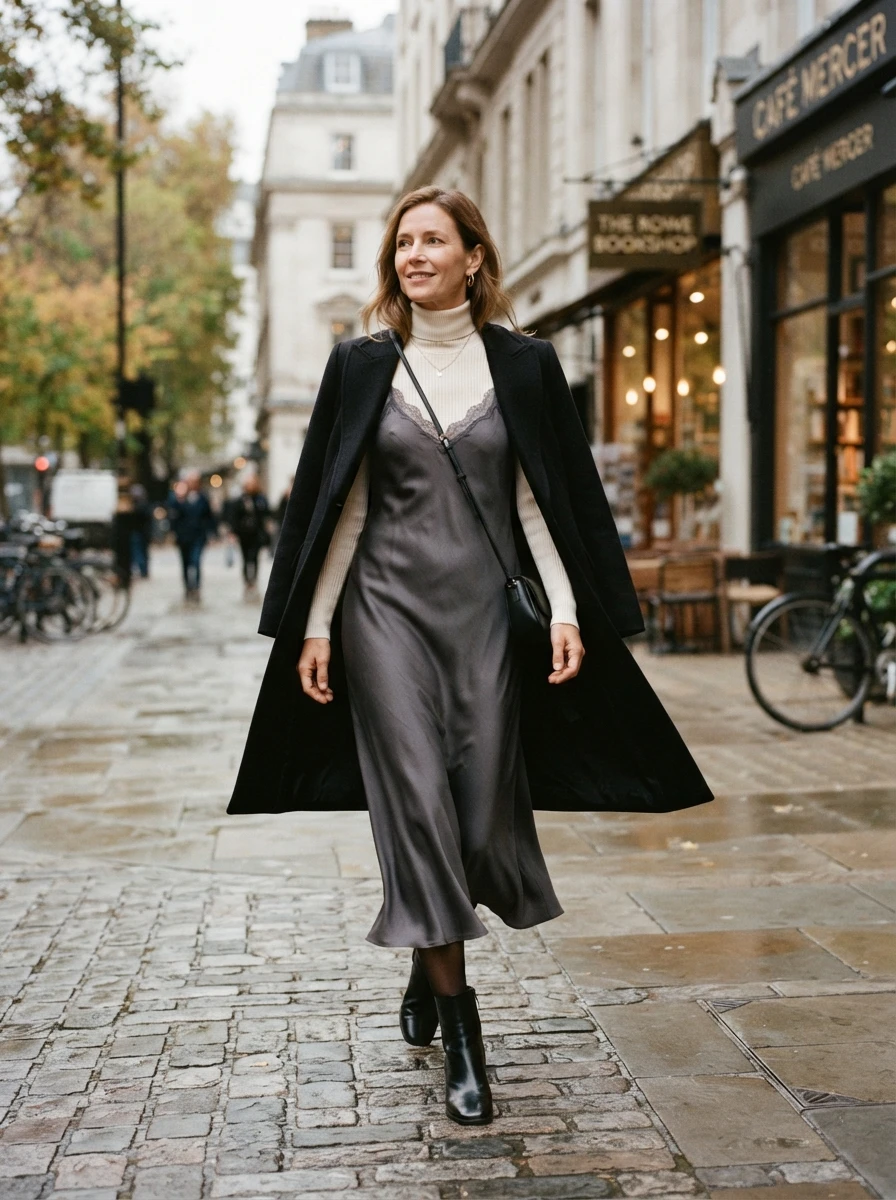
A Turtleneck Under a Slip Dress
The turtleneck-under-slip-dress formula reaches its peak in October. A thin merino or modal turtleneck in black, cream, or charcoal underneath a slip dress adds genuine insulation to your core while the dress provides the silhouette. This works because the eye reads the fitted neckline and the visible sleeve line as deliberate layering rather than as a hack — it is the same logic as a collar peeking from a sweater.
Fit note: the key is fit. The turtleneck must be close enough to lie flat under the dress's straps without bunching, and the dress needs enough ease to accommodate the extra layer. Done right, it is one of the most elegant outfits of the season.
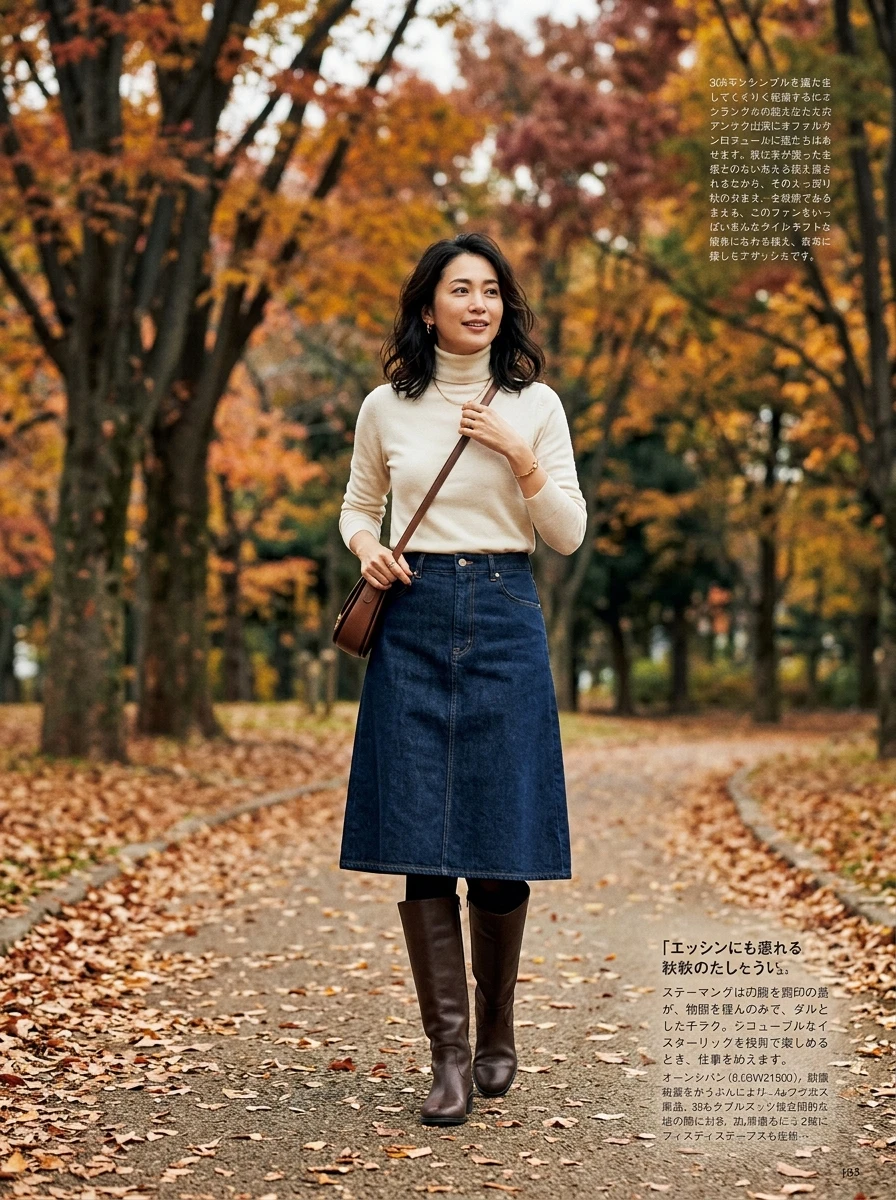
A Denim Midi Skirt With Knee-High Boots
Boots properly enter the rotation in October, and they change what your hemlines can do. A denim midi skirt with knee-high boots is the clearest example: the boots supply the leg warmth that makes a bare-kneed skirt viable in cooling air, while the skirt's A-line or straight cut balances the boot shaft's volume. Tuck in a lightweight turtleneck or long-sleeve tee so the waistline stays defined.
Fit note: the proportion rule here is that the visible gap between boot top and skirt hem — or the deliberate absence of a gap — is what makes the outfit look considered. Either the boots meet the hem or there is a clean, intentional band of leg; nothing accidental in between.
Corduroy Trousers and a Silk Blouse
One more October idea worth keeping in your back pocket: corduroy trousers with a silk blouse. Corduroy is the month's signature texture — the ribbed pile catches low autumn light in a way flat fabrics do not — and pairing its heaviness with something delicate keeps the outfit from feeling leaden. Wide-leg corduroy trousers in rust, chocolate, or olive with a fluid silk or satin blouse in cream creates exactly the heavy-light contrast that defines good fall dressing.
Wear it with: heeled ankle boots, which add the last bit of elevation the wide leg needs. The blouse tucks in to preserve the waistline.
A Sweater Draped Over the Shoulders
And for the days that cannot decide what they are: drape a lightweight sweater over your shoulders atop a tee and jeans. It is not an outfit so much as an insurance policy that happens to look good. The draped knit adds a horizontal line at the shoulders that visually balances wider hips, and the moment the temperature drops, your extra layer is already on your person.
Fabric note: use cotton or thin cashmere so the knot stays flat; anything chunky turns into a scarf you did not ask for.
November: Committing to Warmth Without Bulk
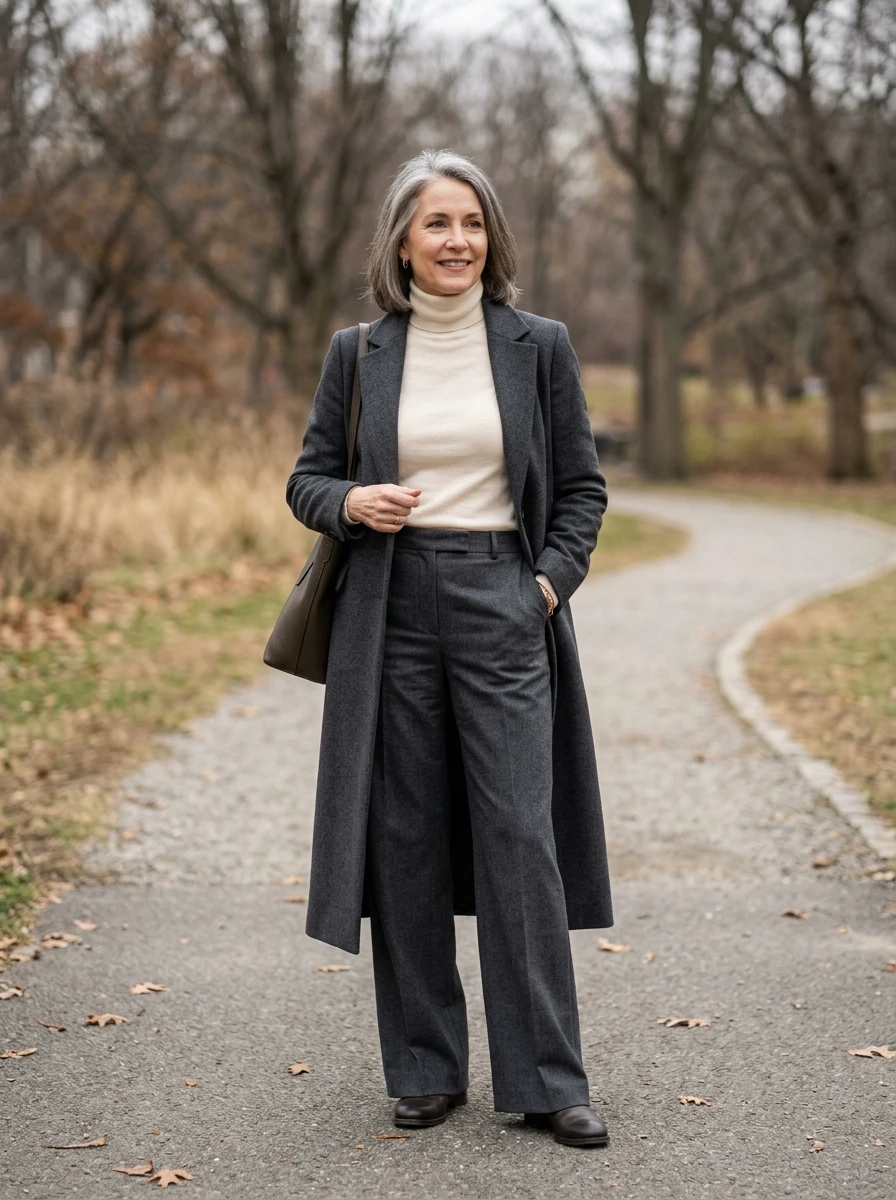
November asks for a real shift in strategy. The goal is no longer to manage fluctuation; it is to stay warm for a full day out without looking like you are wearing everything you own. The enemy is bulk, and the weapon against it is the layering order: thin insulating base, substantive middle, structured shell.
A silk or thermal base layer under a sweater under a coat gives you more warmth with less volume than one very thick sweater, because trapped air between layers insulates better than a single dense mass. This is the technical reason the best-dressed people in cold weather never look puffy.
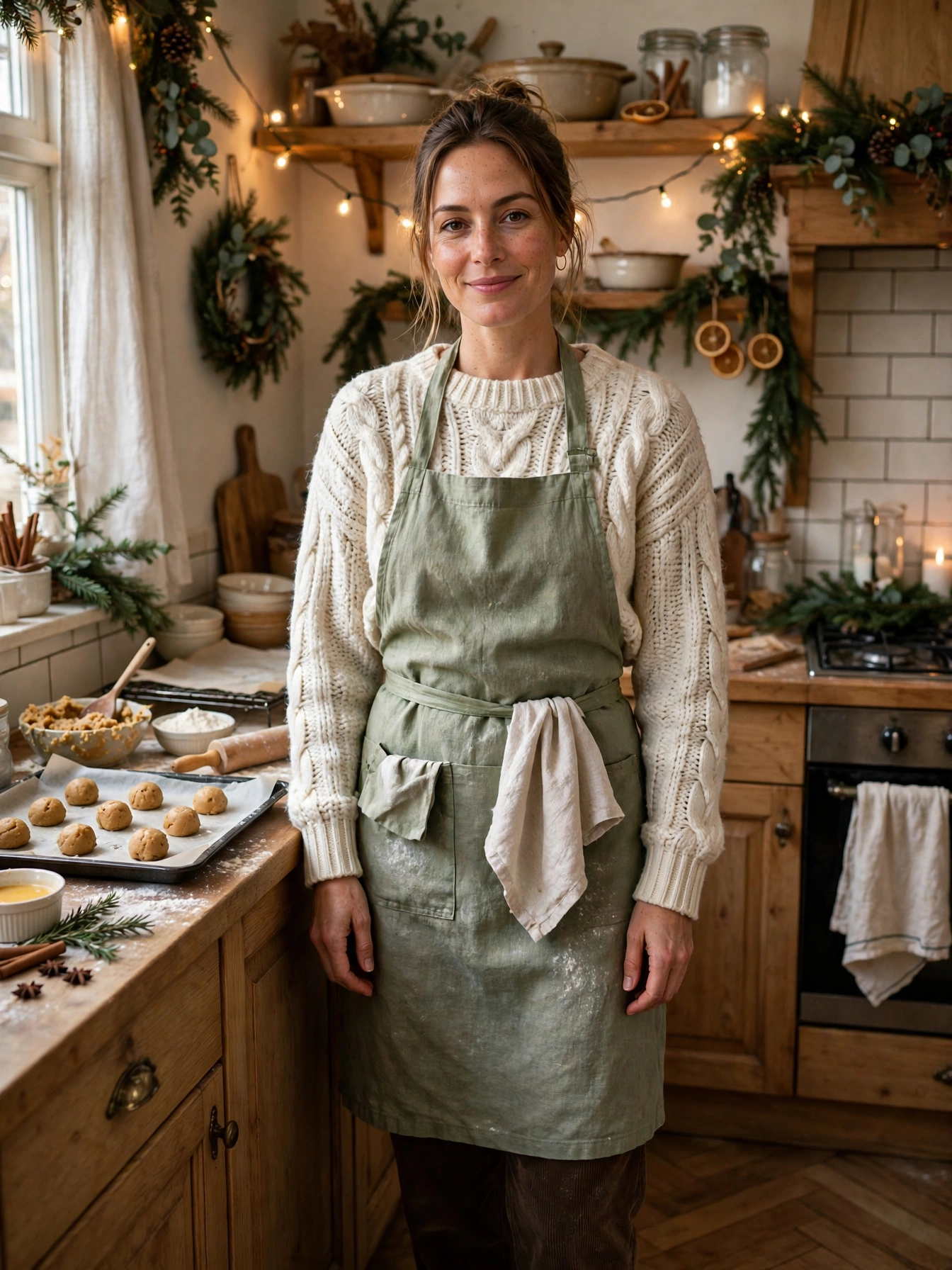
This is also the month your color palette should deepen. September's bright whites and washed-out blues give way to camel, oatmeal, rust, forest, burgundy, and charcoal — not because of a rule, but because warm, saturated colors read as seasonally coherent against November's low, gray light. Pale colors are not banned; they just need heavier textures to anchor them. A cream cable-knit sweater works in November because the chunky texture carries the seasonal weight the color alone cannot.
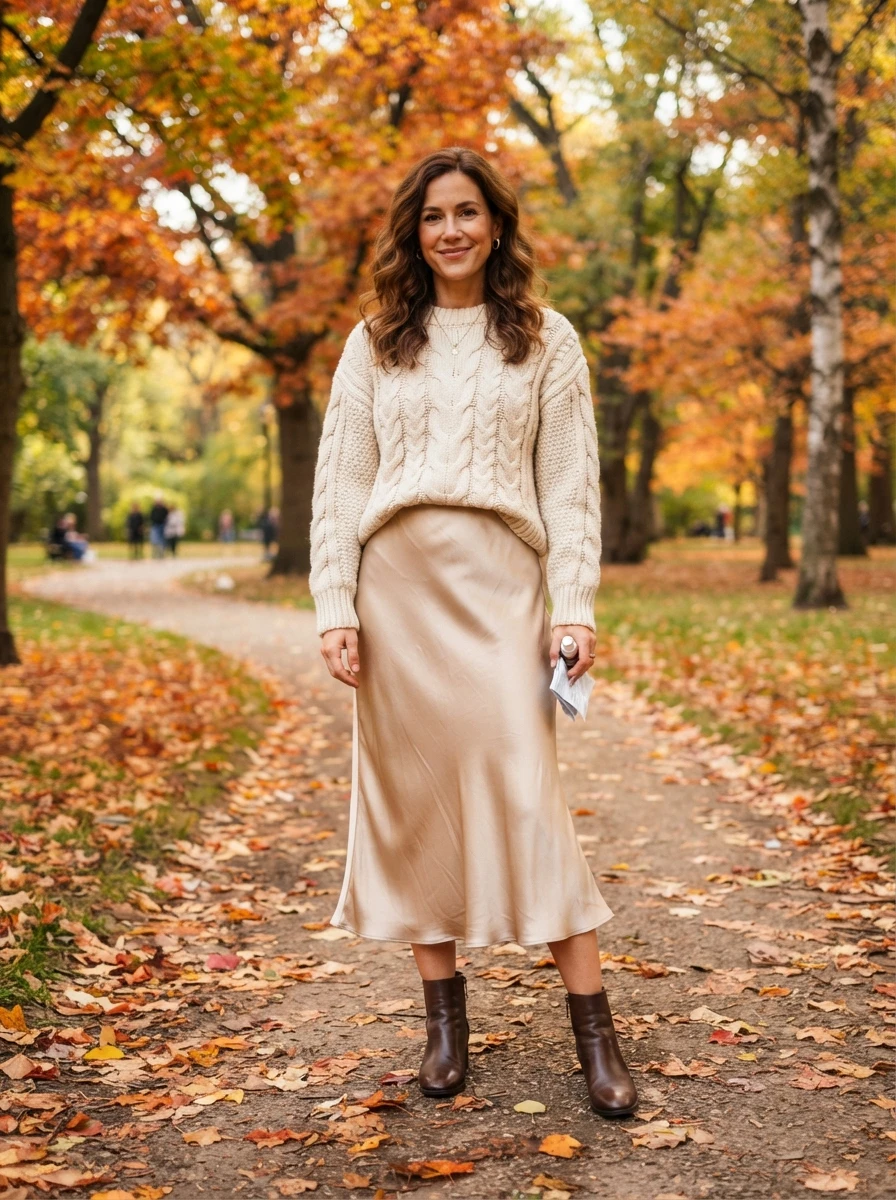
A Cable-Knit Sweater With a Midi Skirt
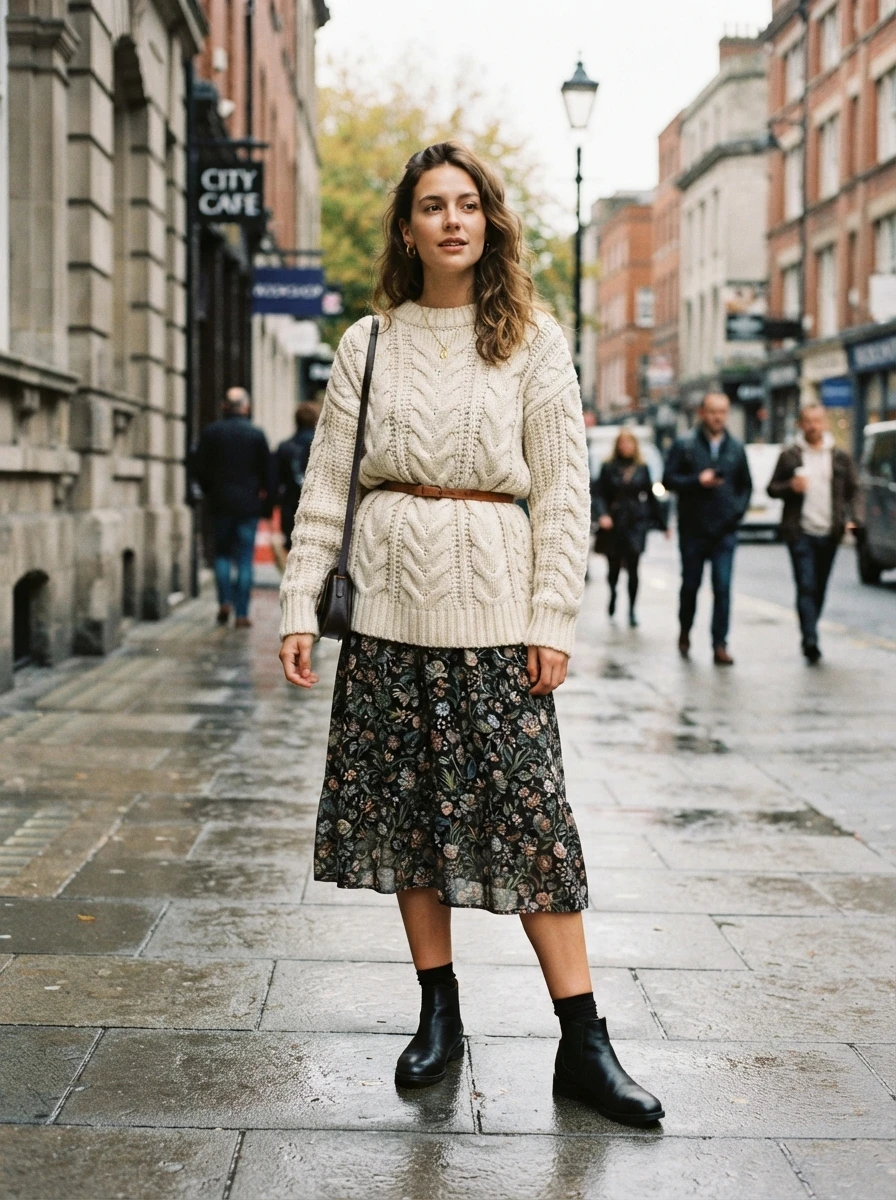
The cable-knit sweater with a midi skirt is the November outfit that best demonstrates heavy-light balance. A thick cream or oatmeal cable knit tucked into a fluid satin midi skirt pairs the season's most insulating texture with one of its most elegant drapes. The chunky knit needs the skirt's fluidity — two heavy pieces together would overwhelm your frame. Ankle boots ground the look, and the proportion logic is straightforward: volume on top, movement below, a defined waist where they meet.
Fabric note: satin and silk-blend skirts hold their drape in cold air, while a stiff cotton midi would fight the softness of the knit. Let the textures do the contrasting.
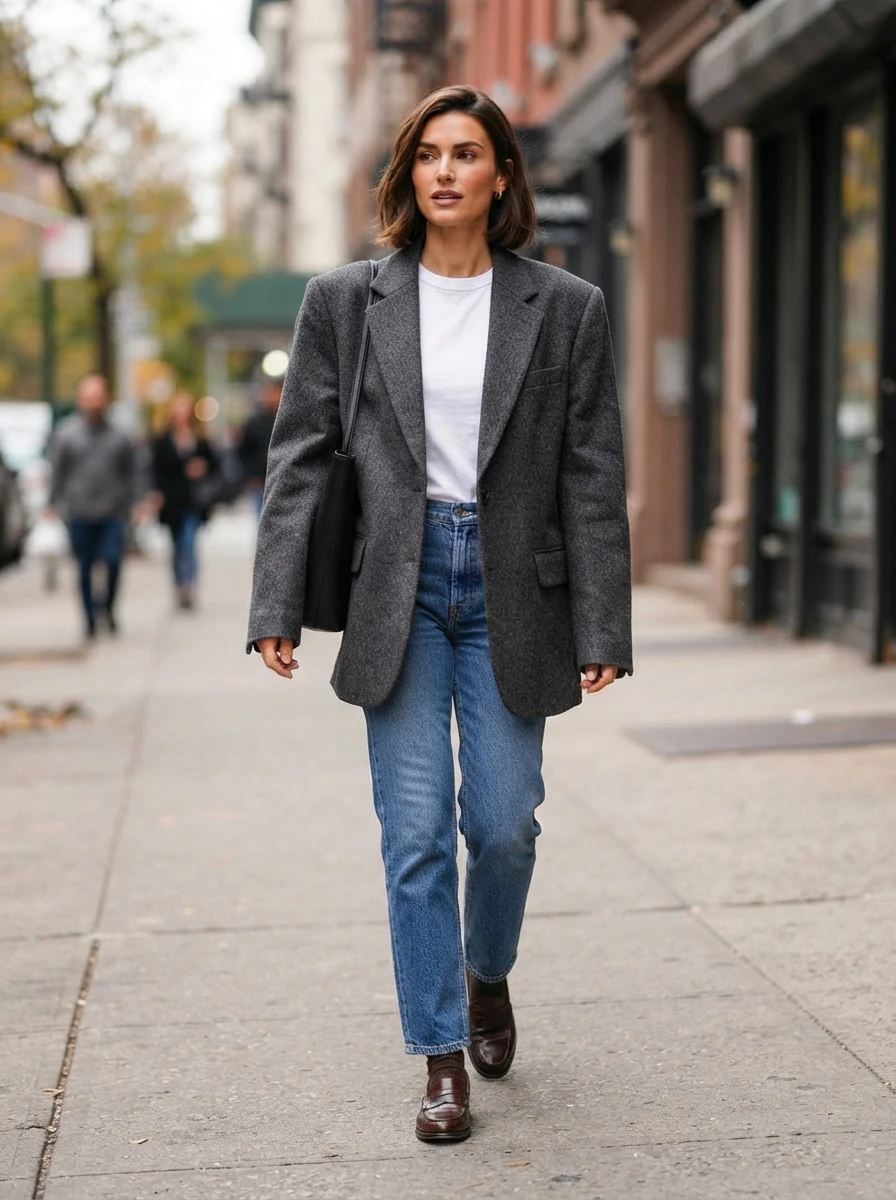
An Oversized Wool Blazer Over Straight-Leg Denim
For days built around errands, work, or travel, the oversized wool blazer over straight-leg denim remains one of November's most useful formulas. The blazer is doing three jobs: insulation at the torso, structure at the shoulders, and polish everywhere.
Fit note: the shoulder seam is the detail that makes or breaks it — it should sit at your natural shoulder edge. Too far past, and the whole silhouette collapses into shapelessness; the oversized trend only works when the structure underneath is correct. A simple tee or thin knit underneath keeps the bulk manageable, and the whole thing layers cleanly under a heavier coat when the wind picks up.
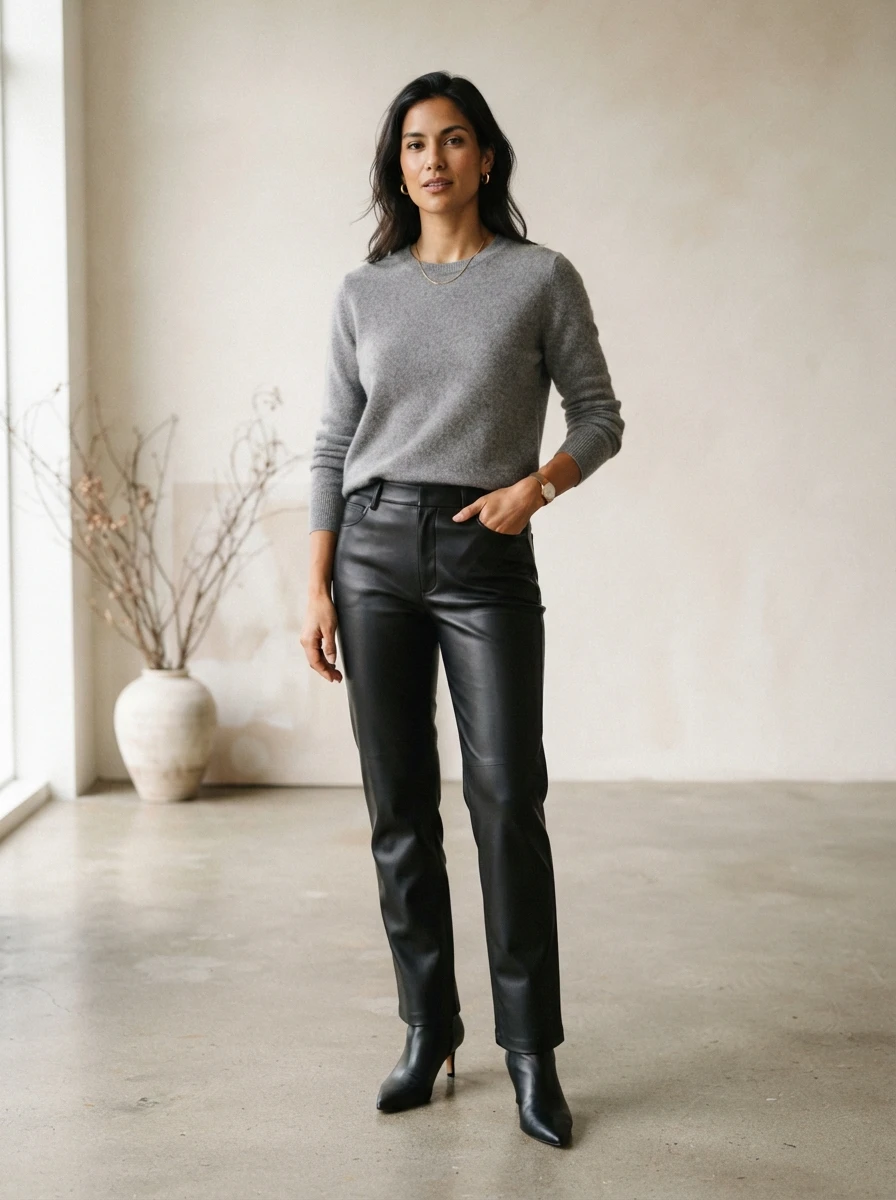
Leather Trousers and a Cashmere Crewneck
November evenings call for leather trousers with a soft cashmere crewneck. The combination works on pure texture logic: the leather's slight sheen against cashmere's matte softness, structure against give. It is a dinner-and-events outfit that requires no accessories to look complete, because the material contrast is doing all the visual work.
Fit note: fit matters here more than anywhere. Leather trousers should skim rather than squeeze, and the cashmere should have enough ease to drape rather than cling. When both pieces fit correctly, the outfit looks expensive regardless of what anything cost.
A Quilted Vest Over a Plaid Flannel Shirt
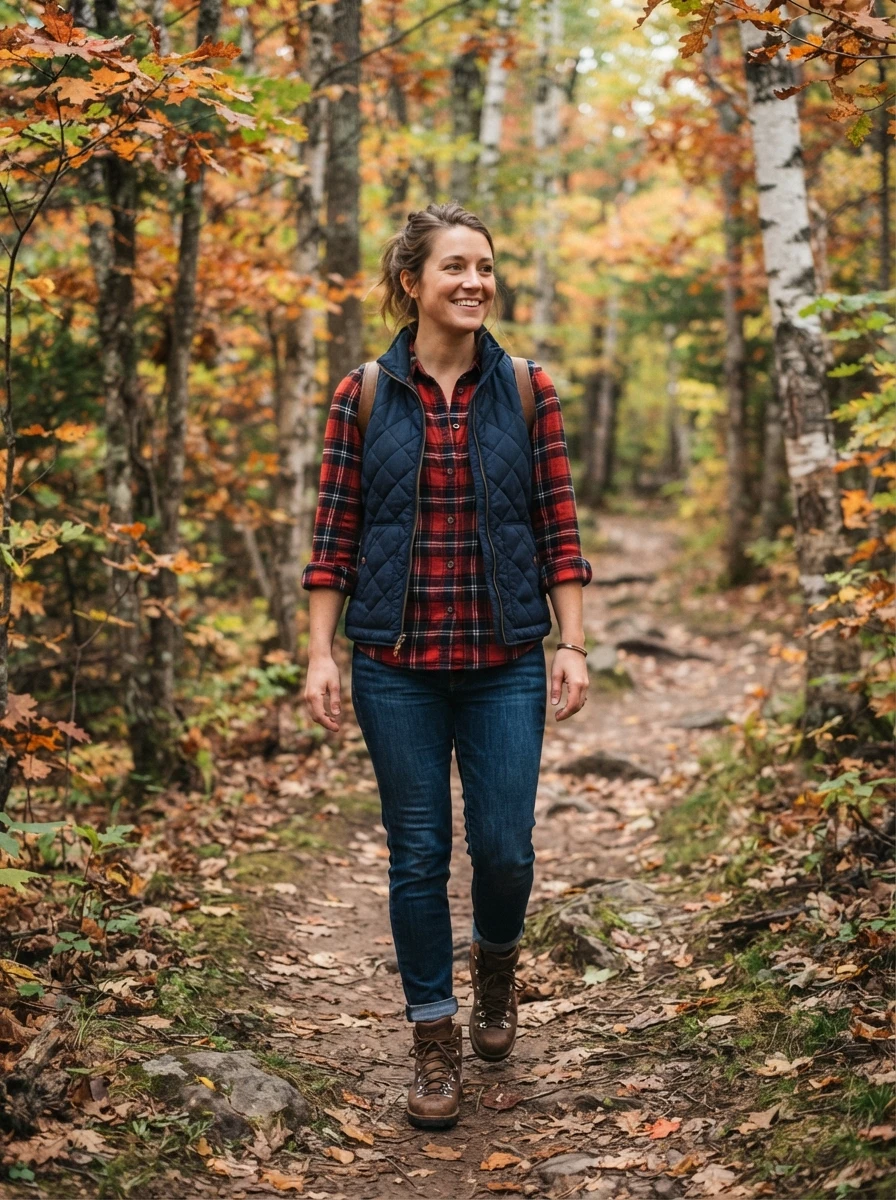
For weekends and outdoor plans, the quilted vest over a plaid flannel shirt is November's pragmatic uniform. The vest insulates your core, where you lose the most heat, while leaving your arms free, and the flannel underneath provides the sleeve warmth a vest cannot. Push the flannel sleeves slightly up to keep fabric from bunching at the wrists. This is function-first dressing that still looks good, because the quilted diamond pattern and the plaid check are both classic textures that read as intentional rather than accidental.
Care tip: flannel softens with every wash, so skip fabric softener — it coats the fibers and dulls the brushed finish that makes flannel feel warm in the first place.
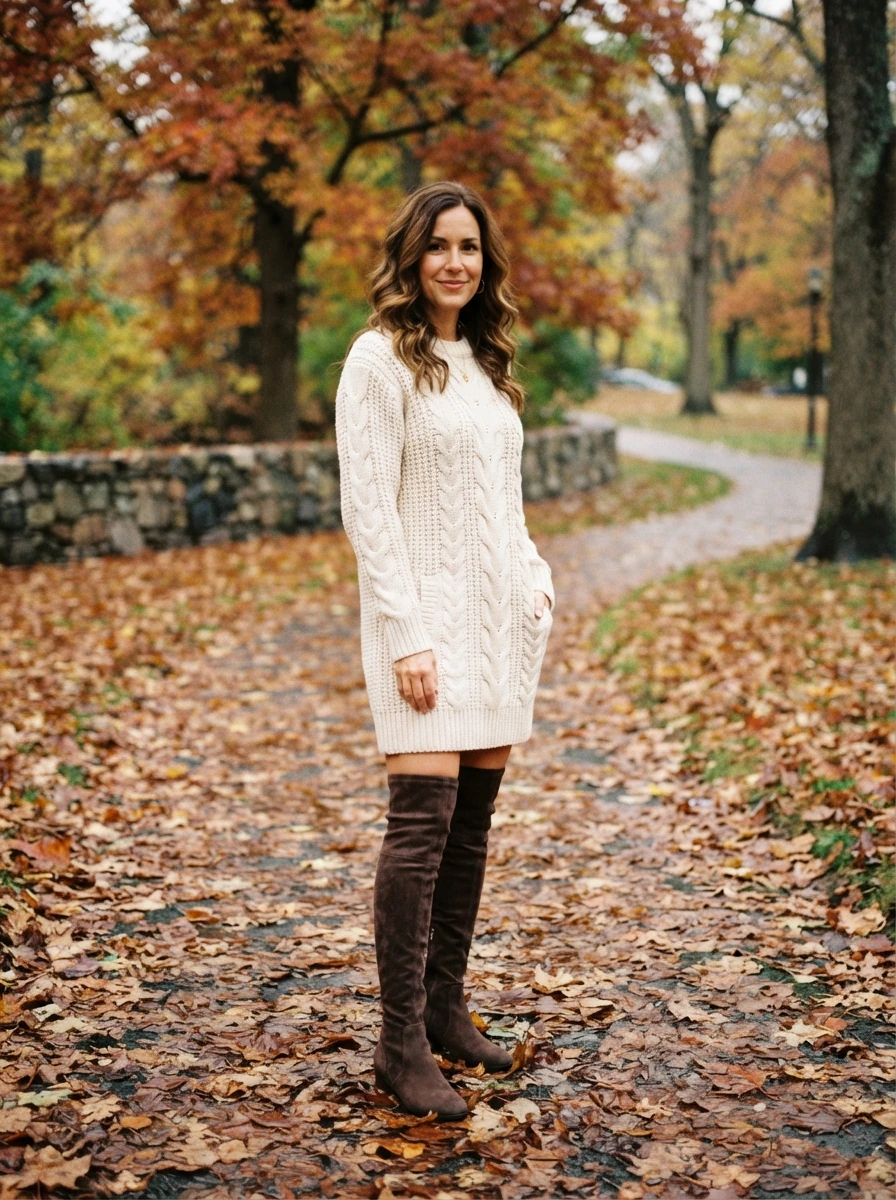
A Sweater Dress With Over-the-Knee Boots
The sweater dress reaches its full potential in November. With over-the-knee boots, it becomes a genuine one-and-done outfit: the boots cover what the dress leaves bare, the knit covers everything else, and there is no layering puzzle to solve on a cold morning. The reason this pairing succeeds where a sweater dress with ankle boots can look unfinished is coverage continuity — the eye travels from knit to boot without an awkward bare gap, which reads as deliberate.
Fabric note: choose a midweight knit with enough structure to skim rather than cling, in camel, charcoal, or deep olive.
A Monochromatic Knit Set
Two more November formulas worth knowing. A monochromatic knit set — sweater and matching skirt or trousers in oatmeal, camel, or charcoal — removes every color-matching decision from your morning while looking more pulled together than separates have any right to. The single color creates one unbroken vertical line, which is flattering on every frame, and the knit-on-knit texture keeps it from reading flat.
Colour pairing: keep the whole set in one tone family; mixing two near-but-not-matching neutrals breaks the line the outfit depends on.
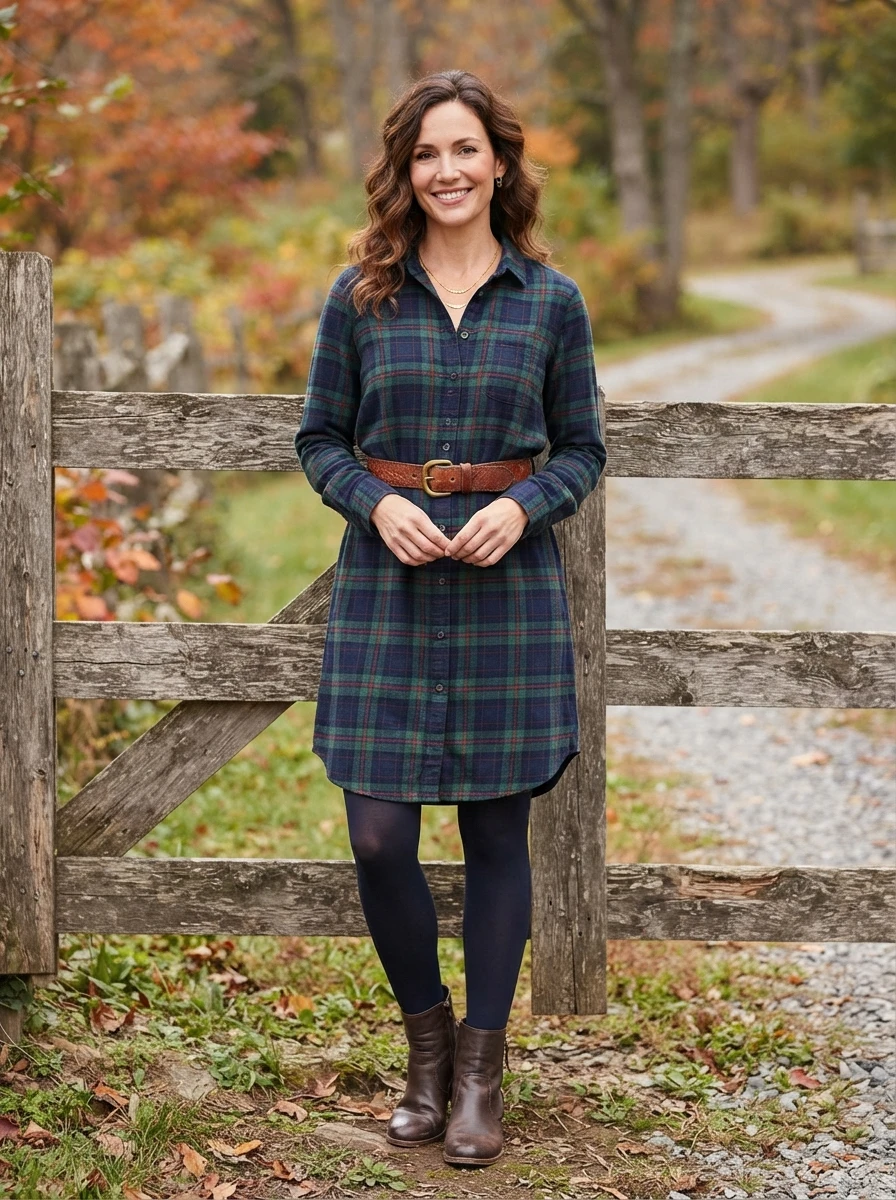
A Flannel Shirt Dress With a Leather Belt
A flannel shirt dress cinched with a leather belt gives you the ease of a one-piece with a defined waist; the belt's structure against the flannel's softness is a small, effective contrast, and tall boots finish the seasonal picture.
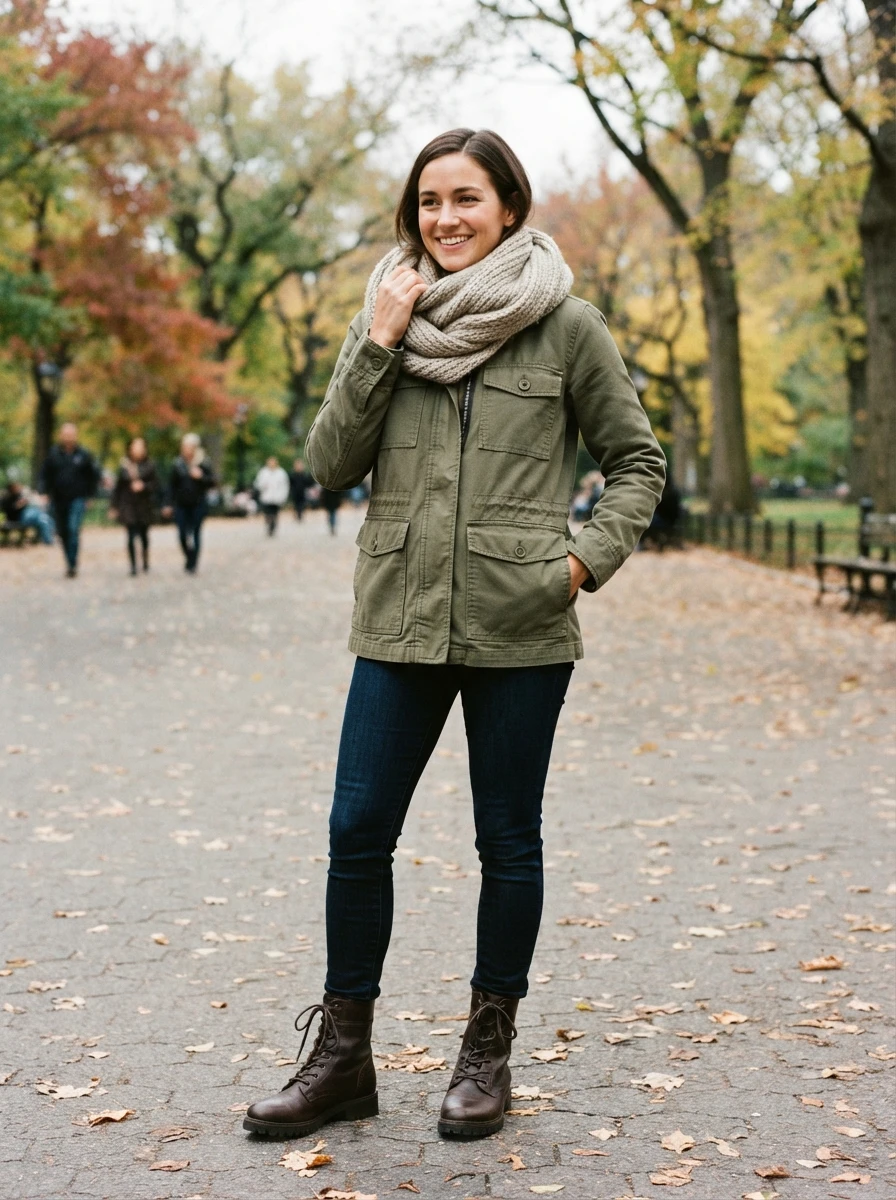
A Utility Jacket and a Chunky Knitted Scarf
Finally, do not underestimate the utility jacket with a chunky knitted scarf for busy November days. The jacket's pockets handle the practical load — phone, keys, gloves — while the scarf does the thermal and visual heavy lifting. A thick hand-knit-look scarf in cream or rust wrapped twice around the neck frames your face, adds the season's coziest texture right where the eye lands first, and provides adjustable warmth: unwrap a loop indoors, wrap it back up outside. It is the simplest high-impact accessory move of the season.
How the Layering Logic Changes Across the Season
If you take one technical idea from this guide, make it this: layering is not stacking clothes; it is assigning each layer a job, and the jobs change by month. In September, your layers are about optionality — every piece must look complete on its own because you will be removing things. The base layer is the outfit; the jacket is the contingency.
In October, layers are about texture and silhouette — the middle layer becomes visible and decorative, which is why October is the month of the open coat, the draped sweater, the visible turtleneck collar. In November, layers are about thermal engineering: base for moisture and insulation, middle for loft, shell for wind — and the outfit's beauty comes from the structure this creates rather than from any single piece. MasterClass explains the same idea in its guide to layering clothes, with the order of base, middle, and shell spelled out.
Fabric weight follows the same arc. September wants open weaves and breathable fibers: cotton, linen blends, chambray, lightweight denim, viscose. October introduces the midweights: cotton twill, midweight denim, flannel, fine-gauge wool, corduroy, leather. November commits to insulation: chunky knits, quilted nylon, heavy wool, cashmere, brushed flannel, lined leather. You do not need three wardrobes; you need to understand which of your pieces belong to which month, and to stop asking September fabrics to do November's job.
A Color Story for the Whole Season
Fall color works on temperature, not on trend cycles. September sits closest to summer, so its palette can stay bright and washed: white denim, chambray blue, soft camel, pale olive. The light is still strong and warm, and light colors reflect it. October is the month of maximum color richness — rust, cognac, forest green, burgundy, mustard — because the turning leaves and the lower golden light make saturated warm tones look like they belong to the landscape.
November cools the light to gray, and the palette deepens and desaturates: charcoal, chocolate, deep olive, navy, cream as the light note rather than white. If an outfit feels "off" for the month, check the color temperature before you change the silhouette. Nine times out of ten, the cut is fine and the colors are a month early or a month late. Who What Wear keeps a running roundup of fall outfit ideas if you want more examples in the same palette.
Frequently Asked Questions
How do I keep layers warm without looking bulky?
Give every layer a distinct job and keep the bulkiest texture to one piece per outfit. A thin thermal or silk base under a medium knit under a structured coat gives more warmth than one thick sweater, because air trapped between layers insulates. Keep the layer closest to your body the most fitted, and let each subsequent layer have slightly more ease. If you can pinch more than an inch of excess fabric at any layer, that layer is too loose for the stack.
When is it time to retire loafers for boots?
Make the switch when your ankles are cold, which is usually mid-October in most temperate climates, but the real signal is your hemlines. Once you are wearing midi skirts or cropped trousers regularly, ankle boots provide the coverage those hemlines need to look seasonal. Loafers still work in October with full-length trousers; they start looking like a summer holdover once bare ankles appear below a fall hemline.
Do summer dresses still work once the weather turns?
Yes, and the method is the same in October and November: add a fitted layer underneath and a structured layer on top. A thin turtleneck under a slip dress plus a leather jacket or blazer over it converts the dress's seasonal register completely. What changes by November is the fabric of the dress — lightweight chiffon and linen start looking out of place no matter the layers, while silk, satin, and heavier crepe carry through. If the dress fabric looks like it belongs in July heat, retire it until spring.
What is the single most useful coat for the whole season?
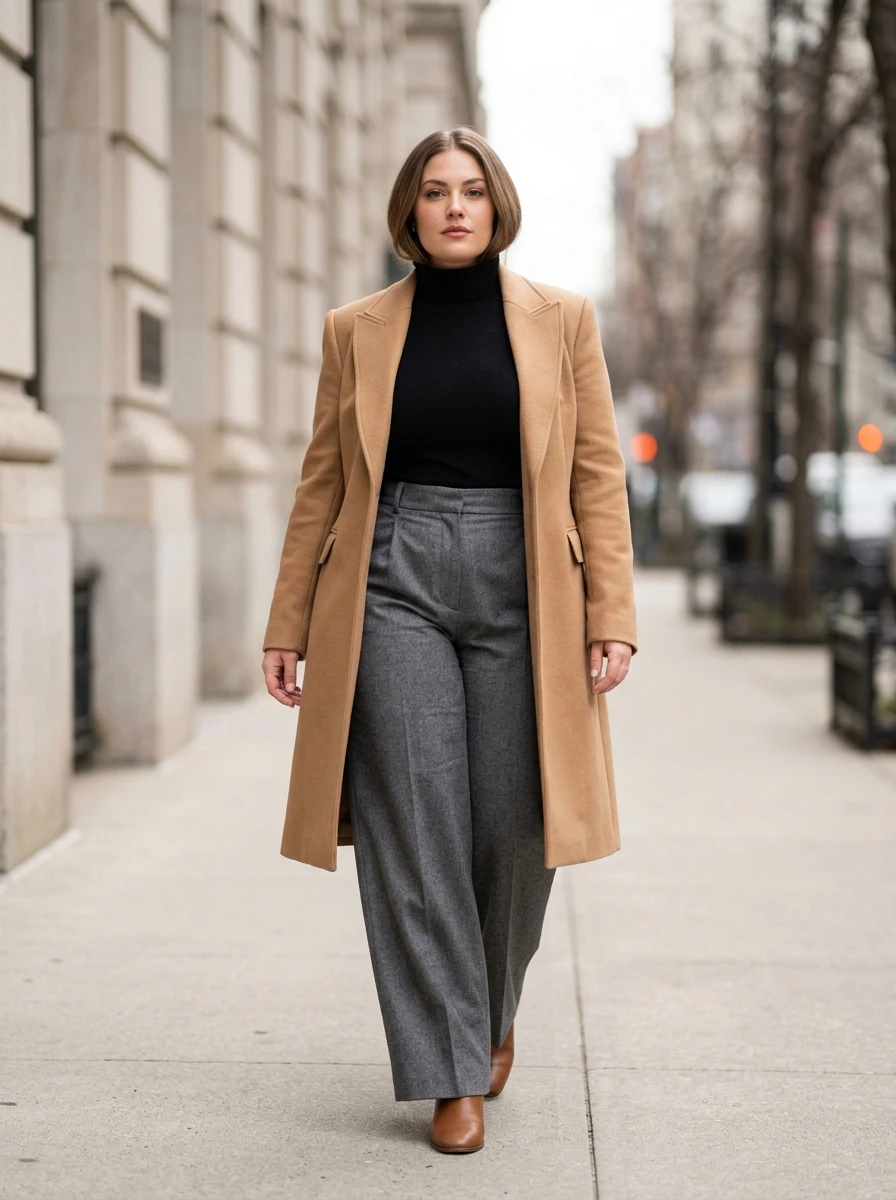
A knee-length wool blend overcoat or a classic trench with room for a sweater underneath, in camel, charcoal, or black. The deciding factor is not the style but the ease: you must be able to close it over your thickest November knit. A coat that only fits over September layers is a September coat. Buy for November's bulk and wear it open through October — open, it functions as a silhouette piece; closed, as insulation.
How far can a small fall capsule actually stretch?
Further than you think, because fall outfits are built from formulas, not items. Ten well-chosen pieces — dark jeans, black trousers, a midi skirt, a slip dress, a white tee, a turtleneck, a knit sweater, a blazer, a trench or wool coat, and ankle boots — combine into twenty-plus distinct outfits once you vary the layering order and the texture pairings. The multiplier is accessories: one chunky scarf, one leather belt, and one pair of boots restyle the same base pieces across all three months.
Your Early-Fall Checklist
Before you step out the door, run through this quick list:
- Check the month, not just the weather. September wants removable layers, October wants texture, November wants insulation. Dress for the month's job.
- One contrast per outfit. Texture against texture, loose against fitted, heavy against light — pick one and let it carry the look.
- Waistline defined. Whether it is a tucked tee, a belt, or a cropped jacket, something should mark where the top ends and the bottom begins.
- Color temperature matches the calendar. Bright and washed in September, rich and saturated in October, deep and grounded in November.
- The outfit survives losing a layer. If removing the jacket breaks the look, it is not a transitional outfit yet.
- Boots when the hemline says so. Bare ankles below a fall hemline are the clearest sign the shoes need to change.
The through line of September to November is a gradual trade: you give up lightness and gain richness. Lighter fabrics become heavier, brighter colors become deeper, bare skin becomes covered, and at every step, the outfits get more interesting, because layering gives you more decisions to make well. Start from where the calendar actually is, build each early fall outfit around one clear idea — a contrast, a proportion, a color — and the season takes care of the rest.