How to Layer for Class in Early Autumn: 6 Comfy Outfits That Handle Cold Rooms and Warm Walks

How to use this guide
These are editorial styling suggestions, not a one-size-fits-all formula. Adapt each look to your wardrobe, proportions, climate, comfort, budget, and the occasion; the most useful idea is the one you can genuinely wear.
Why does the same outfit feel wrong three times before lunch? At 8:45 the lecture hall air conditioning turns your arms to ice. By noon the sun is out on the quad and the jacket you needed an hour ago is a burden. At 3pm the wind picks up on the walk back and you want it again. Early autumn is not one season on campus — it is three microclimates in a single day, and the forecast only ever describes one of them.
The answer is not more clothes. It is the right three layers in the right fabrics, chosen so you can add and shed as the rooms change — without ever looking like you dressed for the wrong weather. The six outfits below all run on that logic, and each one puts the layers somewhere different. For class ready outfits beyond the layering question, this guide covers the rest of the classroom wardrobe.
The Three Layers, and the Order They Come Off
Every outfit below runs on the same three-layer logic. The base sits against your skin and manages temperature — turtlenecks, henleys, fitted tees. The mid adds warmth and visual interest — vests, cardigans, flannels. The outer handles wind and the walk — jackets, trench coats.
The golden rule: one fitted layer and one relaxed layer, never three bulky ones. And build from thin outward. It is easy to add a cardigan at 10am and nearly impossible to cool down in a thick sweater you cannot remove. MasterClass lays out the same logic in its guide to layering clothes for winter: start thin, add warmth in removable steps, and never trap yourself in one heavy layer.
One more test worth running on every outfit here: take the outer layer off at noon. Does what remains still look like a finished outfit? If yes, the system works. If it falls apart without the jacket, it was never layering — just a jacket with clothes under it.
The Sleeveless Mid: Argyle Vest, Turtleneck, Leather Jacket
Mustard and navy argyle sweater vest, white turtleneck, worn brown leather jacket. This is the textbook three-layer system: the turtleneck is the fitted base that traps warmth at the neck (where you actually lose heat), the vest is the insulating mid that adds zero sleeve bulk for writing and typing, and the leather jacket is the wind-blocking outer.
Sleeveless mids are the secret weapon of classroom layering. Your arms stay free, you do not overheat when the lecture hall warms up, and the vest's pattern does the visual work so the rest can stay simple. The leather jacket earns its place because leather blocks wind that cuts straight through knitwear — on the walk between buildings, that is the difference between comfortable and chilled.
Wear it with: dark trousers or straight-leg jeans and clean boots; tortoiseshell glasses are optional, the outfit does not need them. The turtleneck base here is the same piece that anchors these cozy mock neck sweatshirt outfits for fall.
Warm Without the Bulk: Thermal Henley, Sherpa Vest, Flare Pants

Olive thermal henley, cream sherpa fleece vest, black flare pants, trail sneakers. The thermal henley is doing quiet work here. Waffle-knit thermals trap air in their texture, which insulates better than a flat cotton long sleeve of the same weight. That is why this outfit stays warm without looking bulky.
Fabric note: the sherpa vest follows the sleeveless-mid rule, and fleece has a specific advantage — it insulates even when damp, unlike cotton, which just gets cold and heavy. The black flare pants balance the cozy top half with a clean, elongated line, and flares over sneakers is a practical pairing because the wider hem covers the shoe and keeps ankles warm on windy walks.
Tip: a small crossbody beats a tote here; it stays put on a bike or a crowded bus. If you carry a laptop as well, a proper backpack beats a tote, so see these viral Nike and Converse backpacks for college, tech and books. For more flare styling, see these ways to style low rise flare jeans.
Four Layers, Zero Trapped Heat: Graphic Tee, Hoodie, Flannel, Cargo Jeans

Vintage graphic tee, dark zip hoodie, red plaid flannel worn open, dark cargo jeans, lace-up boots. Four layers sounds like a lot until you realize each one is doing a separate job and every one can come off independently. That is the actual test of a good layering outfit. Flannel over a hoodie works because the flannel is structured enough to read as a jacket, not just another soft layer.
Fit note: the zip hoodie — not pullover — is the right mid here for one reason: you can vent it. A pullover traps you at whatever temperature the room decides; a zip lets you regulate in seconds. Dark denim cargos keep the bottom half relaxed but the dark wash keeps it from reading sloppy. Light-wash baggy jeans with this many top layers would tip the whole thing into shapeless. Boots over sneakers because September mornings are often damp, and canvas sneakers soak through.
One Colour, Three Textures: Monochrome Knits and a Trench

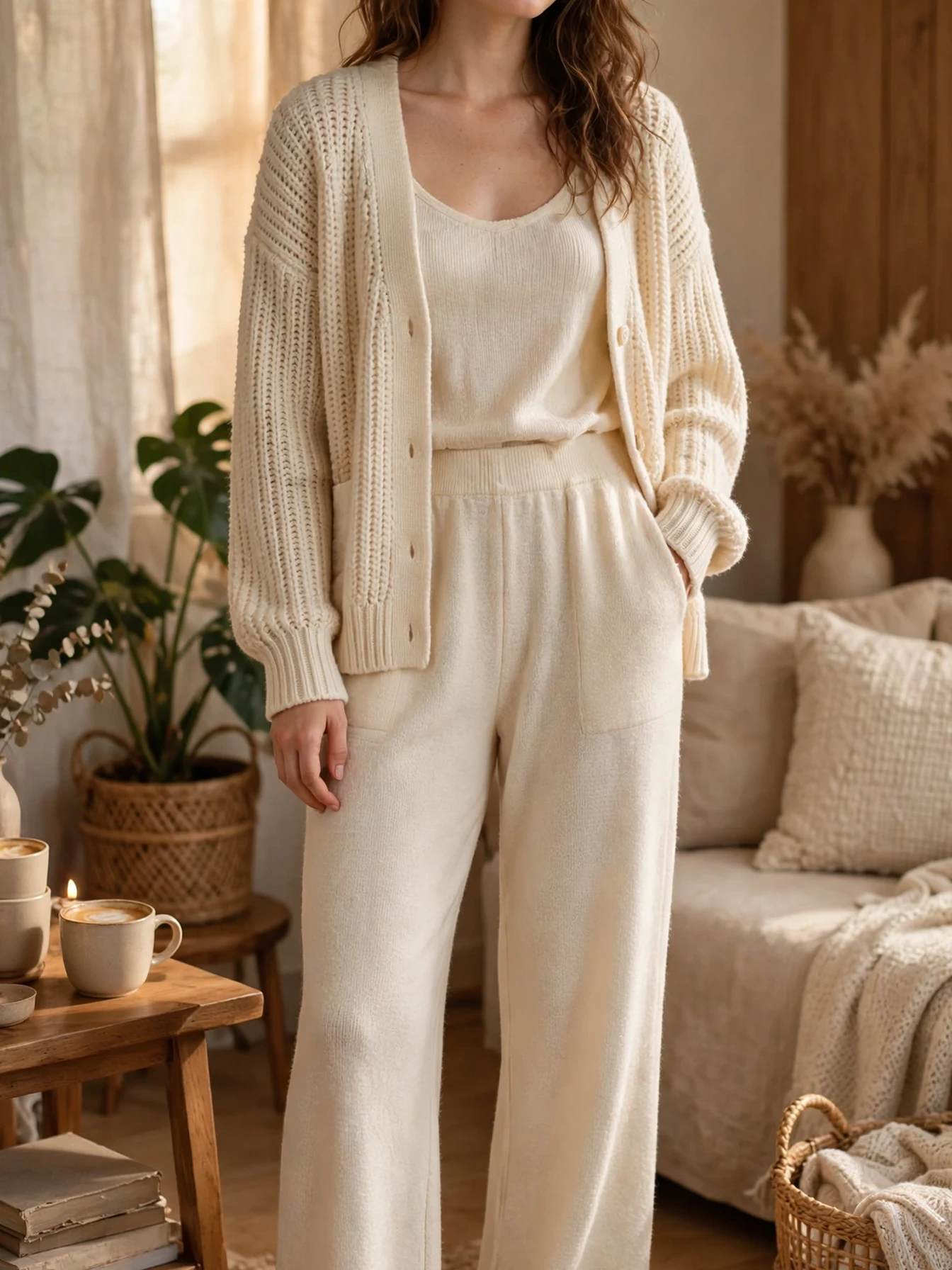
Cream ribbed turtleneck, matching wide-leg knit pants, beige trench coat, white sneakers. Monochrome layering lives or dies on texture, and this one gets it right: ribbed knit against smooth trench gabardine against clean sneaker leather. One color, three textures, zero boredom.
The trench is the hardest-working outer layer on this list. It is wind resistant, water resistant enough for drizzle, and the belt lets you cinch it when it is cold or wear it open when it is not. It adapts through the day instead of being a binary on/off like a puffer.
Care tip: the knit set underneath is effectively pajama comfortable, which is the point — when the base layer is this comfortable, you can afford a structured outer without the outfit feeling stiff. Wash knits cold and flat-dry them so they keep their shape; a shrunken knit set loses the relaxed drape this look depends on. White sneakers keep it campus appropriate; anything dressier would fight the knit set's softness.
The Comfort Trade: Rugby Top, Oxford, Sweatpants, Clogs

Navy and green striped rugby top layered over a white oxford shirt, grey sweatpants, wool socks, tan clogs. This is the comfort-maximalist formula, and it works because the top half is doing all the visual work while the bottom half is pure function. The oxford collar peeking out under the rugby collar is the detail that separates intentional from just-threw-things-on. That one crisp edge tells the eye the layers were chosen.
Rugby tops are ideal classroom mids: heavy cotton knit that is warm without being hot, with a collar sturdy enough to frame the oxford underneath. The sweatpants get a pass here because everything above them is structured — that is the trade that makes it work.
Fabric note: the wool socks are not just aesthetic; wool regulates temperature and does not hold odor the way cotton socks do after a full day in closed shoes. A canvas tote and a tumbler complete the practical side. The oxford itself deserves care too, so see these ways to style a white button down shirt.
Soft Meets Tough: Henley, Maxi Skirt, Chunky Cardigan, Combat Boots

Slate grey ribbed henley, floral maxi skirt in deep autumn tones, oversized cream chunky-knit cardigan, brown combat boots. The tension that makes this outfit interesting is soft versus tough — flowing skirt against chunky boots — and the cardigan bridges them because chunky knit reads both cozy and substantial.
Fit note: the henley is fitted, the cardigan is oversized, the skirt is flowing. That is one fitted piece anchoring two relaxed ones, which is exactly the ratio that keeps layered outfits from looking shapeless. The boots matter structurally, not just stylistically: a maxi skirt with delicate flats can read insubstantial, while boots give the bottom half visual weight that balances the big cardigan up top. The henley's buttons are functional — unbutton one or two when the classroom heats up and you have got built-in ventilation without removing a layer.
All Six Outfits, Side by Side
| Outfit | Base, mid, outer | First layer to shed |
|---|---|---|
| Argyle vest | Turtleneck, argyle vest, leather jacket | Leather jacket on arrival |
| Thermal henley | Henley, sherpa vest, none needed | Sherpa vest indoors |
| Graphic tee | Tee, zip hoodie, flannel | Flannel, then hoodie unzipped |
| Monochrome knits | Turtleneck, knit pants, trench | Trench, belted open first |
| Rugby top | Oxford, rugby top, none needed | Rugby top over the shoulders |
| Maxi skirt | Henley, chunky cardigan, boots | Cardigan, henley vents by button |
Before You Leave: The Layering Checklist
- Thin to thick, always. Start with the thinnest layer against your skin. It is easy to add warmth at 10am; it is miserable to be trapped in a thick sweater you cannot take off.
- One fitted, one relaxed. Pair a fitted base (turtleneck, henley) with a relaxed mid (cardigan, flannel) or vice versa. Two relaxed layers look shapeless; two fitted layers restrict movement.
- Every layer must earn its place alone. If an outfit only works with all layers on, it is not layering, it is a costume. Each piece should look fine if it is the only thing people see in a warm classroom.
- Footwear is part of the system. Closed, weather-capable shoes (boots, leather sneakers) for damp mornings; save the canvas and mesh for confirmed dry days. Cold feet ruin more outfits than wrong jackets do. The same first-day logic applies in high school too, so these high school first day outfits that look effortlessly cool use the same removable-layer rule.
- Noon test passed? Outer layer off, the outfit underneath still looks finished — if not, the system needs rethinking, not another layer.
Classroom Layering Questions, Answered
How many layers can I wear before it gets too much?
Three is the sweet spot for early autumn: base, mid, outer. Four works only if every layer is thin and independently removable, like the flannel outfit above. Past that, you lose temperature control instead of gaining it — and you spend the day managing clothes instead of listening in class.
What is the trick to layering without looking bulky?
Contrast the fits: one fitted piece against one relaxed piece. A slim turtleneck under an oversized cardigan reads intentional; two oversized pieces read like laundry day. Texture contrast does the same work as color contrast — ribbed knit against smooth leather against crisp cotton keeps the eye moving even in one palette.
Are combat boots really practical for a full day of classes?
Yes — broken-in boots with a real sole beat almost everything for campus days. They handle rain, stairs, and long standing stretches, and the ankle support matters more than students expect by November. Just break them in before the first wear; new boots on a 10,000-step day is a blister guarantee.
Which fabrics should I skip for classroom layering?
Anything that wrinkles permanently by noon (cheap linen), anything that cannot handle a backpack strap (delicate silk), and 100% cotton as a mid-layer in damp weather. Cotton holds moisture and gets cold. Wool blends, thermal knits, and fleece are the classroom all-stars for a reason.
Three layers, one fitted piece, and an outer you can shed at noon — that is the whole system. Get those right and the 8:45 freeze, the midday sun, and the 3pm wind all stop being a wardrobe problem.