How to Build a Timeless Capsule Wardrobe for Fall 2026

How to use this guide
These are editorial styling suggestions, not a one-size-fits-all formula. Adapt each look to your wardrobe, proportions, climate, comfort, budget, and the occasion; the most useful idea is the one you can genuinely wear.
Open your closet on the first properly cold morning of October. The rail is full, but nothing seems to work together — the pieces that looked fine in September suddenly feel wrong, and you end up reaching for the same two outfits again. That is not a shortage of clothes. It is a shortage of pieces that actually cooperate.
The fix is not more clothes, it is fewer, better decisions. A capsule piece earns its place through versatility math: how many outfits it joins, how many seasons it survives, and how little thought it demands on a busy morning. That is the whole idea behind a capsule wardrobe, fewer pieces, chosen so well that they multiply.
The five pieces below were picked on exactly those terms — not because they are fashionable this year, but because they were relevant ten years ago and will be relevant ten years from now. Each one gets the same honest treatment: why it lasts, how it multiplies the rest of your closet, and what to check before you buy it, because a capsule is only as good as the quality of its parts. This guide also folds in the minimalist winter capsule — the winter formulas, color matrix, and cost per wear math now live here, so one page covers fall and winter.
The Black Ribbed Turtleneck
A fitted black ribbed turtleneck in merino wool or a wool blend.
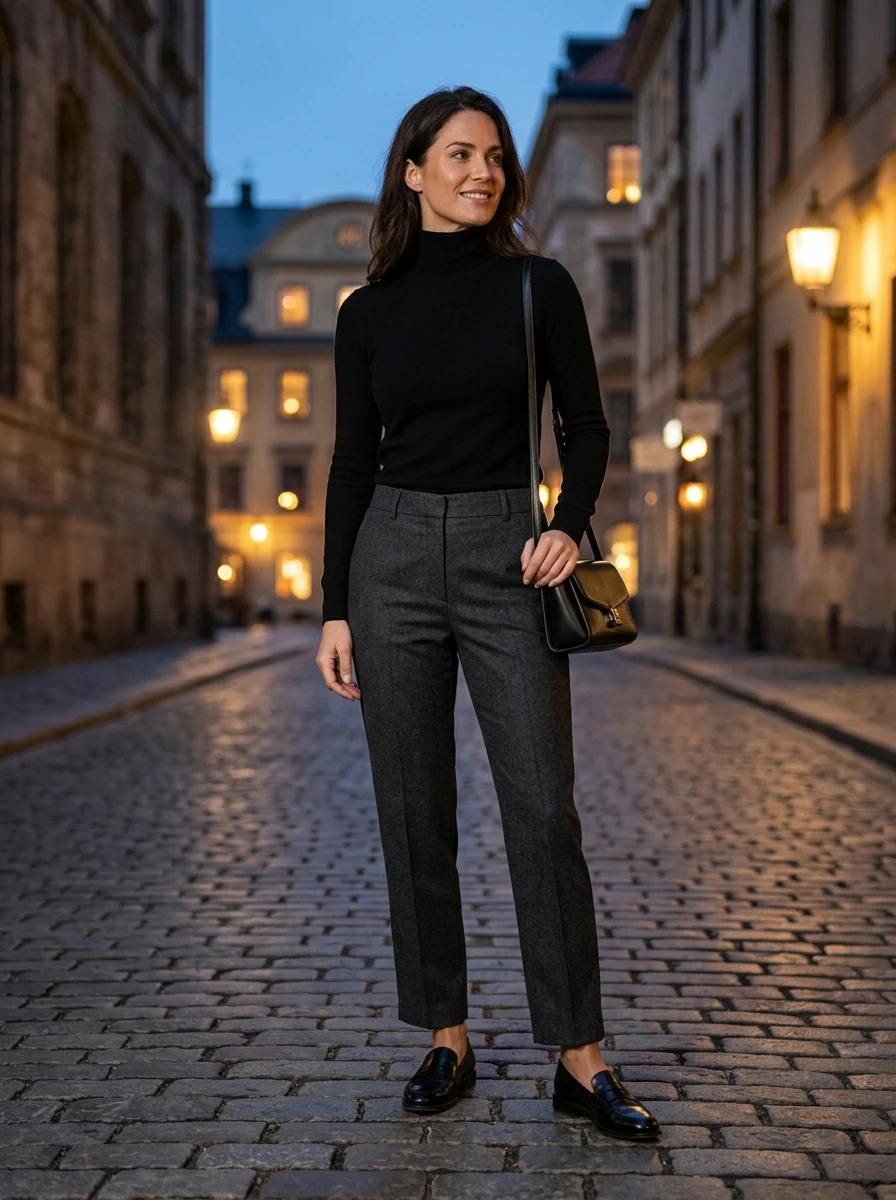
Why it never dates: the turtleneck is the hardest working layer in fall dressing. Worn alone, it is a complete top with a clean neckline that needs no jewelry to look finished. Worn under things — blazers, slip dresses, pinafores, vests — it adds warmth invisibly while its collar reframes whatever neckline sits above it. Black specifically disappears as a choice, which means it never fights the rest of the outfit. The ribbed texture adds just enough surface interest that it does not read as a plain black tee with a high collar.
How it multiplies your closet: it pairs with every bottom you own (jeans, trousers, skirts, leather pants), layers under every top layer, and works from September through March. No other single garment covers that range.
Fit note: look for merino or a merino blend, fine enough to layer without bulk, warm enough to matter — 12 to 16 gauge knit, fine enough that the neck stands on its own, and a neck tall enough to fold once. The fit should skim, not squeeze; a turtleneck that is too tight reads as underwear, too loose bunches under layers. Ribbing should be tight and even, which signals a denser, longer lasting knit. Skip cotton: it bags at the elbows within a month.
Wear it with: chocolate wide leg trousers, a slim belt, and penny loafers — the turtleneck's simplicity lets the rich brown trousers carry the color story.
Worn here with chocolate wide leg trousers, a slim belt, and penny loafers. The turtleneck's simplicity lets the rich brown trousers carry the outfit's color story.
The Penny Loafer in Oxblood
A burnished burgundy/oxblood penny loafer, ideally with a lug sole for fall.
The shoe that covers the middle: the loafer sits at the exact middle of the formality spectrum — more polished than a sneaker, less formal than a heel — which makes it the default shoe for the 80% of fall days that are neither. Oxblood specifically is the strategic color: it reads as a neutral (pairs with black, navy, grey, brown, cream) while adding more interest than plain black. The lug sole earns its place functionally, handling wet pavements that would destroy a leather sole.
How it multiplies your closet: loafers work with trousers, midi skirts, cropped denim, and dresses; they bridge office and weekend without a change. One pair in oxblood covers the territory of three pairs in trendier styles.
Care tip: buy real leather — it molds to your foot and ages well, while synthetic loafers crack at the flex points within a season. Check for a stitched rather than glued sole, and wear them with slouchy wool socks: the sock and loafer pairing is what makes them feel current rather than corporate. Resole them when the sole wears through instead of replacing the pair.

Worn here with a grey wool midi skirt and oatmeal ribbed socks. The oxblood leather catches autumn light, and the lug sole keeps the look grounded.
The Camel Wool Coat
A long camel wool coat, belted or with a clean single breasted closure.
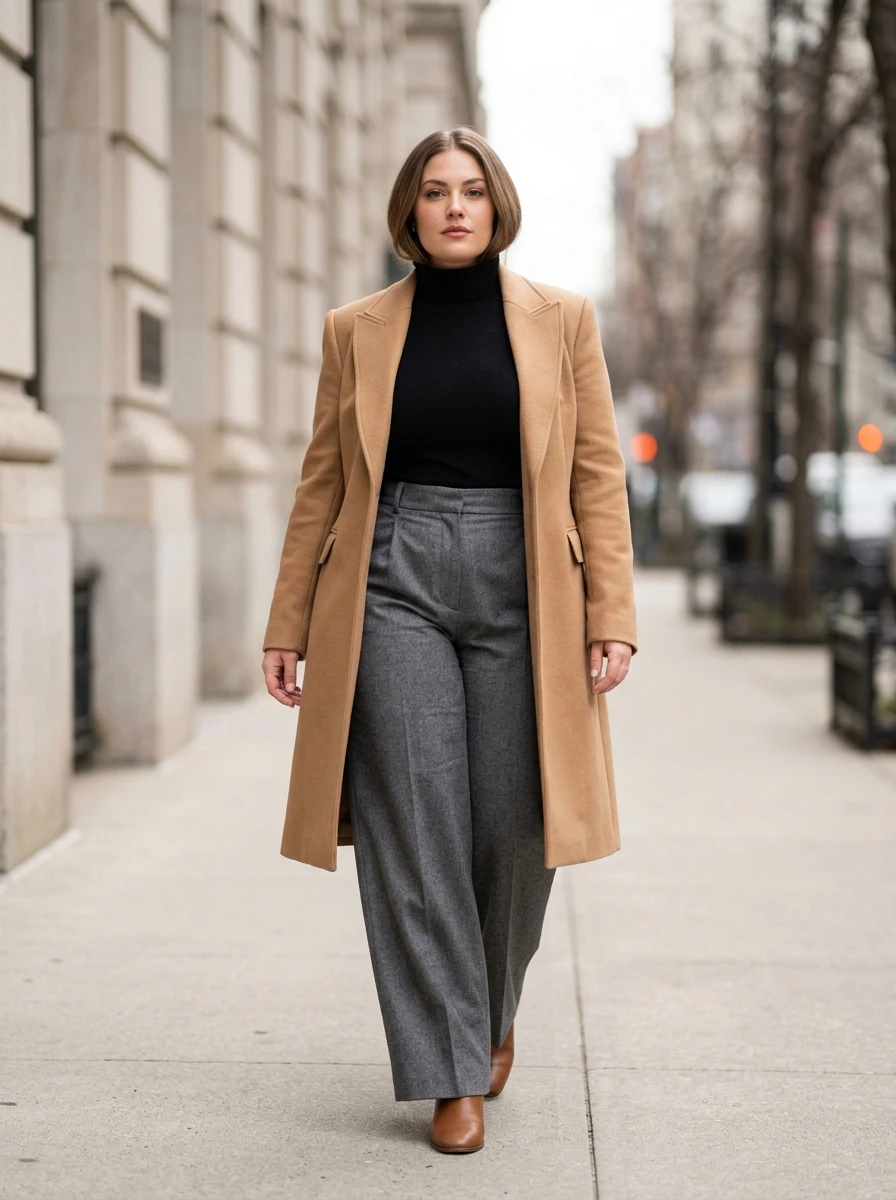
The coat that goes over everything: the camel coat is the outerwear equivalent of a white shirt — it goes over everything and improves everything. Camel is light enough to lift dark fall palettes, warm enough to feel seasonal, and neutral enough to never clash. A belted waist gives you adjustability over whatever is underneath; an unbelted single breasted cut gives you simplicity. Either way, the coat's clean lines do the same job: they impose order on whatever is beneath them.
How it multiplies your closet: it is the only coat that works over a suit, over denim, over a dress, and over athleisure without looking wrong in any of those contexts. Cost per wear on a good camel coat, worn 100+ days a year for a decade, is pennies.
Fabric note: look for at least 70% wool — below that, the coat will not hold its structure or warmth. The lining should let layers slide (sleeves that catch on sweaters will drive you mad by November), and the length should cover your knees; the coverage is functional, not just aesthetic. Check the shoulders: they should sit cleanly with room for a blazer underneath.

Worn here over a white button down shirt and dark denim with ankle boots. The coat's authority elevates the simplest base into something deliberate.
For keeping wool looking its best, see Woolmark's wool care guide.
The Oversized Grey Sweater in Mohair or Brushed Wool
An oversized grey sweater in mohair, brushed wool, or a soft wool blend.
The comfort piece that still looks intentional: every capsule needs one piece that is pure comfort without apology, and the oversized grey sweater is it. Grey is the key. It is the only comfort color that does not read as sloppy — compare: an oversized beige sweater can look like a blanket; grey reads as intentional.
The fuzzy texture of mohair or brushed wool adds the visual interest that keeps an oversized silhouette from looking shapeless. It works over denim, over slip skirts, over leather trousers. The sweater does not care what is underneath, which is precisely its virtue.
How it multiplies your closet: it is the weekend and evening piece that also layers under coats on weekdays. Grey pairs with literally everything, so it never creates a matching problem.
Fit note: the oversized fit should still have structure at the shoulder — a sweater that slides off both shoulders constantly is not relaxed, it is just badly cut. Check the blend before buying: mohair pills, so a mohair wool nylon mix balances softness and durability. And store it folded; hanging stretches the shoulders permanently.
Care tip: depill it regularly and keep it away from rough bag straps, which wear the knit fastest at the shoulder.

Worn here with dark wide leg denim and flat mules. The fuzzy grey texture against clean denim is the whole outfit, and it is enough.
The Shearling Aviator Jacket
A shearling lined aviator or trucker style jacket in worn brown leather or suede.
The personality piece: the shearling jacket is the capsule's character item, the one piece with enough personality to make simple outfits interesting. It works because of a genuine functional history: shearling is extraordinarily warm for its weight, and the aviator cut was designed for movement.
That authenticity is what separates it from trend jackets; it looks good because it was built for a purpose, not for a season. The worn in quality only improves it. This is a piece that gets better with age, which is the definition of timeless.
How it multiplies your closet: it toughens up soft pieces (slip dresses, knit sets) and completes rugged ones (denim, boots). It is the fastest way to add edge to an outfit without adding color or pattern.
The trade-off: fit matters more here than on any other piece in this guide. The jacket should allow a sweater underneath but not swim — aviator jackets look best slightly fitted through the body. Buy real shearling if the budget allows (it regulates temperature in a way synthetics cannot); if not, a high quality faux with a dense pile. And buy it slightly worn looking, or commit to wearing it hard — a pristine shearling jacket looks precious, which defeats its purpose.

Worn here over a champagne satin slip dress with combat boots. The jacket's toughness against the dress's delicacy is the contrast that makes both pieces work harder.
Capsule Math: 5 Pieces, 15 Outfits
| Piece | Three ways to wear it | Cost per wear |
|---|---|---|
| Black turtleneck | Under camel coat; under shearling jacket; alone with wide leg trousers | Pennies, worn September to March |
| Oxblood loafers | With grey midi skirt; with trousers; with cropped denim | Low, replaces three trendier pairs |
| Camel wool coat | Over suit; over denim; over a dress | About $3, 100 wears a year for a decade |
| Grey oversized sweater | Over denim; over slip skirt; under camel coat | Low, grey matches everything |
| Shearling aviator jacket | Over slip dress; over knit set; over denim and boots | Falls with wear, the piece improves with age |
Five pieces, three outfits each, fifteen combinations before you touch anything else in the closet. That is the capsule math: the pieces multiply because the palette is tight and every piece works with every other piece. Add a white shirt and straight leg jeans and the count doubles again.
Winter Formulas from the Minimalist Capsule
The same five pieces carry into winter with three extra formulas folded in from the minimalist winter capsule. First, all black monochrome with mixed textures: matte faux leather leggings, a slim black silk camisole as a base, a relaxed black cashmere crewneck in 2 ply, and a long black wool coat with pointed ankle boots. Four blacks, four textures, and a touch of gold as the only color note. All black reads as expensive only when the fabrics are; cheap black fabrics go grey and pilled within weeks.
Second, the charcoal overcoat with a white shirt and black trousers. The white shirt is a brightness trick: white at the collar and cuffs lifts the whole outfit and keeps charcoal from reading as gloomy. The shirt must be crisp cotton poplin, not soft jersey, because it needs to hold a collar. Charcoal is softer than black against most skin tones and pairs with both black and brown accessories. This is the formal capsule outfit, built for interviews, formal offices, and dinners.
Third, a navy knit dress with a long camel coat. A knit dress is the capsule's one piece answer: one decision, one silhouette, done. Choose fine gauge merino in navy, midi length, with a defined waist from a built in tie or a slim belt. The camel coat over navy is the color contrast that makes the outfit: warm camel against cool navy, the coat's length matching the dress hem so the lines stay clean. Knee high boots in dark brown leather extend the leg line.
Two principles run all three formulas. Texture is your pattern: wool against leather, cashmere against denim, ribbing against crepe. And monochrome elongates: one color head to toe in varying textures is minimalism's most expensive looking trick. Layer thin to thick, fitted to relaxed, and every piece should match at least 80% of what you own. If a piece only works with one other thing, it does not belong in the capsule.
Capsule Wardrobe Building Tips
Buy in order of versatility, not desire. The turtleneck and the coat touch every outfit; the shearling jacket touches fewer. If you are building slowly, start with the pieces that participate in the most combinations and add the personality pieces later. A capsule built in versatility order is wearable at every stage; one built in desire order has gaps for months.
Keep the palette tight. Black, camel, grey, oxblood/burgundy, navy, cream. Every piece on this list lives inside that range, which means every piece works with every other piece. The math is simple: five pieces in a tight palette produce more combinations than fifteen pieces in scattered colors.
Spend where it shows and where it wears. The coat and the loafers take the most abuse and do the most visual work, that is where quality matters most. The turtleneck and sweater can be mid range as long as the fiber content is right (merino, wool blends). Nobody can tell the price of a grey sweater; everybody can tell when a coat's shoulders collapse.
Maintain, don't replace. Resole the loafers, depill the sweater, condition the leather, brush the wool coat. A capsule's economics only work if the pieces actually last, and most quality pieces will, if maintained. The cost per wear of a maintained $300 coat worn for ten years beats a $60 coat replaced annually, by an order of magnitude. For the cold weather version of these five pieces, see these casual winter outfit ideas for a flattering look.
Bonus: Capsule Wardrobe Tools and Math
Color Matrix
| Palette | Base and accent | Metal |
|---|---|---|
| Black / Grey / Camel | Black trousers, camel coat | Gold |
| Black / White / Navy | Navy coat, white shirt | Silver |
| Charcoal / Cream / Brown | Cream knit, brown boots | Gold |
Cost Per Wear
A $300 coat worn 100 times costs $3 per wear. A $60 top worn twice costs $30 per wear. The capsule math is simple: invest in the pieces you wear most, and buy cheap only what you wear rarely. A good coat, good boots, and a good blazer are the three investments that pay for themselves, everything else can be mid range.
- Wool coat: $300, ~80 wears per winter = $3.75 per wear
- Cashmere crewneck: $150, ~60 wears = $2.50 per wear
- Ankle boots: $200, ~100 wears = $2.00 per wear
- Blazer: $250, ~50 wears = $5.00 per wear
Building Your Capsule
- 1. Wool coat: knee length, single breasted, 60%+ wool. Avoid: cheap polyester blends that pill and shine.
- 2. Cashmere crewneck: 2 ply, ribbed cuffs. Avoid: single ply cashmere that pills within weeks.
- 3. Merino turtleneck: 12 to 16 gauge, fitted. Avoid: cotton turtlenecks that bag at the elbows.
- 4. White shirt: crisp cotton poplin. Avoid: soft jersey shirts that will not hold a collar.
- 5. Straight leg jeans: rigid, non stretch denim. Avoid: stretch jeans that bag at the knee.
- 6. Tailored trousers: flat front, wool crepe. Avoid: polyester trousers that shine.
- 7. Ankle boots: pointed, low stacked heel. Avoid: round toe boots that shorten the leg.
- 8. Leather bag: structured, dark leather. Avoid: slouchy bags that lose their shape.
Capsule Wardrobe Questions, Answered
How many pieces does a fall capsule actually need?
Fifteen to twenty five pieces (not counting shoes and accessories) is the working range. Fewer than fifteen and you will feel trapped by Tuesday; more than twenty five and you have just reorganized a full wardrobe, not edited one. Count only the pieces that participate in at least three outfits, that is your real capsule.
What changes for a winter capsule?
Twelve to fifteen well chosen pieces in a tight palette. Winter is the easiest season for this: more layers per outfit means more combinations. The key is that every piece matches at least 80% of what you own. If a piece only works with one other thing, it does not belong in the capsule.
Which fabrics are actually worth paying more for?
Wool, cashmere, and leather, in that order. Wool regulates temperature and holds structure. Cashmere adds warmth without bulk. Leather ages beautifully. Save money on cotton basics and denim, where mid range performs nearly as well as luxury. The price difference is least visible in the pieces that are simplest.
How do I keep a capsule from feeling boring after a month?
Texture and fit variation. The same five pieces in different combinations — the sweater over a skirt one day, over denim the next, under a blazer the third — reads as intentional rather than repetitive. Change the shoes and the bag, and the outfit reads completely differently. The capsule's limitation is a feature: it forces creative combinations. Texture is your pattern here: wool against leather, cashmere against denim, ribbing against crepe.
Is repairing capsule pieces really worth it?
Absolutely, a capsule's economics depend on longevity. A $200 coat repaired for $30 lasts five more years; a $200 coat replaced annually is $1,000 over five years. Find a good tailor and a good cobbler before you need them. Resoling, re heeling, and re lining are the capsule's maintenance costs, and they are small.
What colors suit a minimalist winter capsule?
Black, grey, and camel, or black, white, and navy. The palette should be tight (3 colors plus one metal tone) so everything matches. Warm and cool tones should stay in the same family.
Can I build a capsule without spending a lot?
Yes, invest in the coat, boots, and blazer, and buy the rest mid range. The three investments pay for themselves in cost per wear; the rest can be affordable.
What do I wear from my capsule to something formal?
The charcoal overcoat with a white shirt and black trousers is the formal capsule outfit. It works for interviews, formal offices, and dinners. Add a silk scarf or a simple necklace for polish.
Does a capsule work for every body type?
Yes, the principles (one volume piece, one slim piece, a defined waist) work at any size. The key is choosing the pieces that suit your shape: a defined waist, a clean leg line, and one focal point.
How do I tell if a piece belongs in my capsule?
Ask whether it matches at least 80% of what you own. If it only works with one specific outfit, it is a one outfit piece, not a capsule piece.
Which shoes anchor a winter capsule?
Ankle boots with a low stacked heel, pointed loafers, and knee high boots in dark leather. Shoes with structure that ground the outfit and keep the proportions clean.
When should I replace capsule pieces?
Turtlenecks yearly (they bag at the elbows), coats every 3 to 5 years, boots when the sole wears through. The investments last; the bases are replaceable.
Before You Buy Anything: The Capsule Checklist
- Does it match 80% of what I own? If it only works with one outfit, it is not a capsule piece.
- Does it survive three seasons? A piece that only works in one narrow window earns no place.
- Is the fiber right? Wool, cashmere, leather where it counts; cotton and denim can be mid range.
- Does the palette stay tight? Black, camel, grey, oxblood, navy, cream — if it falls outside, it needs to earn its place.
- Will I still want it in five years? If the answer is no, it is a trend, not a capsule piece.
Pass all five and the piece belongs. Start with the one that solves the most problems in your current wardrobe, wear it for a month before adding the next, and build slowly — a capsule assembled one deliberate choice at a time fits better than one bought all at once. The goal is not a small closet; it is a closet where everything works, everything gets worn, and getting dressed takes no thought at all.