How to Layer Jackets for Men This Autumn: 7 Outfits That Work All Day
How to use this guide
These are editorial styling suggestions, not a one-size-fits-all formula. Adapt each look to your wardrobe, proportions, climate, comfort, budget, and the occasion; the most useful idea is the one you can genuinely wear.
Picture the same day twice. At 8am you step out into cold air and a jacket feels non-negotiable; by 3pm the sun is out, the jacket is in your hand, and whatever is underneath has to carry the outfit on its own. That is the whole autumn problem — not the cold itself, but the swing between morning and afternoon. One heavy coat overshoots the day, one light jacket undershoots the morning, and most men just put up with one of the two.
The fix is a layering system: a base, a mid-layer, and a shell, built so each piece can come off without the outfit falling apart underneath it. Run this test on everything below: Take the outer layer off at noon — does what remains still look like a finished outfit? If yes, the system works. If the look collapses without the jacket, it was never a system, just a jacket with clothes under it. The seven combinations below are each built around that test, tuned to a different autumn situation.
Start With Texture: Olive Quilted Bomber Over Flannel and a Band Tee
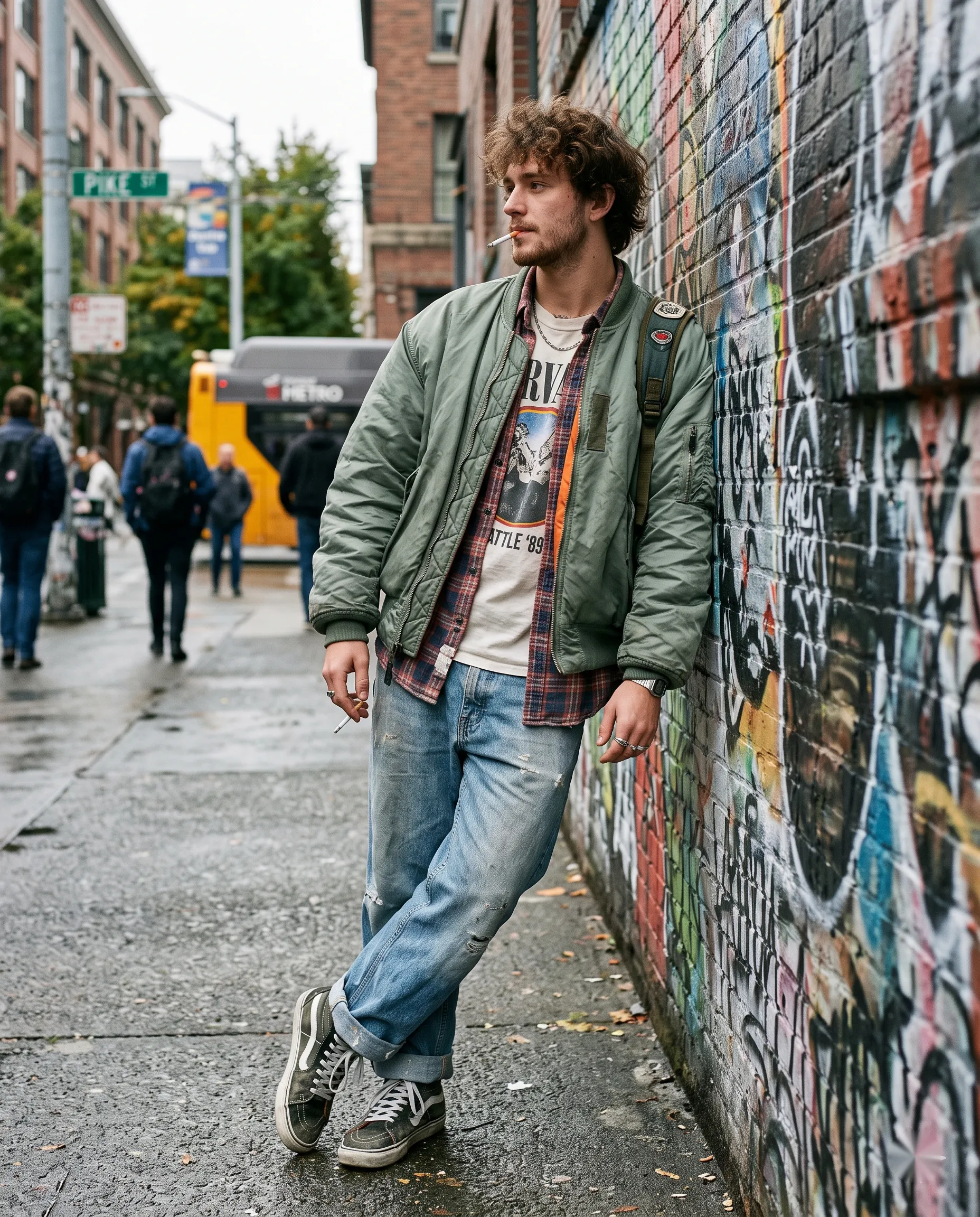
An olive quilted bomber sits over an open flannel shirt, worn above a vintage-wash band tee. Three layers, and what holds them together is texture separation: quilted nylon, brushed flannel, and jersey cotton are three completely different surfaces, so the eye reads three deliberate choices instead of a pile of clothes. If all three were the same flat cotton, the outfit would look accidental — variety of surface is doing the work here, not variety of color. The bomber itself has a long history as military issue, and the history of the jacket covers it from the flight line onward.
Lose the bomber when the afternoon warms up and the flannel-over-tee combination is still a complete look, because the flannel's open front frames the tee like a casual overshirt. Fit matters on the bottom half: baggy light-wash jeans balance the bomber's cropped, slightly puffy shape, while a slim jean under a voluminous top would make the legs disappear. The palette stays in muted earth tones, which is what lets three textured pieces coexist without fighting. One rule worth stealing: when you stack three layers, keep them in the same color family and let texture do the differentiating.
Wear it with: light-wash baggy jeans and clean sneakers or simple boots — nothing else competing for attention up top.
The Countryside Formula: Quilted Jacket, Cable Knit, and an Oxford Collar

A quilted olive jacket over a chunky cream cable-knit sweater, with a white Oxford shirt collar peeking out at the neck. That visible collar is doing more work than it looks — it is a small, crisp, structured signal at the exact point where two soft layers (quilt and chunky knit) could otherwise blur into shapelessness. Whenever you stack two bulky soft pieces, a hard detail at the collar or cuff keeps the whole thing from reading sloppy.
Below, brown corduroy trousers ground the outfit in a third autumn texture. Corduroy, cable knit, and quilted nylon: three distinct surfaces in one tonal family of greens, creams, and browns, finished with dark brown leather boots. Proportion matters here too — the sweater is chunky, so the trousers are straight rather than wide; two voluminous pieces would swallow the frame. This is countryside layering logic, and it translates directly to city weekends: texture variety plus one crisp detail.
Fit note: chunky knits add real bulk, so size the jacket to fit over the knit — if the shoulders pull, the knit is too thick for that jacket.
One Loud Jacket, Everything Else Quiet: Rust Suede Fringe on Black

A rust-orange suede fringe jacket over a black zip fleece, black selvedge denim, and black leather boots. This outfit runs on the statement-jacket principle: when the outer layer is loud — fringe, saturated color, heavy texture — everything underneath goes quiet. The all-black base is not boring here; it is a deliberate dark field that lets the rust suede be the only thing the eye processes.
Fringe specifically needs stillness around it because it moves. A moving texture next to other busy details creates visual noise; against flat black, the movement reads as intentional. The mid-layer is chosen for warmth-per-thickness — a zip fleece adds real warmth without the bulk a sweater would bring, so the jacket's silhouette stays clean. Suede needs a little care to stay this good: keep it dry, brush it after wear, and save it for dry days rather than rainy ones.
Wear it with: black selvedge denim and black leather boots — the whole base stays one quiet color so the jacket owns the outfit.
Smart-Casual Stack: Tweed Blazer, Burgundy Cardigan, Oxford Shirt

A brown herringbone tweed blazer over a deep burgundy cardigan, over a blue Oxford shirt with a dark knit tie. Three layers, but the logic here is tonal depth rather than texture contrast: brown, burgundy, and blue all sit in the same muted, autumnal register, so the stack reads rich instead of busy. Herringbone tweed has enough pattern to be interesting up close and enough neutrality to behave like a solid from across the street.
The knit tie is the detail that makes the smart-casual balance work. A woven silk tie would push this into formal territory; the knit texture keeps it in the same relaxed material language as the cardigan. Slim dark trousers keep the lower half clean so the three-layer top half stays the focus — wide trousers here would add a fourth visual event and tip the outfit into fussiness. And the shed test holds: blazer off at a warm café, and the cardigan-over-Oxford still reads as a complete, intentional outfit. That is the difference between layering and just wearing a jacket.
Tip: when the top half carries three layers, keep the bottom half simple — one color, one clean line, no extra patterns.
Workwear Honesty: Sherpa-Collar Jacket Over a Waffle Henley

A washed charcoal work jacket with a sherpa collar over a mustard waffle-knit henley, with faded dark denim below. Workwear layering works on honesty: the jacket's washed canvas looks better slightly worn, the henley's thermal waffle texture is openly functional, and nothing pretends to be dressier than it is. That coherence is why the outfit reads confident rather than careless.
The color logic is worth noting. Mustard against charcoal is a warm accent inside a cool field — one warm note, not a warm palette. If the jeans were warm-toned too, the outfit would lose its anchor; the faded dark denim keeps the bottom half neutral so the henley can be the single warm event. The sherpa collar adds a second texture at the neck, which matters because the henley's own neckline is simple — without the collar, the top of the outfit would have less going on than the bottom. Small calibration, big effect.
Fabric note: washed canvas and waffle knits both soften with wear, so this combination gets better over a season rather than worse — hang the jacket to air out instead of washing it after every wear.
The Real Three-Layer System: Technical Shell Over Sherpa Fleece

An orange-and-navy technical shell over a cream sherpa fleece, over a grey base tee. This is the actual three-layer outdoor system — shell, mid, base — adapted for city life, and it is the most functionally honest combination here. Each layer has a job: the tee manages moisture, the fleece traps warmth, the shell blocks wind and rain. When the afternoon warms up, the shell comes off and the fleece-over-tee still works; when it cools again, the shell goes back on in ten seconds. This shell, mid and base system is the same one the layering guide teaches for cold weather.
The color-blocking does real work too. The shell's orange and navy pick up the accents in the sneakers below, which ties the top and bottom of the outfit together across a neutral middle of grey tee and olive cargo pants. Without that echo, a bright technical shell can look disconnected from the rest of an outfit — like gear worn over street clothes rather than part of them. The lesson: if your shell is colorful, repeat one of its colors somewhere else in the outfit, ideally at the opposite end.
Wear it with: olive cargo pants and sneakers that pick up the shell's orange or navy — the echo is what makes the technical piece look like part of the outfit.
One Statement Piece: Camel Overcoat Over a Black Turtleneck

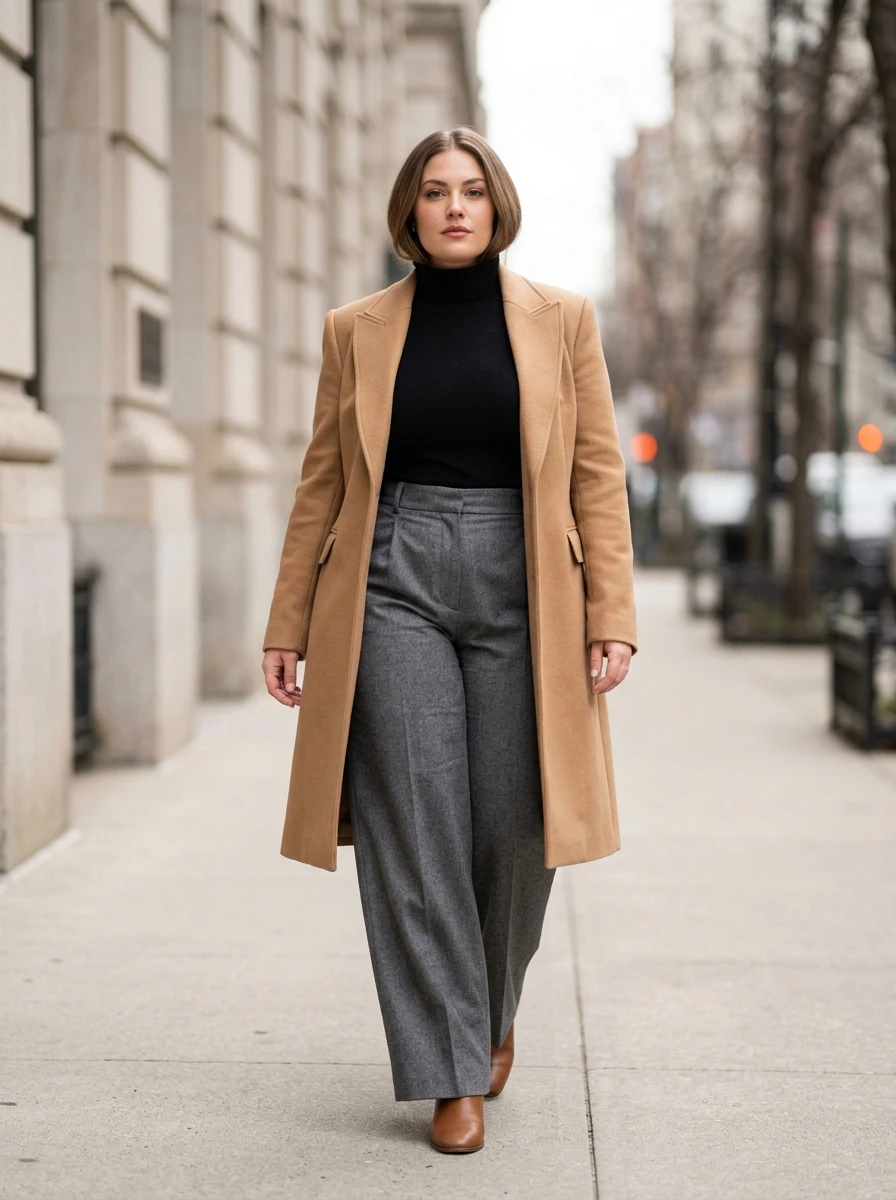
A long camel wool overcoat over a fitted black turtleneck, grey tailored trousers, and black Chelsea boots. This runs on the monochrome-base principle: everything under the coat is dark and quiet — black, charcoal, grey — so the camel coat becomes the entire statement. The outfit has exactly one thing to look at, which is why it reads so authoritative.
Proportion is doing the heavy lifting. A long overcoat needs a slim lower half; wide trousers under a long coat create a bell shape that reads sloppy rather than draped. The turtleneck is fitted rather than chunky for the same reason — the coat supplies all the volume the outfit needs, and a thick sweater underneath would strain the coat's shoulders and ruin its line. The warm camel against cool charcoal contrast is the whole color story, and it is enough. When the base is this restrained, one strong outer piece is all an outfit needs.
Fit note: a wool overcoat should button without pulling across the chest with the turtleneck underneath — if it strains, the mid-layer is too thick, not the coat too small.
Before You Walk Out the Door: A Quick Layering Checklist
- Noon test passed? Outer layer off, the outfit underneath still looks finished.
- One loud piece only. A statement jacket gets a quiet base; a bright shell gets its color echoed once, not three times.
- Textures differ, colors stay close. Same color family, different surfaces — quilt, knit, corduroy, suede — reads rich; the same surface everywhere reads flat.
- One fitted layer against the body. Only one layer carries the volume; the rest sit close.
- One warm note, not a warm palette. A single mustard henley or rust jacket inside a cool, neutral field.
Questions About Layering Jackets This Autumn
Can I wear a quilted jacket without looking bulky?
Yes — pair it with a straight or slim bottom half and keep the mid-layer flat where the jacket sits. A quilted bomber over an open flannel works because the flannel is thin; a quilted jacket over a chunky knit needs a jacket cut with room in the shoulders, or the bulk stacks up in the wrong places.
How do I keep suede looking good through autumn?
Keep it dry and brush it after wear — a quick brush lifts dust and keeps the nap even. Save suede for dry days and store it somewhere airy rather than sealed in plastic, which traps moisture. A suede jacket is a fair-weather piece; treating it like one is what keeps it looking new.
Is a tweed blazer too formal for everyday autumn wear?
Not in a textured cloth. Tweed, flannel, and corduroy read casual because the surface is soft and matte; smooth worsted wool is what reads corporate. Layer the blazer over knitwear instead of a dress shirt, skip the silk tie in favor of a knit one, and wear denim or casual cotton trousers instead of suit trousers.
What makes a technical shell work in the city instead of just on a trail?
One repeated color. A bright shell looks like part of an outfit when one of its colors shows up again somewhere else — the sneakers, a cap, the bag strap. Without that echo it reads like gear thrown over street clothes. Keep the middle layers neutral and let the shell and one echo do the work.
How long should a camel overcoat be?
Just above or just below the knee is the safe range for most men — long enough to read as an overcoat, short enough to move in. The key fit check is the shoulder: the coat's shoulder seam should sit on your own shoulder with a fitted turtleneck or thin sweater underneath, not stretched by a chunky knit.
The Takeaway: Dress for the Swing
Autumn is not a season for one perfect jacket. It is a season for a system: three layers that each earn their place, a palette calm enough to let texture speak, and one piece doing the talking. Get the morning-to-afternoon swing right and the rest of the outfit takes care of itself.