5 Smart Casual Fall Looks for Men (College & Work)
How to use this guide
These are editorial styling suggestions, not a one-size-fits-all formula. Adapt each look to your wardrobe, proportions, climate, comfort, budget, and the occasion; the most useful idea is the one you can genuinely wear.
8 a.m. lecture, 2 p.m. shift at the campus job, dinner with friends at 6. Three different rooms, one outfit, no time to change in between. That is the actual problem smart casual solves. It is not about looking "dressy" — it is about building one outfit that survives a whole day of context switches without looking wrong in any of them.
The fix is a ratio, not a shopping list: exactly one structured piece per outfit, with everything else relaxed around it. The structured piece — a coat, a blazer, a collar detail, a shoe choice — does the smart. The relaxed pieces do the casual. One piece, one job.
Nail the ratio and the same outfit works in a lecture hall and a workplace. Miss it and you are either overdressed — blazer, dress shirt, feeling like you are in costume by noon — or underdressed, hoodie and jeans, comfortable but invisible. The rule matches the standard definition of smart casual, a dress code that sits between formal and casual without a fixed uniform.
The five looks below run from most relaxed to most formal, each putting the structured piece somewhere different — top, outer layer, collar, shoe. For each: what the anchor is, why it works, and what would break the outfit. For the rest of the classroom wardrobe beyond these five, these college outfit ideas that actually work for class cover the everyday base layers.
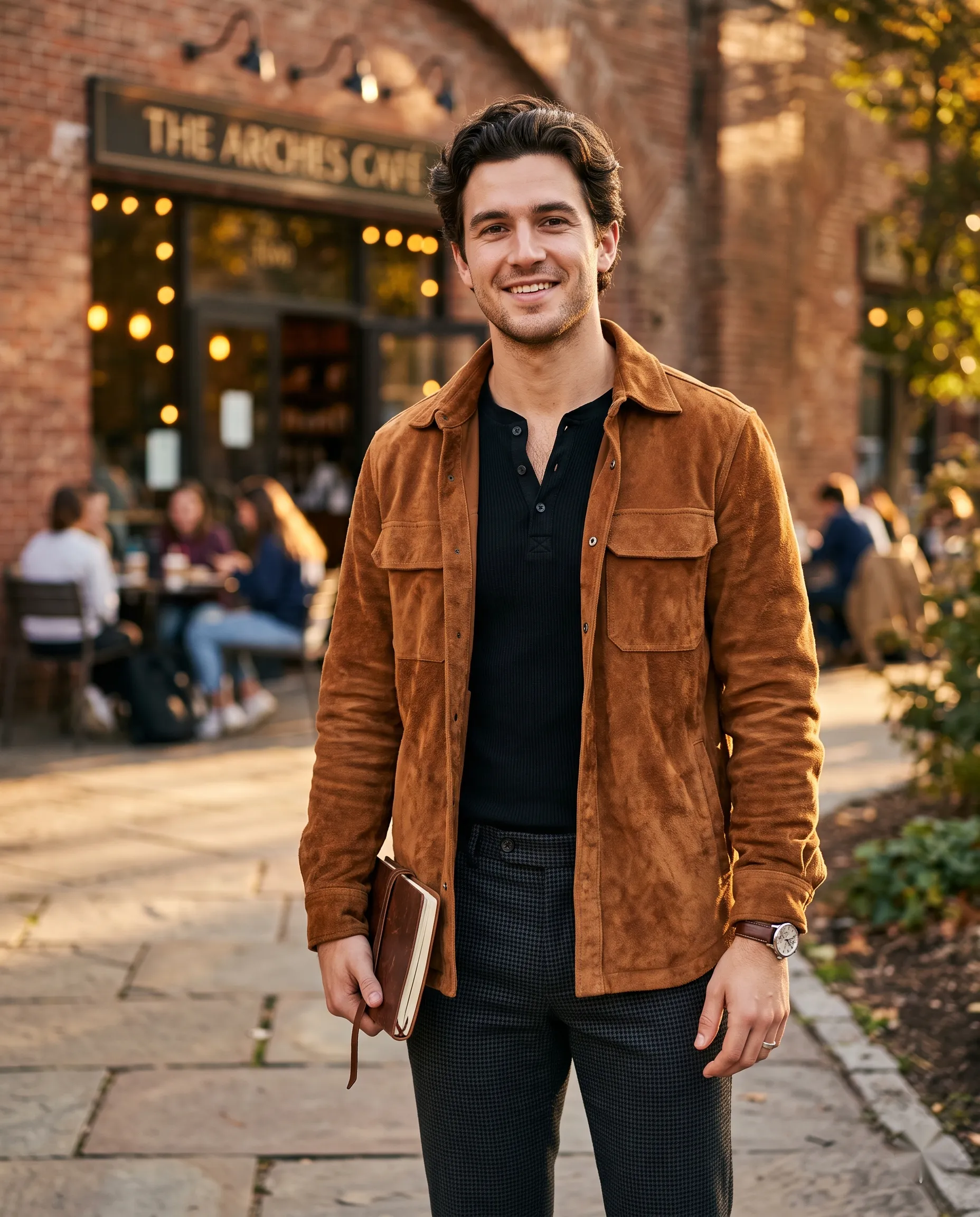
Tan Suede Overshirt, Black Henley, Houndstooth Trousers
Wear it with: dark houndstooth trousers, clean dark boots or minimal sneakers, a leather notebook optional but on brand.
A tan suede overshirt worn open over a black ribbed henley. The anchor here is the overshirt, but barely — and that is the interesting part. Suede has enough body to hold its shape even worn open, which is what lets it read as layered rather than thrown on. A cotton overshirt worn the same way would hang flat and lose the effect; the material is doing structural work that the cut alone could not.
Suede asks for a little care: a quick brush keeps the nap even, protector spray before the season keeps light rain from marking it, and if it gets wet, let it air dry at room temperature — never use direct heat — then brush it back. The henley matters more than it seems: its ribbed texture and button placket give the base layer its own quiet interest, so the outfit does not depend entirely on the overshirt. And the houndstooth trousers are the pattern move, a classic menswear check that adds visual texture without color. The palette stays dark and tonal (tan, black, dark pattern), which keeps the whole thing cohesive.
On fit: wear the overshirt open, sleeves to the wrist bone, henley tucked or half-tucked so the waistband anchors it — a henley that bunches at the waist ruins the line.
Where it goes wrong: buttoning the overshirt fully (it becomes a shirt, and the layering logic collapses), or swapping the henley for a plain crewneck tee (the base goes too plain and the outfit loses its middle register).
The Rust Corduroy Suit That Does the Work for You

Fabric note: corduroy's ribs catch light differently at every angle, which is what gives the rust color its depth. Brush it down in one direction after wearing; steam out creases rather than ironing flat, which crushes the pile.
A matching rust corduroy blazer and wide leg trouser set, grey graphic tee, clean sneakers. The anchor is doing double duty: a matching set reads as more put together than any single blazer could, because matching top and bottom is inherently deliberate. Nobody matches by accident. That is exactly why the plain graphic tee underneath does not undercut the outfit.
The tee can be casual because the suit carries all the formality: the more formal the frame, the more casual the interior can be. Corduroy is the right fabric beyond aesthetics: its ribbed texture gives the rust color depth, and it is genuinely warm without a coat. The sneakers should be clean and minimal; the outfit is already making one bold move (the rust suit), and busy footwear would be a second. For another men's trouser option, see these ways to style cargo pants for men.
On fit: a wide leg trouser needs a slight break or none at all — pooling fabric over the sneaker drags the whole set down. Keep the blazer unbuttoned with the tee, and let the tee's hem sit just below the waistband.
The mistake to avoid: a loud graphic on the tee (it would compete with the suit for attention — keep the graphic small and tonal), or dress shoes instead of sneakers (the outfit would tip from smart casual into trying too hard; the sneaker is what keeps it grounded).
Camel Mac Coat: The Three-Layer Collar

Fit note: the coat should sit on the shoulder, not past it, and end mid-thigh. The sweater underneath needs to be fine-gauge — a chunky knit swallows the shirt collar and kills the layering effect this look is built on.
A camel mac coat worn open, grey crewneck sweater over a light blue Oxford shirt, dark navy jeans, suede Chelsea boots. The anchor is the mac coat, but the real lesson is at the collar: three visible layers — coat, sweater, shirt — each peeking slightly past the one over it. Each edge showing is what reads as considered, the visible evidence that someone thought about the order.
The colors are tonal and safe — camel, grey, light blue, dark navy, all cool to neutral — which is precisely why it works everywhere: class, office, dinner. The Chelsea boots are the quiet polish at the bottom. Suede keeps them from reading as too formal, but the Chelsea silhouette keeps them firmly out of sneaker territory. The shirt layer matters here too, so see these ways to style a white button down shirt.
Keep the jeans dark — light wash denim adds a second casual signal and drags the whole thing toward the weekend.
Don't: wear a sweater so thick the Oxford collar disappears underneath it (the three-layer collar effect is the outfit's signature — lose it and you lose the point), or swap in light wash jeans.
The Shawl Cardigan: One Borrowed Detail

Tip: fold chunky knits, never hang them — a hanger stretches the shoulders out of shape in a season. A de-pilling comb once a month keeps an oatmeal knit looking new instead of fuzzy.
A chunky oatmeal shawl cardigan, plain white tee, dark brown chinos, white sneakers. This is the most relaxed of the five, and it stays on the smart casual side of the line for exactly one reason: the shawl collar. A crewneck cardigan in the same weight, color, and knit would read as a sweatshirt — comfortable but shapeless. The shawl collar borrows a tailoring detail (the folded lapel is suit language), and that single borrowed element is enough to keep the whole outfit on the right side.
One tailoring detail can rescue an otherwise casual outfit: a shawl collar, a structured shoulder, a crisp placket — any single element borrowed from formalwear's vocabulary signals intention. The dark brown chinos (not jeans, not khakis) and the clean white sneakers complete the register: relaxed everywhere, with that one collar doing the smart work.
Keep the tee plain and bright white — a grey or off-white tee would muddy the oatmeal-on-brown palette. And keep the sneakers actually clean; white leather scuffs fast, so a wipe-down before you leave matters more here than with any other look.
What kills it: swapping the shawl cardigan for a hoodie (the tailoring detail vanishes and it is just loungewear), or distressed jeans instead of the chinos (too many casual signals — the outfit needs the chino's relative polish to balance the knit's softness).
Olive Wax Jacket, Grey Turtleneck, Black Derbies

Wear it with: tailored navy trousers with a clean break, black Derby shoes polished, no visible socks or dark socks that match the trouser, not the shoe.
An olive waxed jacket with a corduroy collar, grey turtleneck, tailored navy trousers, black Derby shoes. This is the most formal of the five, and the formality comes almost entirely from the shoe. The derby is the anchor here. Swap in a sneaker and the same jacket, turtleneck, and trouser combination reads as smart casual; the derby's closed lacing and polished leather push it close enough to business casual for client meetings, not just class.
The waxed jacket is genuinely functional outerwear (water resistant, windproof), which gives the outfit an authenticity fashion-only pieces cannot fake. Never machine wash it — that strips the coating; sponge it clean and re-wax once a season. The corduroy collar is the texture detail that keeps it from reading as purely utilitarian. And the turtleneck-under-jacket pairing is doing quiet work: the turtleneck's clean neckline means there is no collar competition with the jacket's corduroy collar, so each element has its own territory.
Derbies earn their keep with a little maintenance: a quick polish, and shoe trees overnight so the leather holds its shape instead of creasing at the vamp.
Where it goes wrong: sneakers instead of the derbies (the outfit drops a full formality level — fine for class, wrong for the meeting), or a brightly colored jacket (the olive's mutedness is what lets it sit next to navy tailoring; a loud color would fight the trousers).
The One Anchor Rule, Generalized
| Look | Anchor | What breaks it |
|---|---|---|
| Suede overshirt | Material body, suede holds shape | Buttoning it fully, plain crewneck base |
| Corduroy matching set | Deliberate matching | Loud graphic tee, dress shoes |
| Mac coat | Outer layer authority | Thick sweater hiding the collar |
| Shawl cardigan | One borrowed tailoring detail | Hoodie swap, distressed jeans |
| Wax jacket and derbies | Footwear formality | Sneakers, bright jacket color |
Five different anchors, one rule: the structured element can live anywhere in the outfit — top, middle, bottom, outer, shoe — as long as there is exactly one of it. Two and you are overdressed; zero and you are underdressed. Once it is instinctive, building new combinations from your own closet stops requiring real thought.
For anyone wanting to push the anchor further toward formal, the old money approach takes the same one structured piece logic and dresses it up a level, same rule, higher register. For the cold weather version of the same logic, these casual winter outfit ideas for a flattering look keep the anchor rule through heavier layers.
Four Habits That Do the Heavy Lifting
1. Count before you leave. Literally count the structured pieces: blazer, coat, derby shoes, crisp collar — how many? Two or more, remove one. Zero, add one. This single habit fixes more smart casual outfits than any shopping ever will.
2. Let the palette stay quiet. Camel, grey, navy, olive, brown, black, white. When the colors agree with each other, the one structured piece stands out for the right reasons. A chaotic palette plus a blazer just looks like a chaotic outfit with a blazer. If you add one color outside this family, keep it small — a tee graphic, a pocket square — never the coat or the trousers.
3. Pick the shoe last, and on purpose. Sneakers cap an outfit at smart casual; derbies or boots raise it toward business casual. Decide where you are going, then choose the shoe. It is the fastest formality adjustment in menswear, faster than changing any garment. Whatever you pick, keep it clean — scuffed sneakers or unpolished derbies drag the whole outfit down.
4. Fit beats fabric. Even with the one structured piece rule working, clothes that do not fit undermine it — trousers pooling over shoes, jacket shoulders two inches past yours. Smart casual has less margin for poor fit than formalwear, because there is no suit's overall polish to hide behind. Hem the trousers — a clean break at the shoe is the cheapest upgrade in this guide.
Smart Casual Questions, Answered
What's the actual difference between smart casual and business casual?
Business casual has a floor: collared shirt and dress trousers minimum, no denim, no sneakers. Smart casual has no floor but has the one anchor rule. A sweater and well fitted dark jeans can qualify if one piece is doing structural work. Business casual is a dress code; smart casual is a formula. The Modest Man's smart casual guide for men draws the same line: structured on top, relaxed below, with the shoe setting the ceiling.
Can I wear a suede overshirt when it rains?
Light drizzle, yes — if you prepared it with protector spray before the season, applied in two light coats. A proper downpour is different: suede soaks, water-spots, and stiffens as it dries. If it gets wet, stuff it with paper to hold the shape, let it dry at room temperature away from radiators, then brush the nap back. Never use direct heat, and never iron suede.
How do you handle class in the morning and work in the afternoon?
Build around a removable anchor: the outfit without the structured piece works for class, and adding the blazer or coat elevates it for work. Pack the anchor, do not wear it all day — a blazer stuffed in a backpack all morning looks it by afternoon. The two outfit one base trick only works if the anchor arrives fresh. A proper bag matters here, so these viral Nike and Converse backpacks for college, tech and books cover options that keep a folded blazer presentable.
What should a college guy buy first on a budget?
In order: dark jeans that fit properly (hemmed), clean minimal sneakers, one unstructured blazer or overshirt, one pair of brown chinos. Mixed with tees and sweaters you already own, those four pieces generate more smart casual outfits than a closet full of statement pieces — the formula is in the combinations, not the items. The camel coat version of the same starter logic appears in our classy elegant winter outfits to pin and wear.
Before You Walk Out the Door
A thirty-second check that replaces all the second-guessing:
- One structured piece? Count it. Two means remove one; zero means add one.
- Do the colors agree? Camel, grey, navy, olive, brown, black, white — if one color is fighting the rest, swap it.
- Does the shoe match the destination? Sneakers for class, derbies or boots for anything with a meeting in it.
- Are the layers in order? Collar peeking, sweater edge showing, coat sitting on the shoulder — each layer visible, none swallowing the one under it.
- Is the fit clean? Shoulders on the shoulder, trousers hemmed, no pooling at the shoe.
Pass all five and the outfit is done: one anchor, a quiet palette, shoes matched to the day. Learn to feel the ratio and you stop asking "is this smart casual?" — you will already know.