How to Wear Cute Plus Size Fall Outfits for Curvy Women: A Fit-First Guide
How to use this guide
These are editorial styling suggestions, not a one-size-fits-all formula. Adapt each look to your wardrobe, proportions, climate, comfort, budget, and the occasion; the most useful idea is the one you can genuinely wear.
It is 7:40 on a Tuesday in mid-October. The morning is cold enough for a coat, the office will be warm by eleven, and by the time you walk home the wind will be cutting across the parking lot. You open the closet and everything in it seems to belong to a different day: the cardigan that pulled across your bust last week, the jeans whose waistband dug in the moment you sat down at your desk, the coat that made your shoulders look twice as wide as they are. Sound familiar?
So why does fall feel harder to dress for than any other season on a curvy frame? It is not the clothes, and it is not your body. It is the layers. Summer asks one piece to do one job. Fall asks three or four pieces to work together across a cold morning, a heated room, and a windy evening, and every layer has to negotiate with your actual shape instead of hanging off an idealized one. When the fit logic is wrong, each added layer makes the problem louder: waistbands that dig, sleeves that ride up, cardigans that gap, coats that add width where you never asked for it.
This guide works the other way around. Instead of handing you nineteen disconnected outfits, it starts with the fit logic that makes fall dressing work on a curvy body, proportion, hem length, texture, structure, fabric, and color, and then shows that logic in action across nineteen outfits, from a ribbed turtleneck with corduroy trousers to a long cardigan over a slip dress. Learn the logic once, and October stops being a morning argument.
The Fit Logic Behind All 19 Outfits
Start with proportion, not with pieces. Every fall outfit that looks good on a curvy body follows one rule: one volume, one line. When the top half carries the volume, a draped poncho, a chunky cable knit, a long duster cardigan, the bottom half stays narrow: skinny jeans, leggings, slim trousers. The narrow base gives the volume somewhere to end.
Flip it when the bottom is the statement piece. A flowing midi skirt or wide leg trousers need a top that stays close to the body, a fitted ribbed turtleneck or a tucked-in tee. Two voluminous pieces worn together is how an outfit ends up wearing you instead of the other way around, so pick one half to carry the drama and let the other half go quiet.
Where a layer ends matters more than the layer itself. The eye stops wherever a hem stops, which makes hem placement a proportion tool. A cropped moto or denim jacket that ends at your natural waist preserves your torso length, a blazer landing just past the hip stretches it, and a cardigan stopping at mid-thigh shortens the leg line. That is why the same cardigan can look exactly right over a midi dress and completely wrong with skinny jeans: the hem lands in a different place relative to your proportions.
The anchor underneath all of it is the rise of your bottoms. A high rise sits above the fullest part of the belly, which stops the waistband from digging in when you sit and draws one unbroken line from waist to ankle. Test it in the fitting room by sitting down. If the waistband gaps at the back, digs at the front, or the pockets flare open, the rise is wrong for your body, whatever the size tag says.
Texture is what makes fall look expensive. Fall's palette runs dark and muted, so texture does the visual work that color does in summer. Outfits that look rich almost always pair two different surface qualities: a matte knit against something with a sheen, a soft nap against a crisp weave. Two identical textures in similar colors is what reads as flat, or worse, shapeless.
The pairings that hold up season after season are a ribbed knit with corduroy, a heavy knit with a fluid skirt, a matte legging with a brushed blazer, and a weighty cardigan over a satin slip dress. The first four outfits below put each one on, so you can see the contrast working before you try it yourself.
Structure has to survive sitting down. A structured outer layer is the fastest route to looking put together, but most off-the-rack structure is drafted for a straighter frame. On a curvy body the fit points that matter are shoulders, armholes, and waist, in that order. If the shoulders fit, a tailor can handle the rest. If the shoulders do not fit, nothing below them will ever sit right.
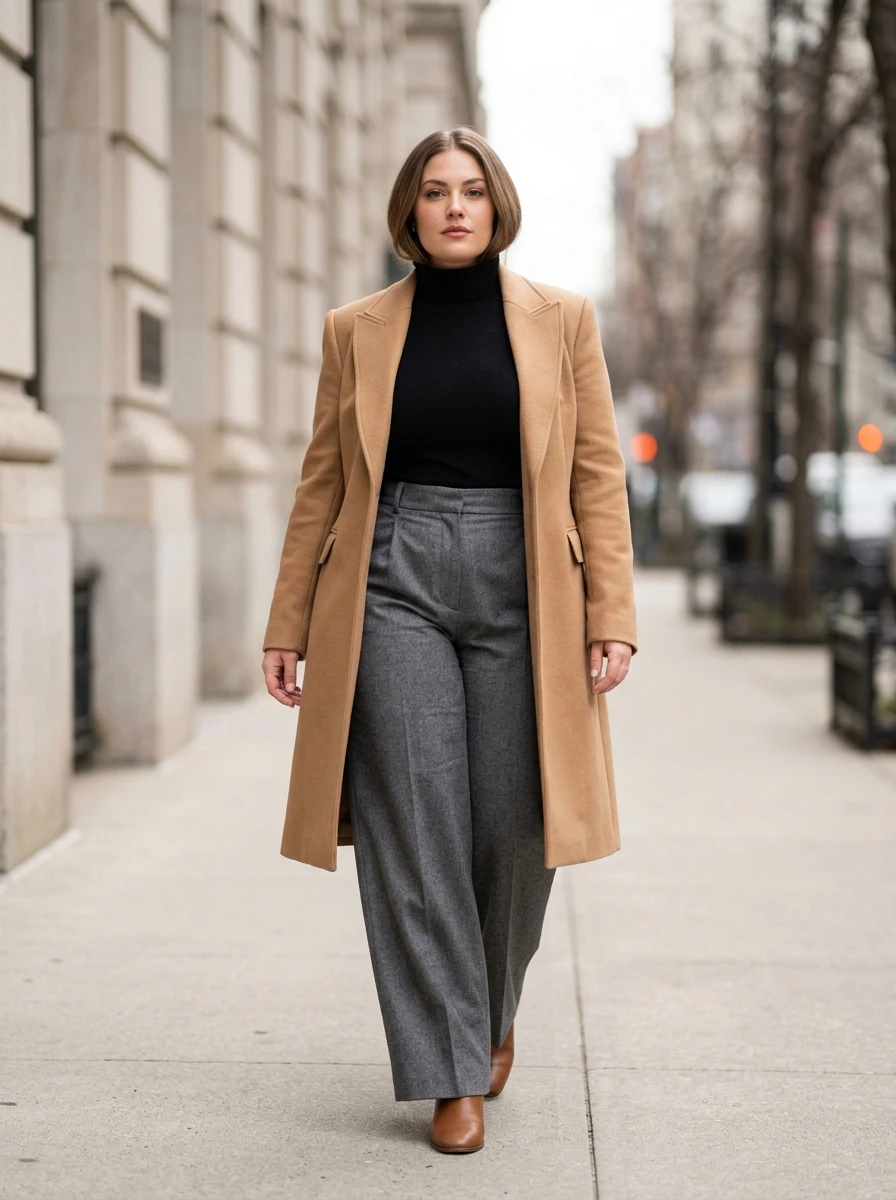
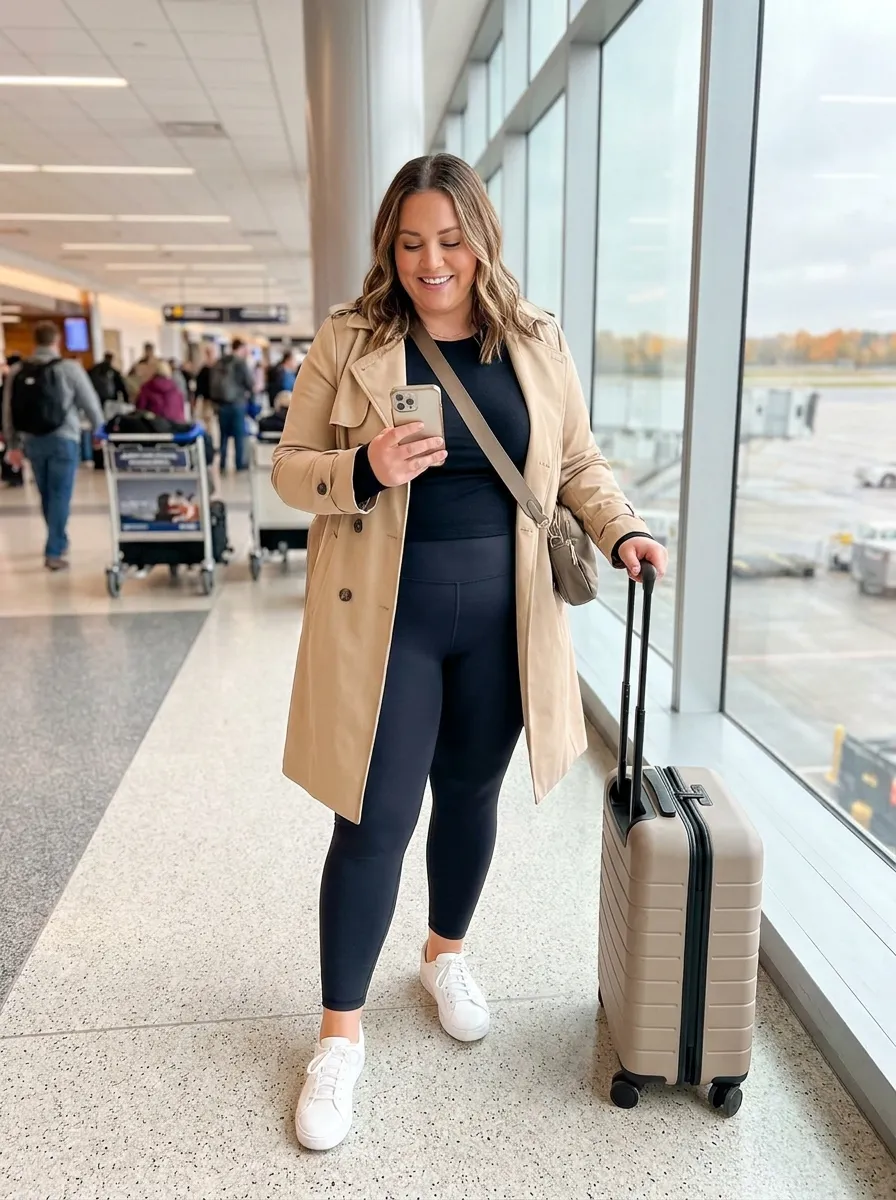
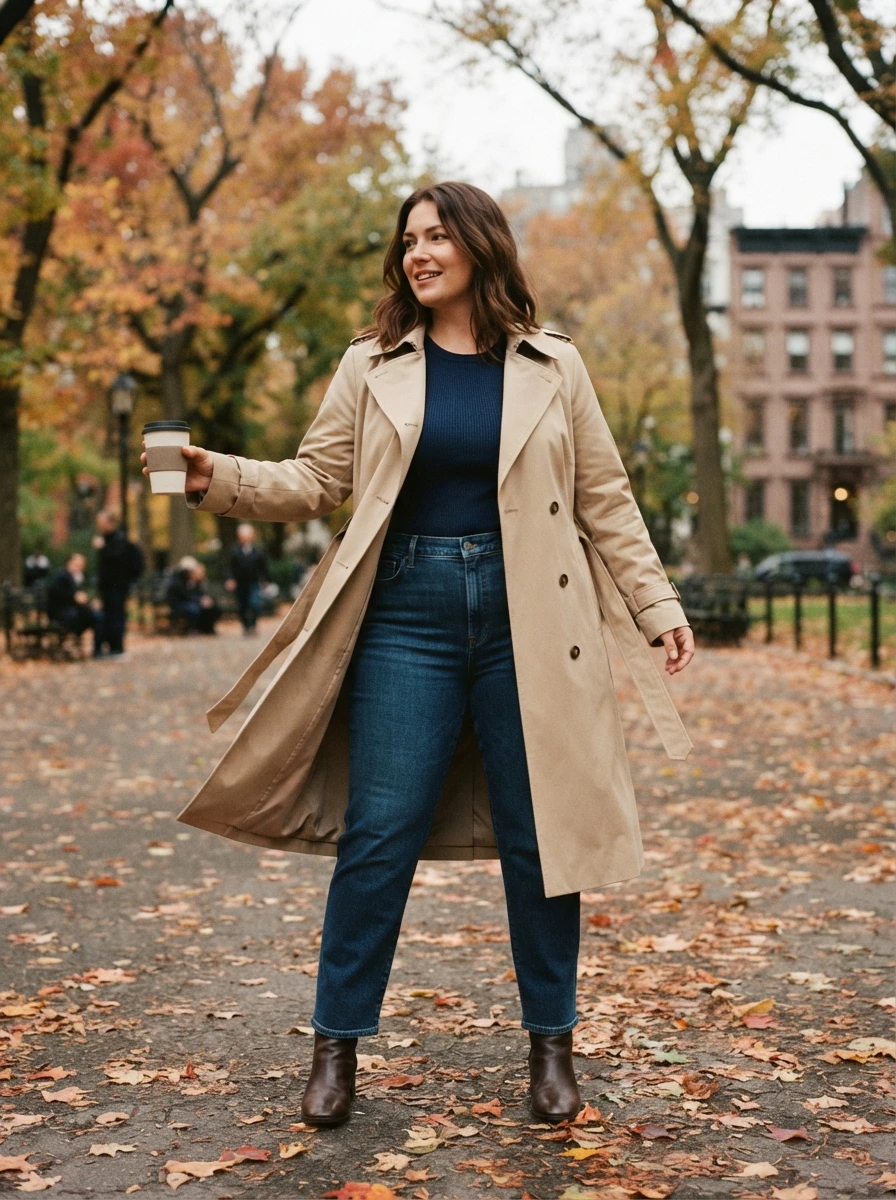
The trench coat anchors a fall wardrobe for a reason: it is structure with an adjustable waist. A cotton-blend trench with a removable belt gives you two silhouettes in one garment, belted, which defines the waist over straight-leg denim, or worn open, which forms two long vertical panels that lengthen the torso. A trench falling below mid-calf can overwhelm a shorter frame, so if you are petite as well as curvy, aim for just below the knee.
A leather or vegan moto jacket does the opposite job. It ends at the natural waist and adds definition exactly where a longer coat would add coverage. A utility jacket earns its place through adjustability, with an internal drawstring that pulls in the waist over a dress or loosens over a sweater. The blazer remains the single most useful structured piece, and the shoulder rule applies double: a blazer that fits in the shoulders but needs the waist taken in is a good buy, while one that pulls across the bust is not, because no tailor can add fabric that is not there.
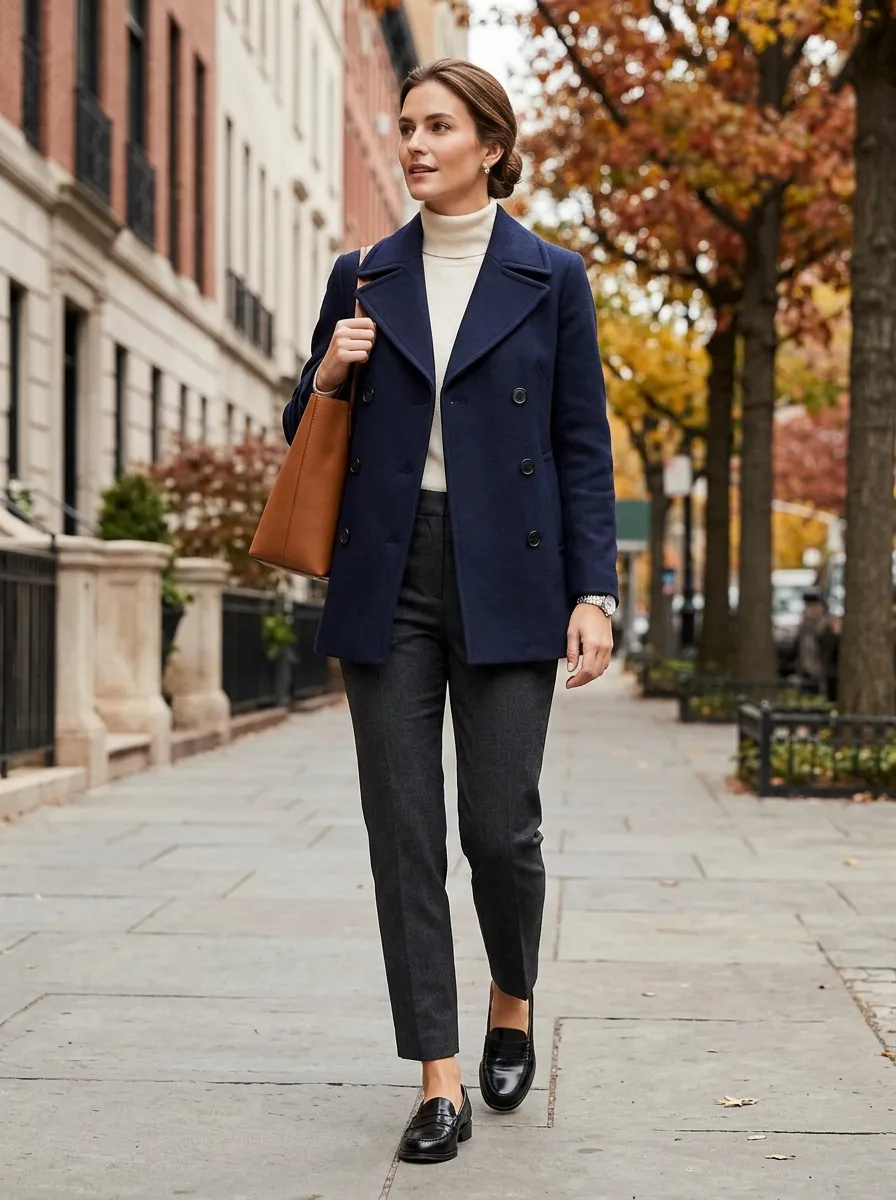
One note on peacoats: the double-breasted cut brings genuine warmth and a polished nautical line, but the broad lapels and wide button stance add visual width across the chest. If you are fuller busted, a single-breasted wool-blend coat with a clean front gives you the same warmth with a smoother line.
A belted trench over straight leg jeans: structure with an adjustable waist.
Choose fabrics that skim instead of clinging. The difference between an outfit that flatters and one that frustrates is usually decided by the fabric, not the cut. Fabric should skim over the fullest parts of your body and cinch only at the narrowest points: the natural waist, the wrist, the ankle. Anything that clings to the belly or pulls across the hips will look and feel worse than a looser garment in a better fabric.
Universal Standard designs for curvy frames first, and its fit notes explain why rise and waistband placement matter more than the size label.
A matching knit set in a single color is the clearest demonstration: sweater and skirt in one tone create an unbroken vertical line, and fabric quality decides whether it works, since a tight, dense knit holds its shape through a day of sitting and standing while a loose, thin knit sags by lunch.
Wrap dresses in heavier jersey or stable knits are a curvy body's best friend in fall because the wrap construction adjusts to your actual waist. The one real failure mode is the wrap gaping at the bust, which a strip of fashion tape or a small safety pin solves permanently.
The tunic sweater and leggings combination works on the same skim principle, with two conditions: the tunic needs side slits so the fabric does not pull tight across the thighs, and the leggings need a thick, wide waistband that stays put all day.
A sweater dress follows the same logic in a single piece: midi length, tall boots, and a soft modal or cotton blend if wool irritates your skin. A cable-knit sweater vest over a crisp button-down keeps the core warm without the bulk of full sleeves, and a long duster cardigan over a basic tee and belted jeans adds warmth without the weight of a coat.
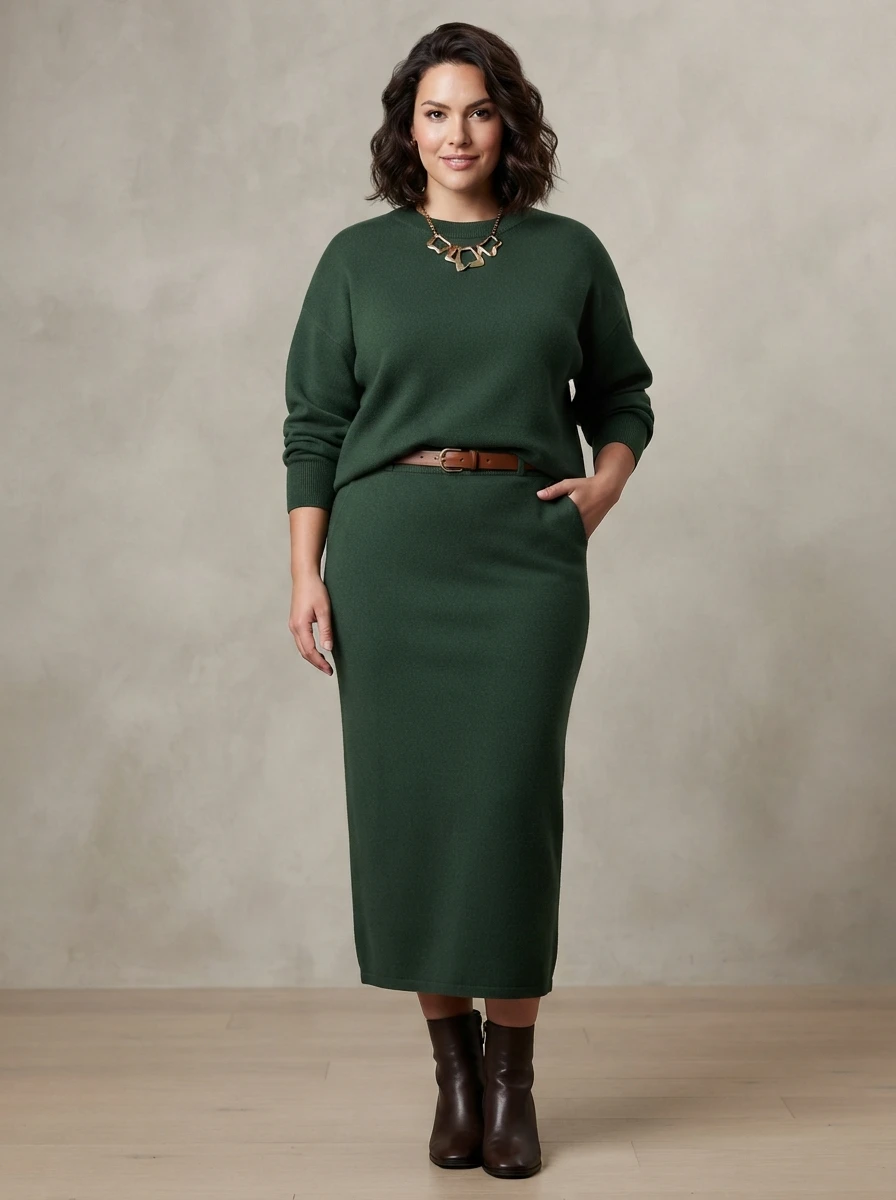 A matching knit set in one color: an unbroken vertical line, styled for you.
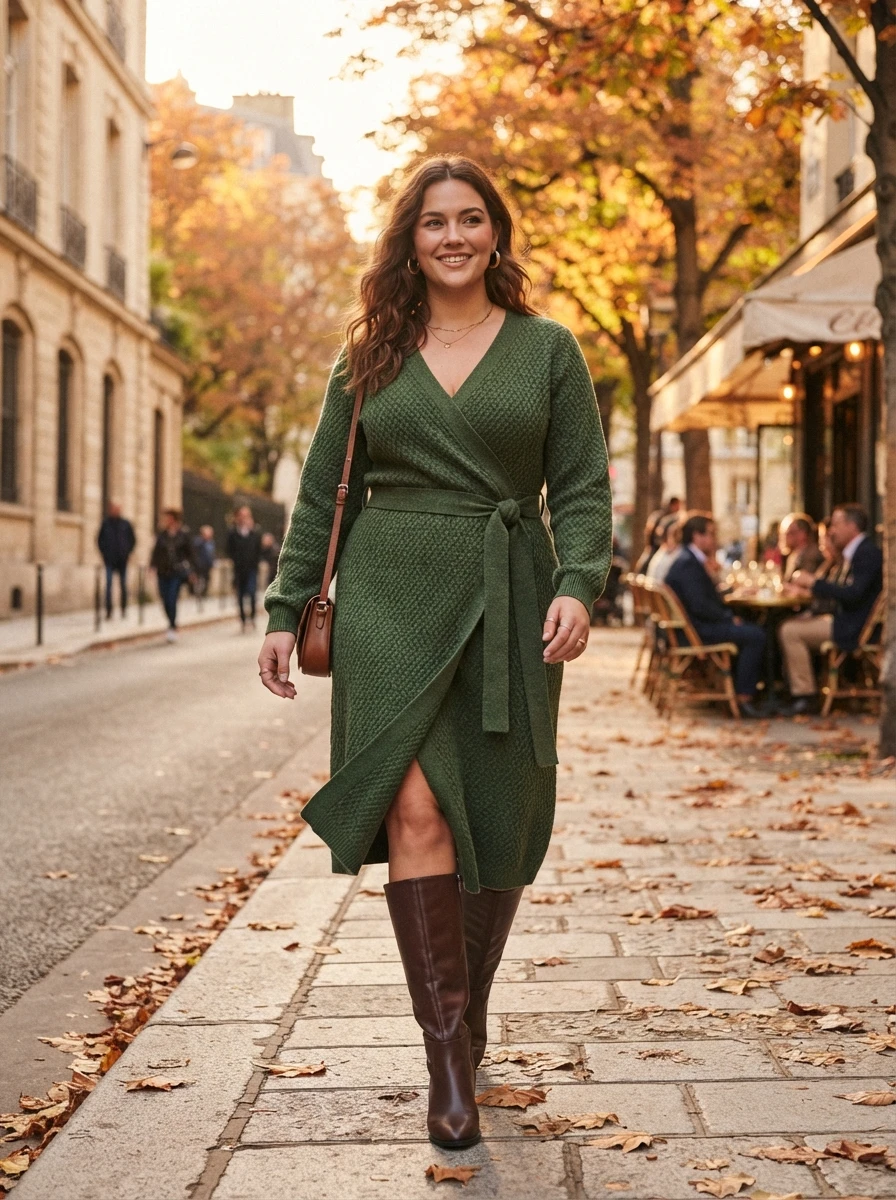 A wrap dress in a heavier knit: the construction adjusts to your actual waist.
Fall color works by temperature, not by rulebook. Fall's palette, rust, burnt orange, olive, mustard, camel, chocolate, cream, is warm by nature, and warm colors tend to be kinder to more skin tones than the stark contrasts of a winter wardrobe. You do not need a color analysis to use this. The rule is color temperature, not specific shades: warm, earthy tones sit harmoniously against most skin, while icy or neon brights create contrast that draws attention, useful when it is deliberate, distracting when it is not.
Light colors are allowed after September. The trick is pairing them with fall textures so they read as seasonal rather than leftover summer: a cream cable knit with dark-wash denim, a tan trench over a rust dress, an ivory turtleneck tucked into chocolate corduroy. Monochrome dressing in a single light neutral, a camel knit set, for instance, works the same lengthening magic as an all-black outfit, with more warmth.
If you love bright color, fall is the season to use it as punctuation rather than the whole sentence. A plum scarf, a forest-green bag, burgundy boots, small, deliberate pops against a neutral base give you the personality without the visual noise.
And do not overlook pattern: a plaid flannel worn open over a fitted tank, or a button-front skirt in suede or corduroy, adds visual interest through texture and vertical line rather than relying on color alone. The buttons themselves form a vertical seam that the eye follows downward, a small detail that genuinely changes how a skirt reads.
From the logic to the outfits. The nineteen combinations that close this guide come from a casual curvy fall wardrobe and survive contact with real schedules, each one built from the proportion, texture, and fabric principles above. The first four show the texture pairings in detail; the rest rotate from weekend errands to work to evenings out.
Ribbed Turtleneck and Corduroy Trousers
The fine vertical rib of the knit and the wider wale of the corduroy run in the same direction, creating a long vertical rhythm that draws the eye up and down rather than across. Corduroy is fall's signature fabric precisely because of that ribbed nap; look for trousers cut with a few percent elastane so the stiffness does not fight your stride. Rust, burnt orange, and olive are the colors that show the texture off best, and loafers finish the collegiate line without adding bulk at the ankle.
Keep the turtleneck fitted rather than slouchy so the ribs stay visible against your frame, and check that the trouser waistband sits flat when you sit, since corduroy shows pulling more than softer fabrics do.
Wear it with: loafers and a structured tote for a polished daytime line.
 Rust corduroy trousers and a ribbed turtleneck: matching vertical ribs draw the eye up and down, not across.
Chunky Cable Knit and Flowing Midi Skirt
This is soft-on-soft contrast: heavy, structured knit against fluid fabric. The trick is the tuck. A half tuck, or a knit that ends right at the hip, keeps the sweater's volume from swallowing your waist. A V neckline opens the neck and collarbone, which matters when the fabric itself is thick. An elastic-waist midi in a substantial fabric skims rather than clings; if the skirt fabric is too thin it will bunch at the midsection, so hold it up to the light before you buy.
On a curvy frame, choose a knit that ends at the hip rather than below it, so the volume stops where your waist begins and the skirt gets room to move.
Fit note: a V-neck or open collar keeps the neckline visible under a heavy knit, which stops the top half from reading as one solid block.
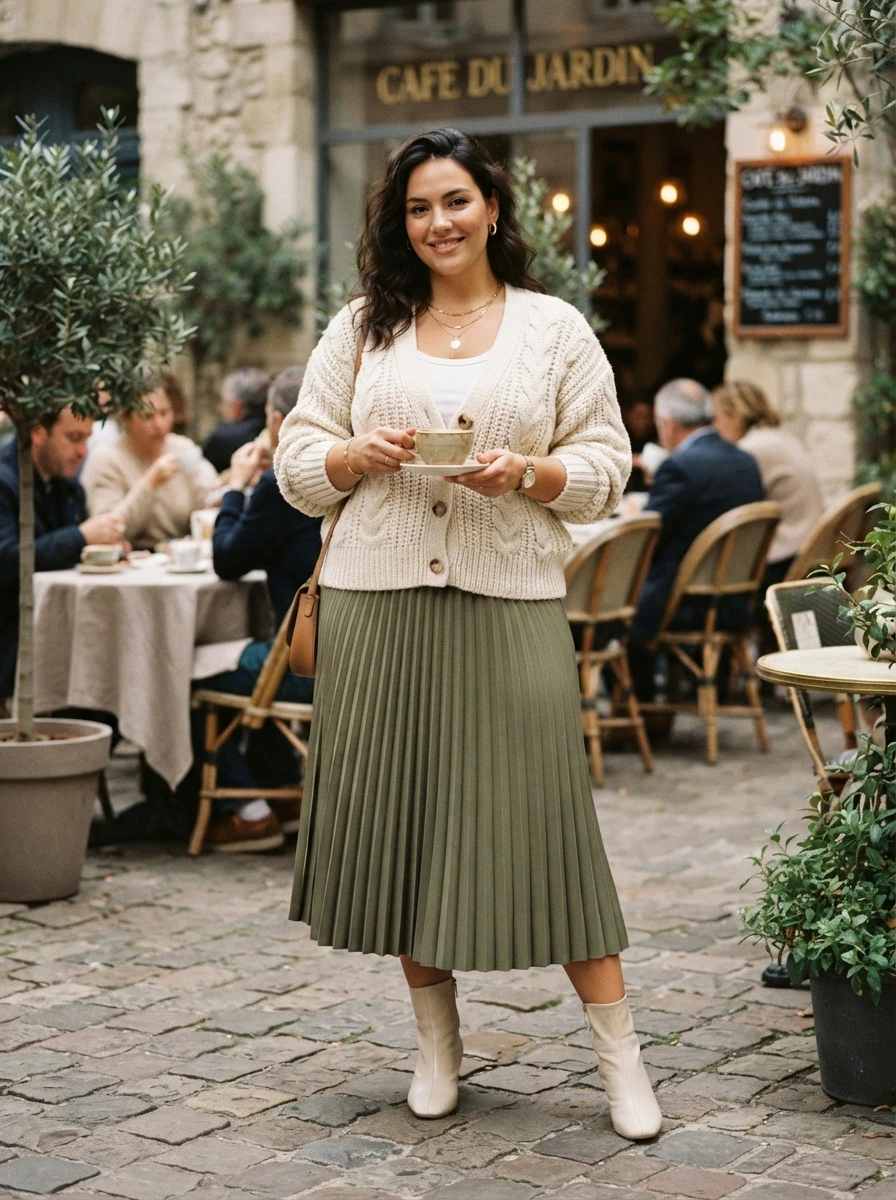 Chunky knit over a flowing midi skirt: soft on soft contrast, half tucked at the hip.
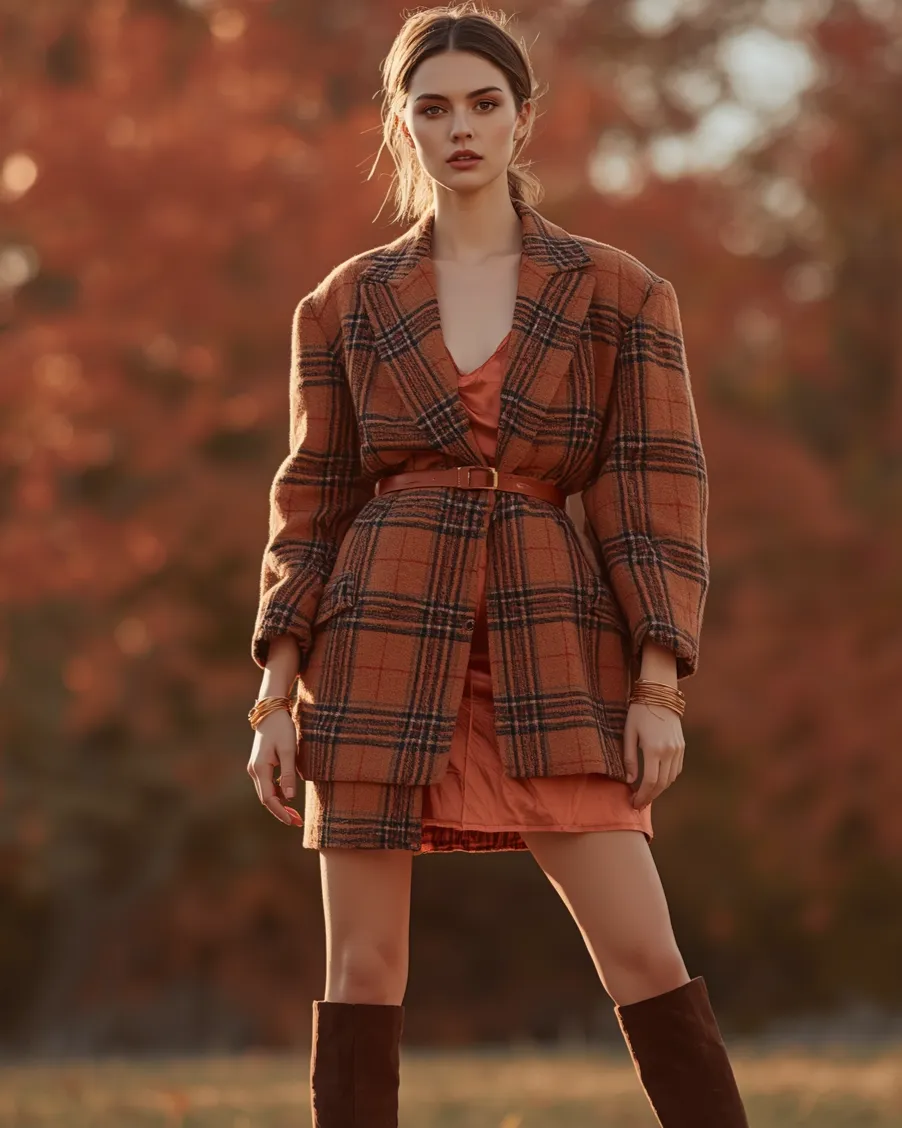
Matte Faux Leather Leggings and an Oversized Blazer
The leggings' slight sheen against the blazer's brushed wool or flannel is the classic tough-meets-tailored contrast. On a curvy body this works because the blazer's structure covers the hip and thigh while the leggings keep the leg line clean underneath. The non-negotiables: a wide, high waistband on the leggings so nothing rolls during the day, and a matte finish rather than a shiny one. Shine reads as costume in daylight.
Choose leggings with a waistband at least two inches wide, since a narrow band rolls on a curvy waist by midday. If the blazer feels too boxy through the back, a tailor can take it in cheaply; the shoulder line is the part you cannot fix.
Fabric note: matte faux leather holds its shape through a full day, while a high-shine finish creases at the hip and knee by afternoon.
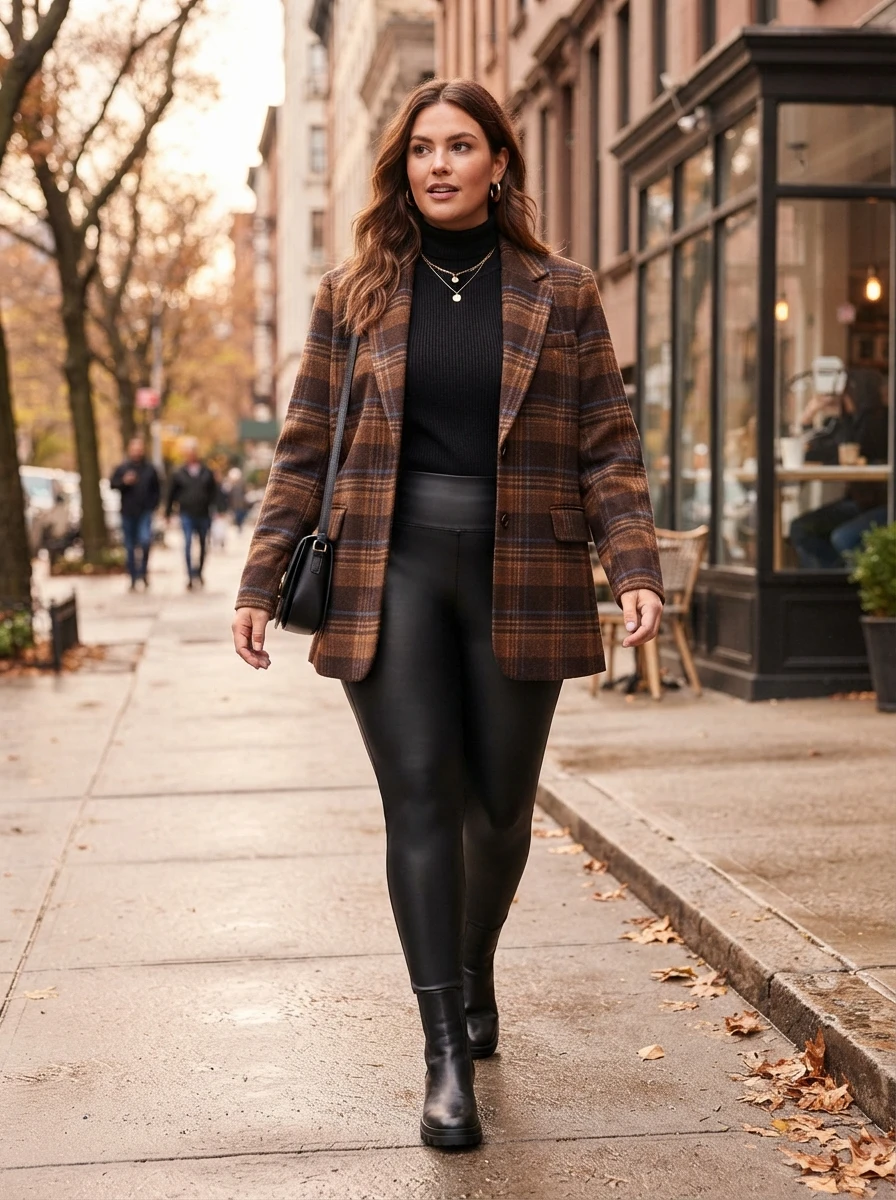 Oversized plaid blazer over matte faux leather leggings: the classic tough meets tailored contrast.
Heavy Knit Cardigan and a Satin Slip Dress
The weight contrast is the whole point: something substantial thrown over something fluid. This is also how you keep summer dresses in rotation through October. The cardigan needs to be genuinely long, hip length or longer, so the slip dress reads as intentional underneath rather than like a layering accident, and ankle boots ground the lightness of the satin.
Fit notes for a curvy frame: pick a slip dress with adjustable straps so the neckline sits where you want it across a fuller bust, and choose a satin with some weight, since tissue-thin rayon collapses under a heavy knit. A cardigan with an open front keeps the neckline visible, which stops the layers from reading as one solid block.
Wear it with: ankle boots and a slim crossbody, so the fluid dress keeps its line under the heavy knit.
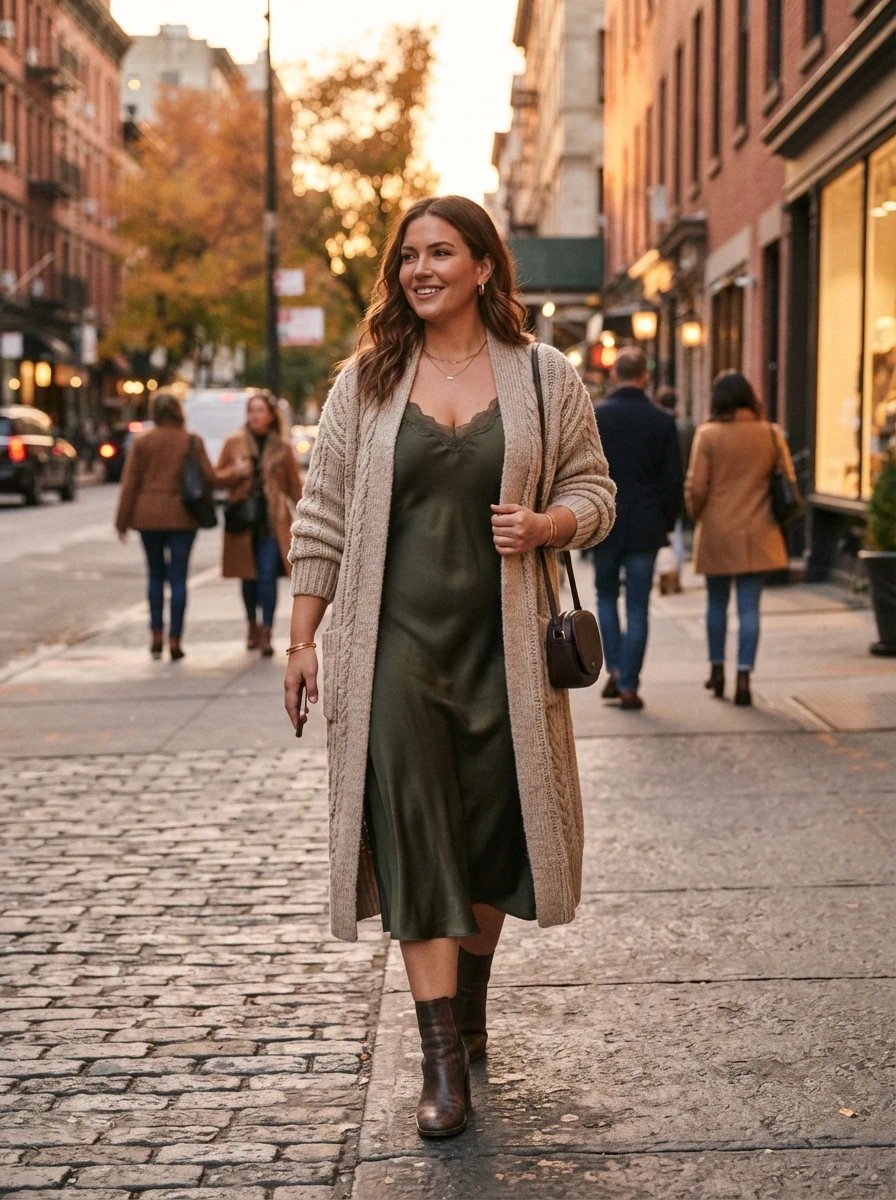 Heavy knit cardigan over a satin slip dress: weight contrast that keeps summer dresses in rotation.
The Softest Silhouette: Chunky Knit and Midi Skirt
Level: Beginner.
A thick cable knit half-tucked into a flowy midi skirt is the softest silhouette in fall dressing. Keep the skirt at mid-calf so it moves when you walk, and finish with ankle boots to balance the volume up top. The technique to get right is the half tuck: it marks your waist without adding bulk at the hip. One comfort note, heavy knits can sit hard on the shoulders, so if you overheat easily, choose cotton blends over pure wool.
A knit in a cotton blend keeps the same softness with less shoulder weight, and a skirt with an elastic waist lets the half tuck sit flat instead of bunching at the front.
Care tip: fold heavy knits instead of hanging them, so the shoulders keep their shape through the season.
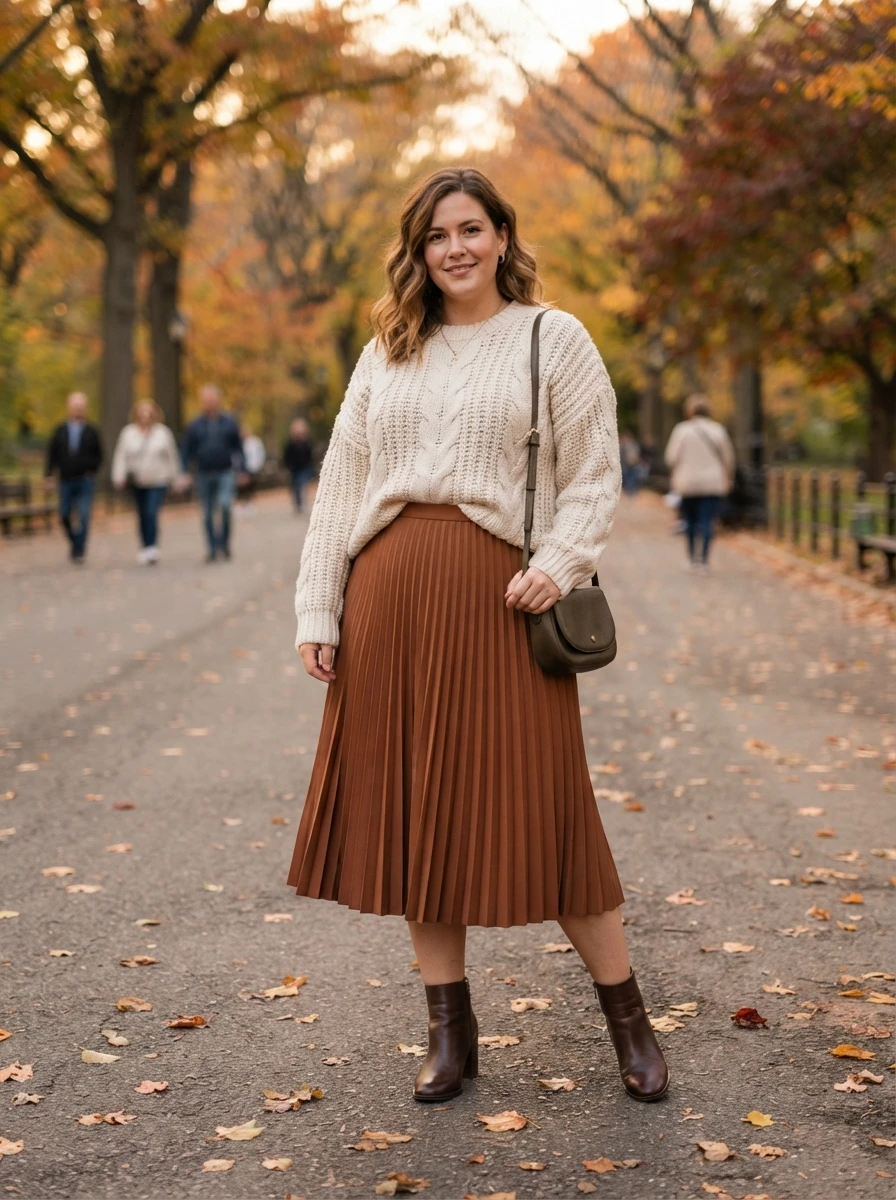 Cable knit half tucked into a midi skirt: mark the waist, let the skirt move.
Denim Jacket Over Maxi Dress
Level: Beginner.
A structured denim jacket over a jersey maxi dress is instant shape: the jacket draws a defined shoulder line while the dress keeps everything below relaxed. Choose a jacket that ends at the hip; longer cuts the torso awkwardly on a curvy frame. Check the armholes before you buy; you need room to layer a long-sleeve top underneath when the temperature drops.
On a curvy frame, a jacket with a little stretch in the denim keeps the shoulders comfortable over that extra layer, and a dress in a fabric with some weight stops the jacket from pulling the skirt out of line.
Fit note: the jacket should close without pulling across the bust, even if you plan to wear it open most of the time.
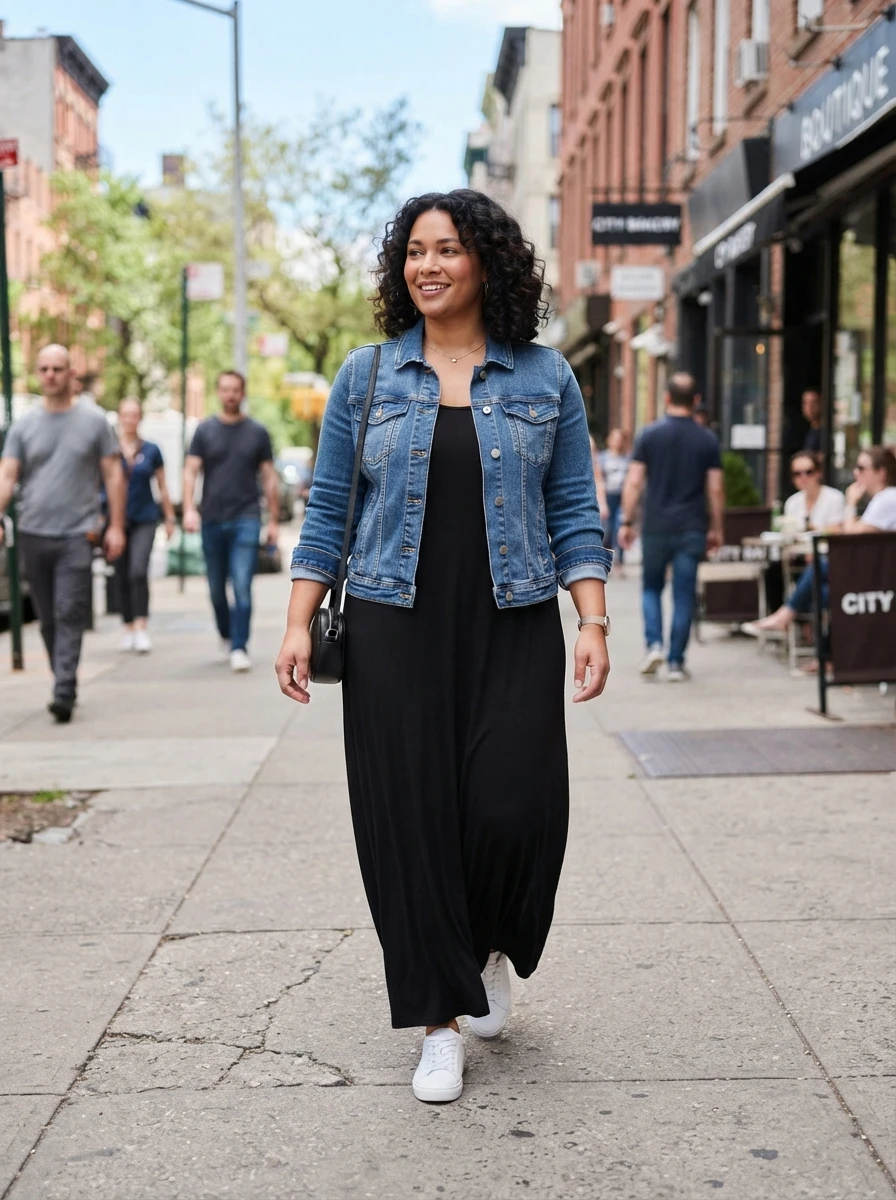 Denim jacket at the hip over a maxi dress: structure on top, ease below.
The Errand-Day Uniform: Oversized Flannel and Leggings
Level: Beginner.
The classic flannel worn open over a fitted tank is fall's most reliable errand uniform. The shirt acts as a lightweight jacket, the tank keeps the base smooth, and high-waisted leggings give full coverage when you are bending into car boots and shopping carts. Flannel pills with washing, so wash it inside out in cold water to preserve the texture.
Look for leggings with a wide waistband that stays put when you bend, since a thin band is the first thing that gives way on an errand day, and keep the flannel open rather than buttoned so it reads as a layer, not a shirt that pulls across the bust.
Care tip: wash flannel inside out in cold water and skip the dryer when you can; heat is what roughens the nap and speeds up pilling.
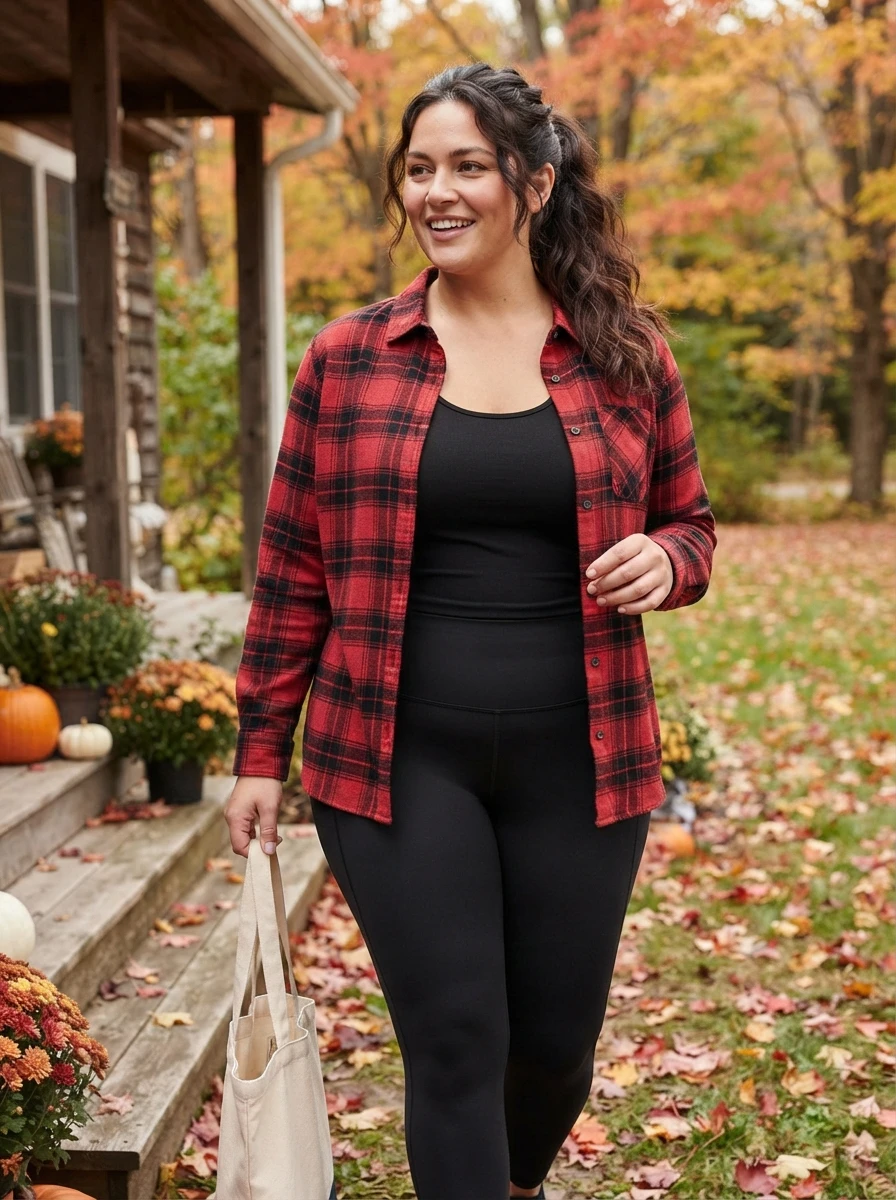 Open flannel over a fitted tank and leggings: the errand day uniform.
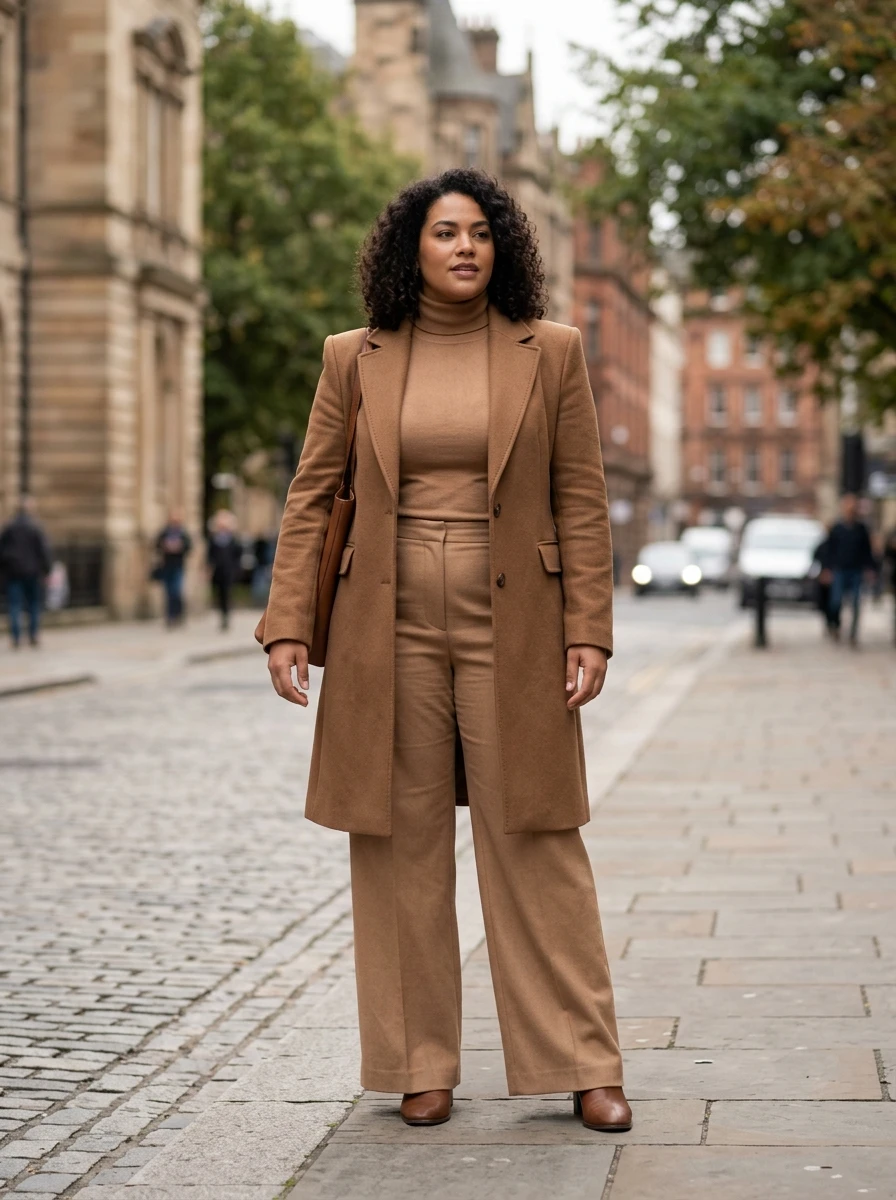
Turtleneck and Wide Leg Trousers
Level: Beginner.
A fitted turtleneck tucked into high-rise wide leg trousers draws one clean vertical line, close to foolproof for business casual. The trousers need enough stretch to clear your hips without the pockets pulling. If turtlenecks feel restrictive, look for modal or rayon blends; the breathability makes the difference between wearing it all day and peeling it off by noon.
A turtleneck in a modal blend breathes better than pure wool, and a trouser with a flat-front waistband keeps the tucked line smooth across the belly instead of adding a ridge under the knit.
Wear it with: pointed-toe flats or a low block heel, which extend the trouser line instead of cutting it off at the ankle.
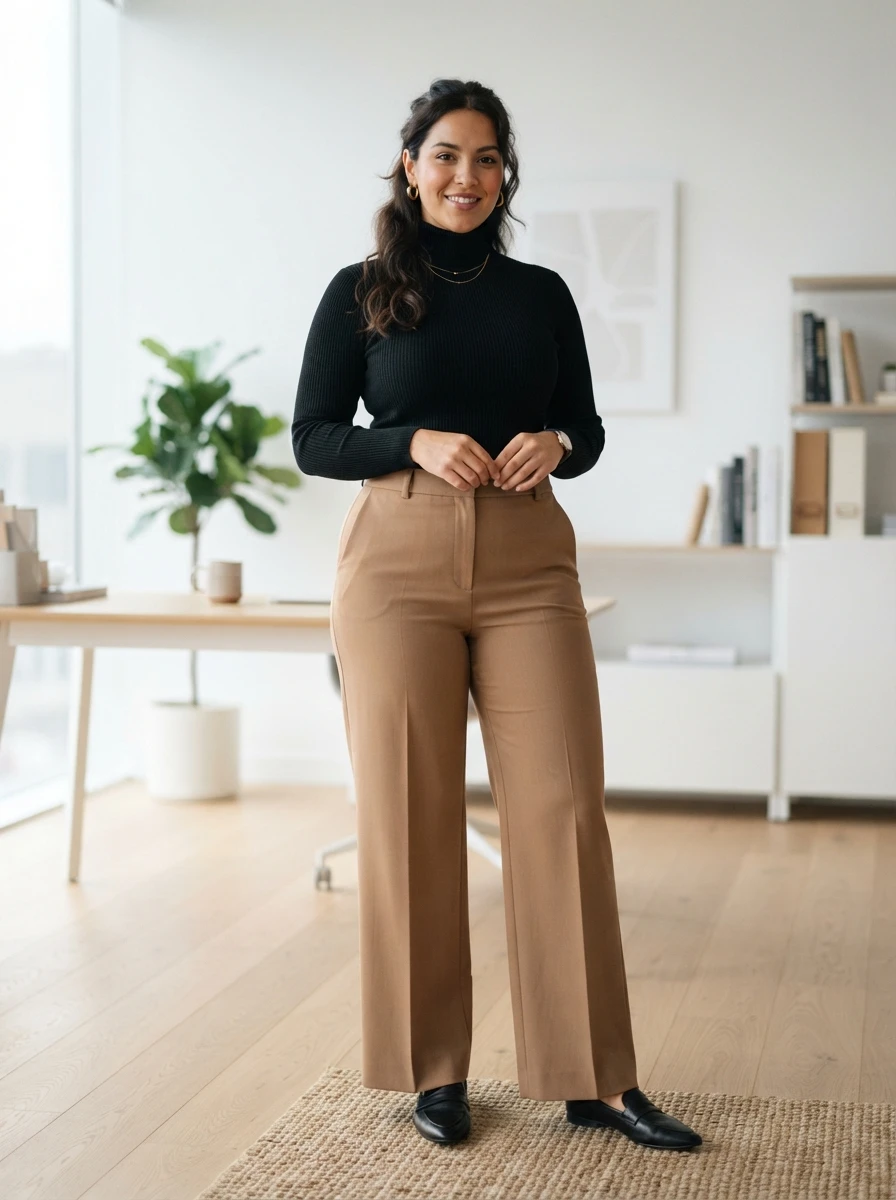 Fitted turtleneck plus wide leg trousers: one clean vertical line.
Leather Moto Jacket and Pencil Skirt
Level: Intermediate.
A cropped leather jacket over a pencil skirt works on a curvy frame when the jacket ends exactly at your natural waist, not at the hip and not above the bust. That endpoint marks the narrowest part of your torso and lets the skirt skim below. Check two fit points before you buy: the zip or buttons must close without gaping across a fuller bust, and the armholes need room for a long-sleeve top underneath.
Vegan leather is often lighter and less stiff than real leather, so it drapes over curves instead of standing away from them. Store it on a wide hanger so the shoulders do not collapse in the off season. A pencil skirt with a back vent and a little stretch lets you walk and sit without the fabric pulling across the hips.
Fabric note: vegan leather softens with wear but stiffens in the cold, so let the jacket warm up indoors for a few minutes before you head out.
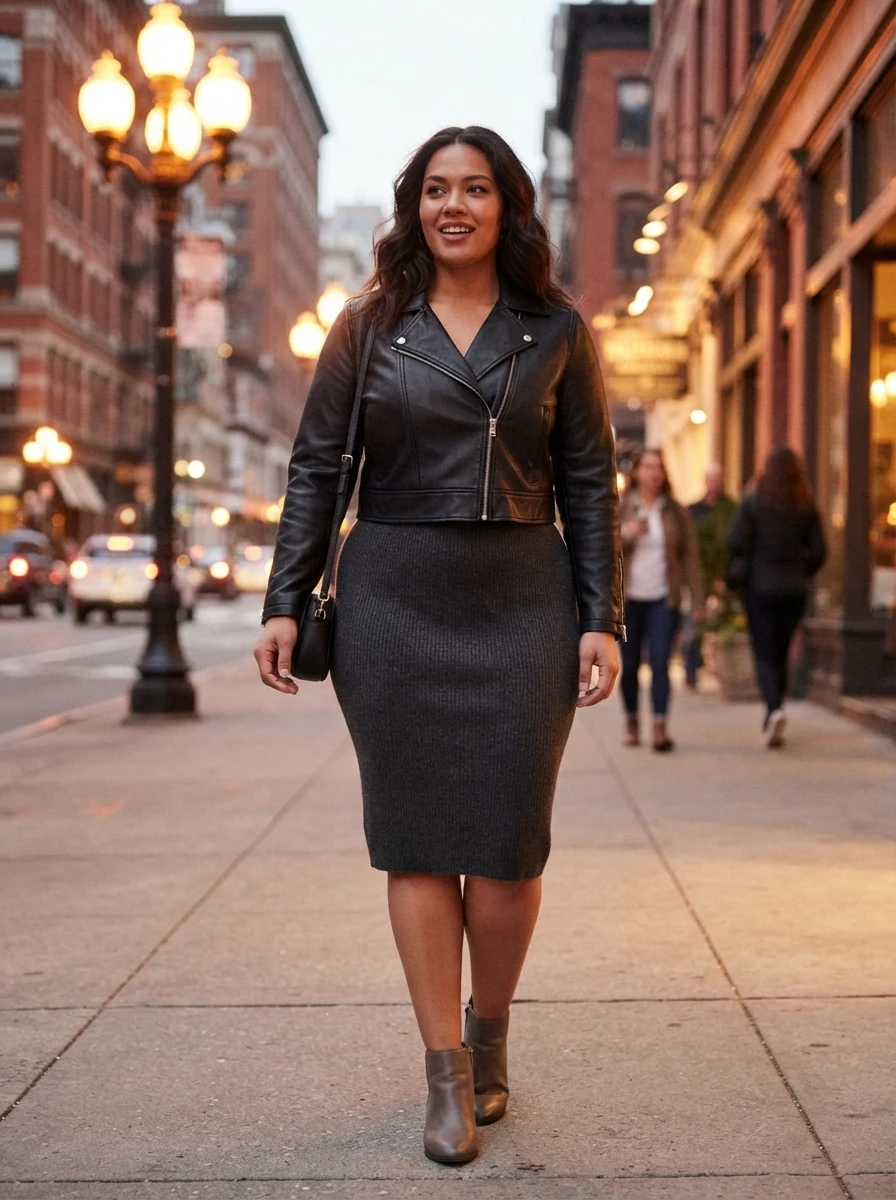 Cropped moto over a pencil skirt: structure meets softness for evenings.
Utility Jacket and Midi Dress
Level: Beginner.
A utility jacket over a midi dress works on a curvy frame when the drawstring sits at your natural waist, above the belly, and not at the hip where it would add bulk. Pull the drawstring in over the dress to mark your shape, and size the jacket for your shoulders rather than your waist, since the drawstring does the shaping work. Heavy utility fabrics can run stiff, so look for cotton blends that let your arms move freely.
Check the pocket placement too: patch pockets that sit at the hip add width exactly where you do not want it, while chest pockets keep the line clean. Sizing down for the waist only pulls the shoulders tight, so let the drawstring, not a smaller size, create the shape.
Fit note: buy the jacket for your shoulders and let the drawstring do the waist work; a jacket that fits the shoulders can always be cinched, but a tight shoulder cannot be fixed.
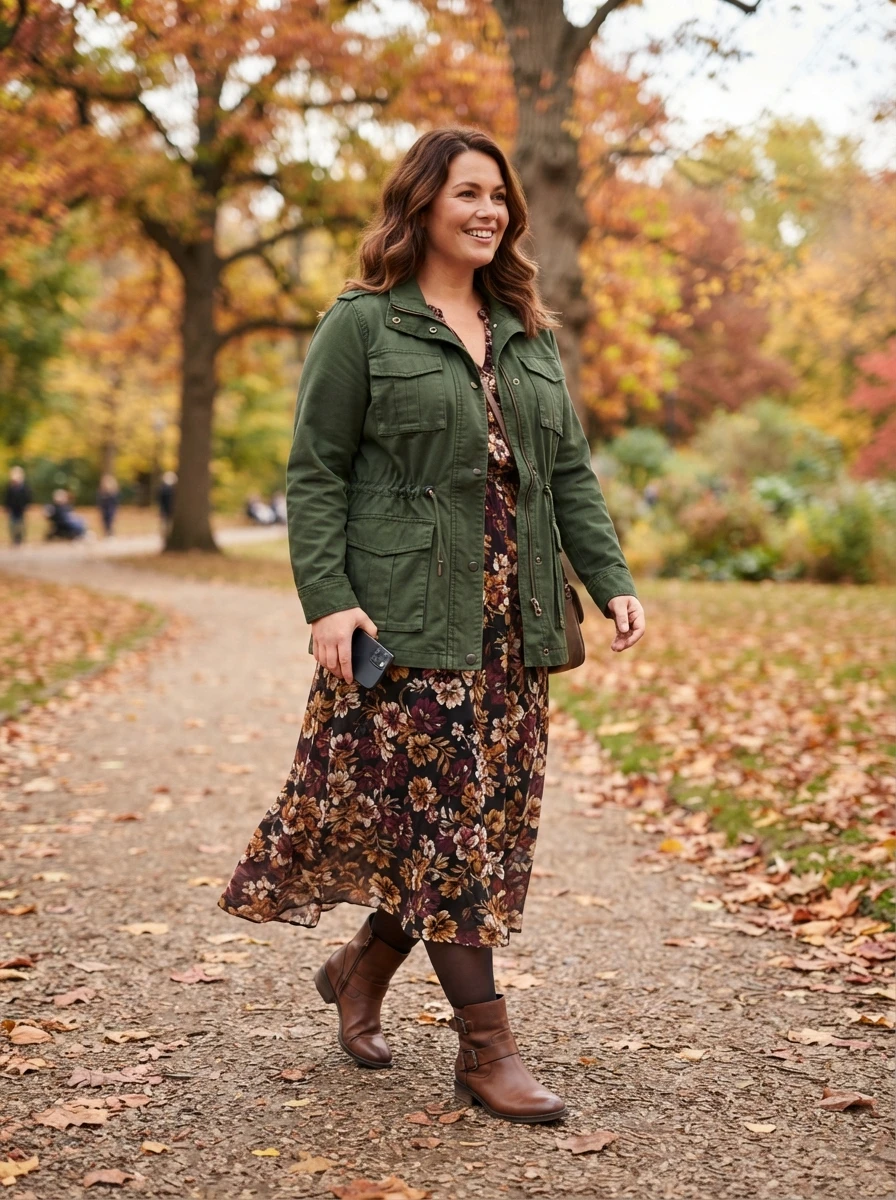 Utility jacket over a midi dress: structure, drape, and real pockets.
The Weekend Uniform: Oversized Hoodie and Leggings
Level: Beginner.
The ultimate weekend uniform: an oversized hoodie with a drop shoulder over high-quality leggings, finished with chunky sneakers so it reads intentional rather than just for the house. The drop shoulder is what keeps the fit relaxed instead of sloppy. Wash the leggings inside out, they pill against other laundry, and the smooth finish is what makes this look work.
A hoodie that ends at the hip keeps the proportions clean; one that ends mid-thigh shortens the leg line. Choose leggings with a wide waistband and a matte finish, since shine and a rolling band are what turn this outfit from intentional to loungewear.
Care tip: wash leggings inside out in cold water and air-dry them; heat breaks down the stretch that keeps the waistband sitting flat.
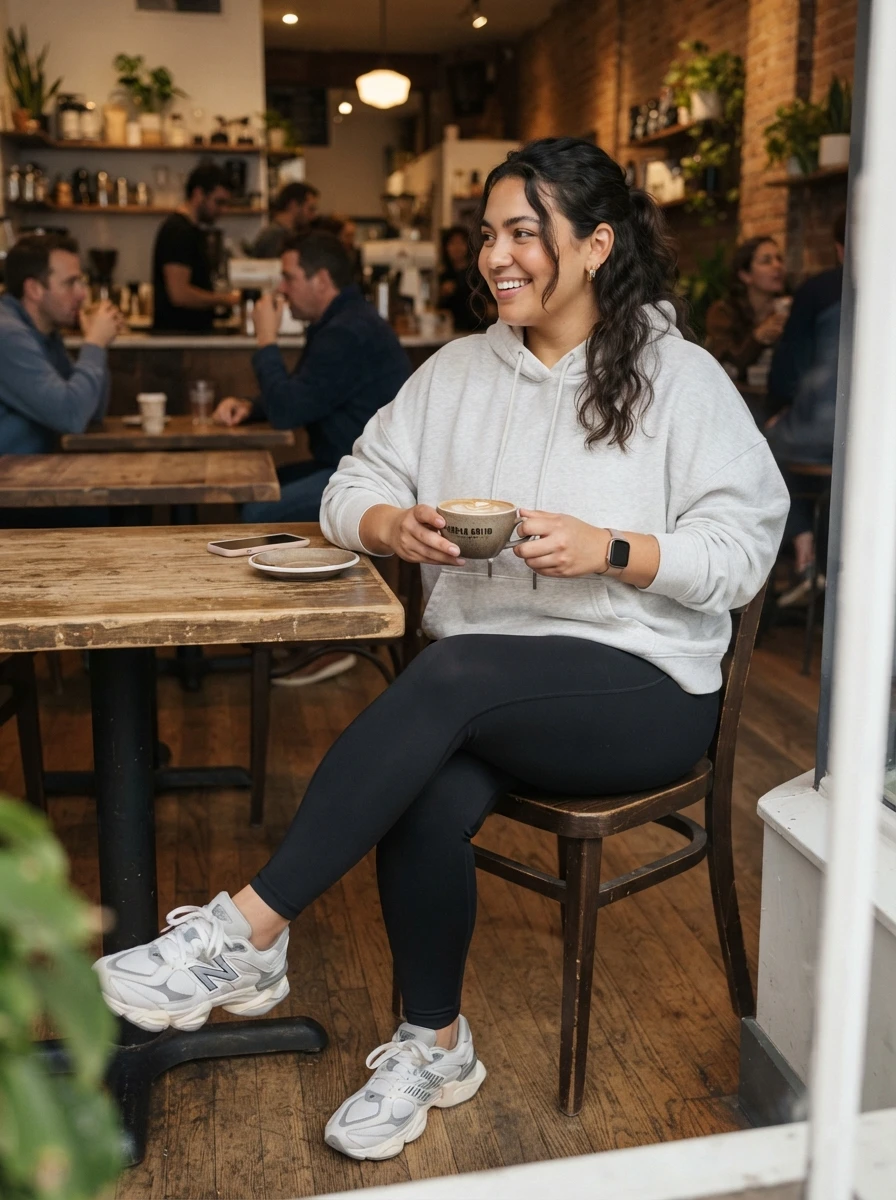 Drop shoulder hoodie, leggings, chunky sneakers: the intentional weekend uniform.
Blazer and Graphic Tee
Level: Intermediate.
A structured blazer over a graphic tee and dark jeans turns an errand outfit into something dinner-ready on a curvy frame, and the fit rules are specific. First, the shoulder seam must sit at your actual shoulder, not past it. Second, a single-button blazer must close without gaping across a fuller bust; if it pulls, size up and have the waist taken in, because a tailor can fix the waist but cannot add fabric across a pulling bust.
Third, keep the graphic tee print in scale with your frame: a small chest print gets lost, while a larger print reads intentional. Thrift stores are gold for this, since vintage blazers often have better construction than new fast-fashion ones.
Wear it with: dark-wash jeans and clean white sneakers for daytime, then swap the sneakers for ankle boots when the evening calls for it.
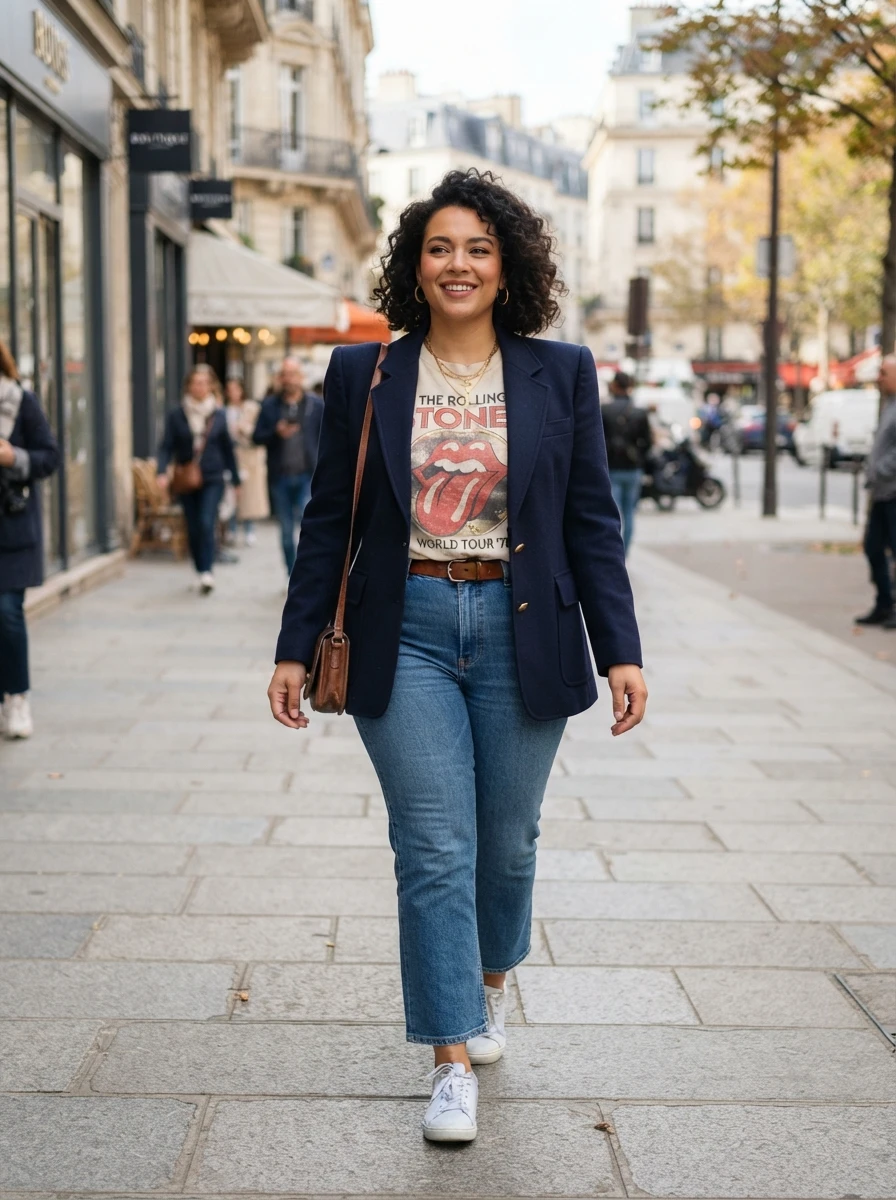 Blazer over a graphic tee: fit the shoulders, tailor the rest.
Poncho and Skinny Jeans
Level: Beginner.
A poncho gives you blanket-level warmth with a deliberate look, but only when the bottom half goes narrow. Skinny jeans balance the volume on top, and showing the neckline keeps it from reading as a blanket. One practical note: ponchos and shoulder bags fight, so switch to a crossbody on poncho days.
A poncho with a V-neck or a cowl opening keeps the neckline visible, which is what stops the volume from reading as a blanket, and a jean with a high rise keeps the waistband from digging when you sit in all that extra fabric.
Fit note: if the poncho has no neckline opening, fold the front edge down once to create one; a visible neckline is what separates a styled poncho from a blanket.
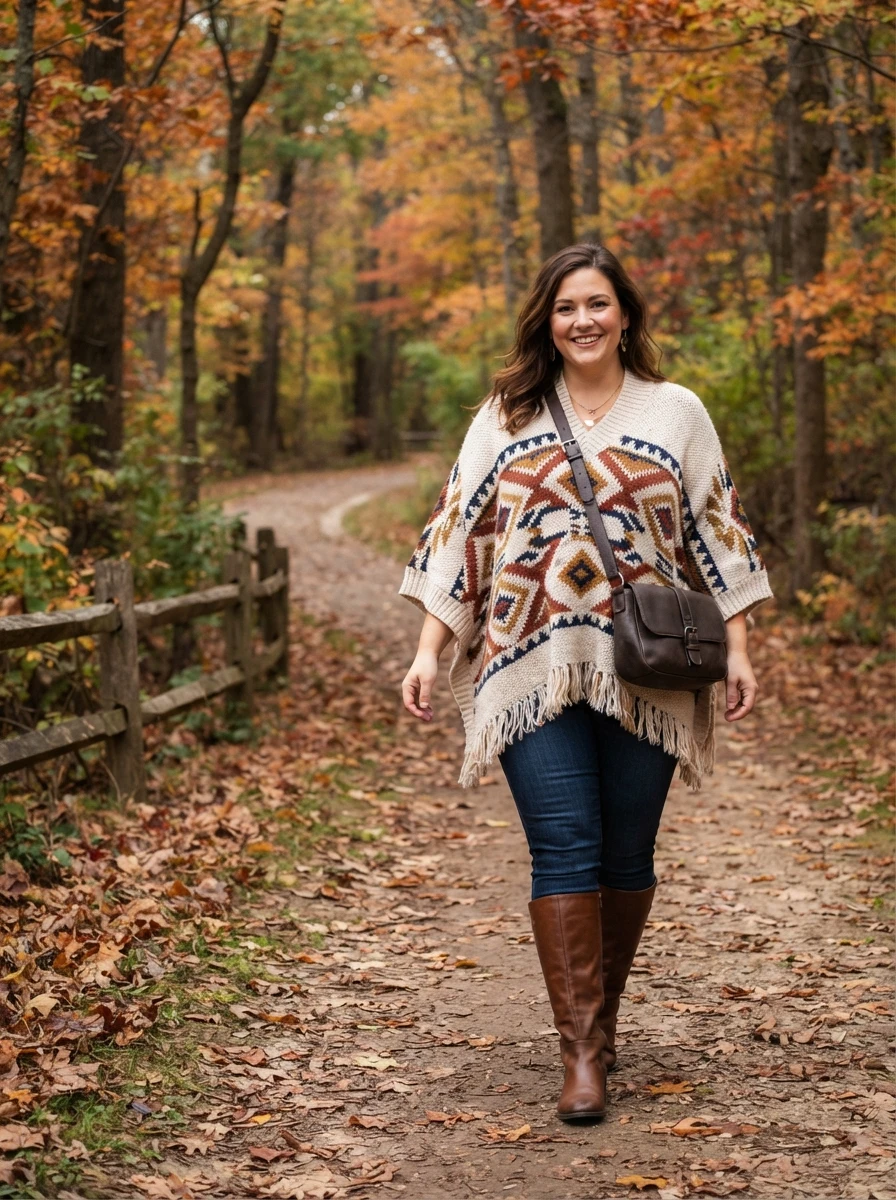 Poncho over skinny jeans: one volume on top, narrow below.
Sweater Dress and Tall Boots
Level: Beginner.
The one-and-done award: a midi sweater dress with tall boots is the lowest-effort way to look deliberately dressed on a cold morning. Choose a dense knit that holds its shape; thin knits sag at the seat and elbows by lunch. If wool irritates your skin, a soft acrylic or cotton blend gives you the same silhouette without the itch.
Tall boots that fit your calves matter more than the dress: if the shaft pinches, the whole outfit feels wrong by noon. A dress with a defined waist, either built into the knit or added with a slim belt, keeps the straight silhouette from reading as a sack on a curvy frame.
Fabric note: a dense, tightly knitted sweater dress holds its shape through a full day of sitting, while a loose, thin knit sags at the seat and elbows by lunchtime.
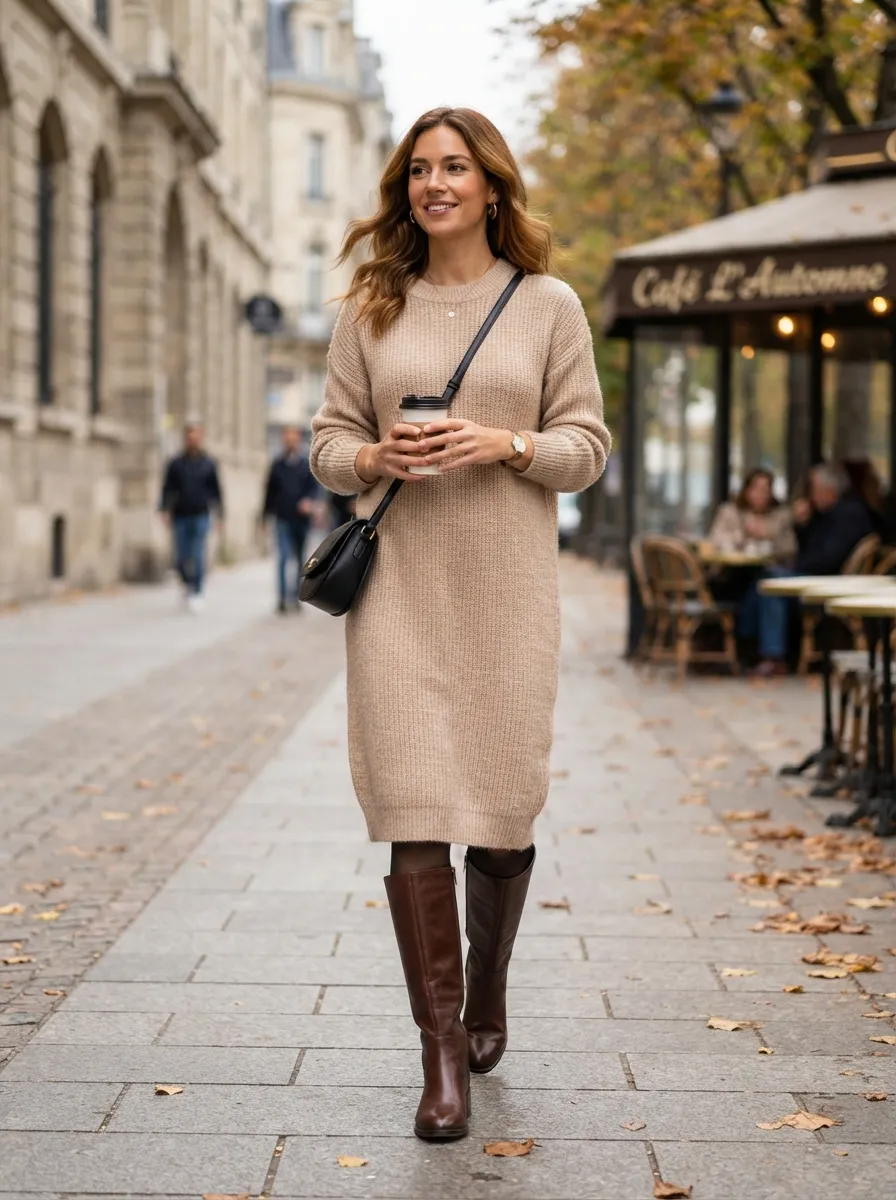 Midi sweater dress and tall boots: one decision, fully dressed.
Trench Coat and Wide Leg Jeans
Level: Intermediate.
A classic trench refines even jeans and a tee: belted to define the waist, worn open for two long vertical panels that lengthen the torso. Wide-leg jeans balance the coat's length below. Two fit notes: below mid-calf overwhelms a petite frame (aim for just below the knee), and trenches wrinkle, so hang yours immediately after wearing.
On a curvy frame, belt the trench at your natural waist rather than at the hip, since a low belt cuts the torso in the wrong place, and choose jeans with a high rise so the waistband stays hidden and flat under the coat.
Wear it with: a simple tee and clean sneakers for daytime, or a fitted knit when the temperature drops in the evening.
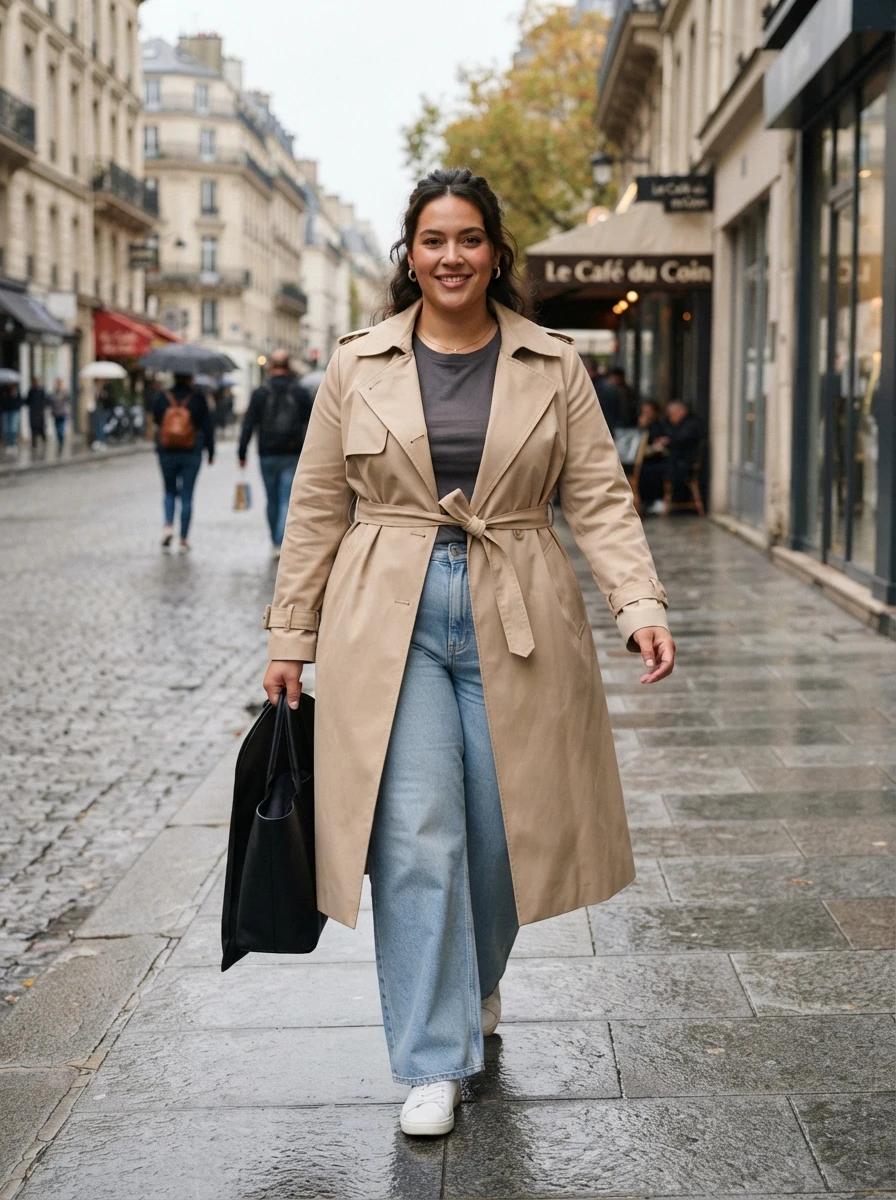 Belted trench over wide leg jeans: two silhouettes from one coat.
Denim Skirt and Chunky Sweater
Level: Beginner.
A button-front denim skirt with a chunky half-tucked sweater is the playful mild-day option: the denim's texture against the knit's softness, with the vertical button line quietly working for your proportions. Make sure the skirt has enough stretch to sit comfortably at the waist when you sit, and add opaque tights when the temperature drops.
On a curvy frame, a skirt that ends just above the knee keeps the leg line long without riding up when you walk, and a sweater that ends at the hip keeps the half tuck from adding bulk at the waistband.
Fit note: the button line down the front is a vertical seam the eye follows downward, so keep the buttons fastened all the way; an open gap at the hem breaks the line.
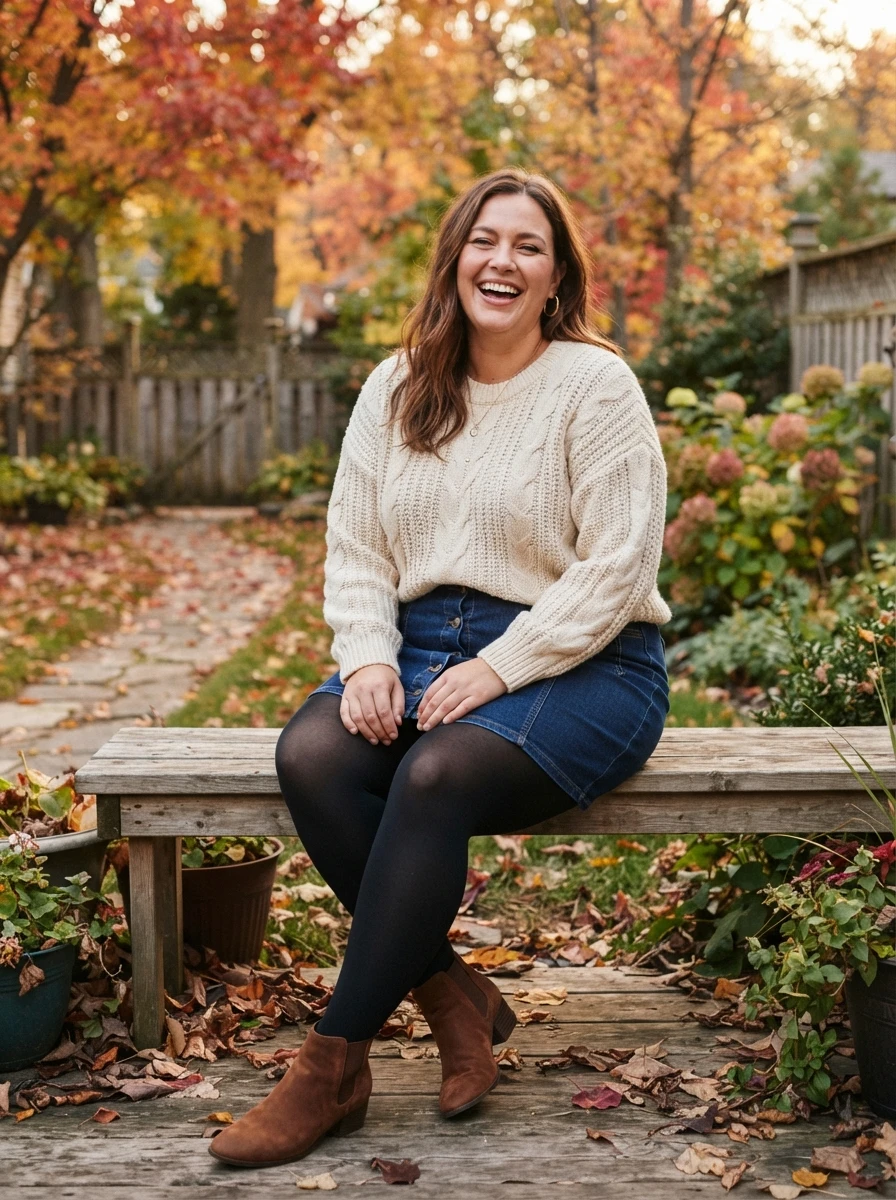 Button front denim skirt, half tucked chunky sweater: texture plus vertical line.
Bomber Jacket and Joggers
Level: Intermediate.
A bomber over Ponte joggers hits the sporty modern note without looking like loungewear, and Ponte is the key word, because its structure is what separates public joggers from pyjamas. Watch the bomber's elastic hem: if it grips at the hip, size up and let the jacket sit relaxed. The same joggers with a soft unlined knit blazer pass for a casual Friday.
Ponte joggers with a smooth front and a drawstring waist hold their shape all day, while a thin jersey pair bags at the knee by evening. On a curvy frame, a bomber that ends at the waist keeps the proportions clean instead of cutting across the hip.
Fabric note: Ponte is a double-knit with real structure, which is why it holds a crease and a silhouette; thin jersey has no structure at all, which is why it bags out by evening.
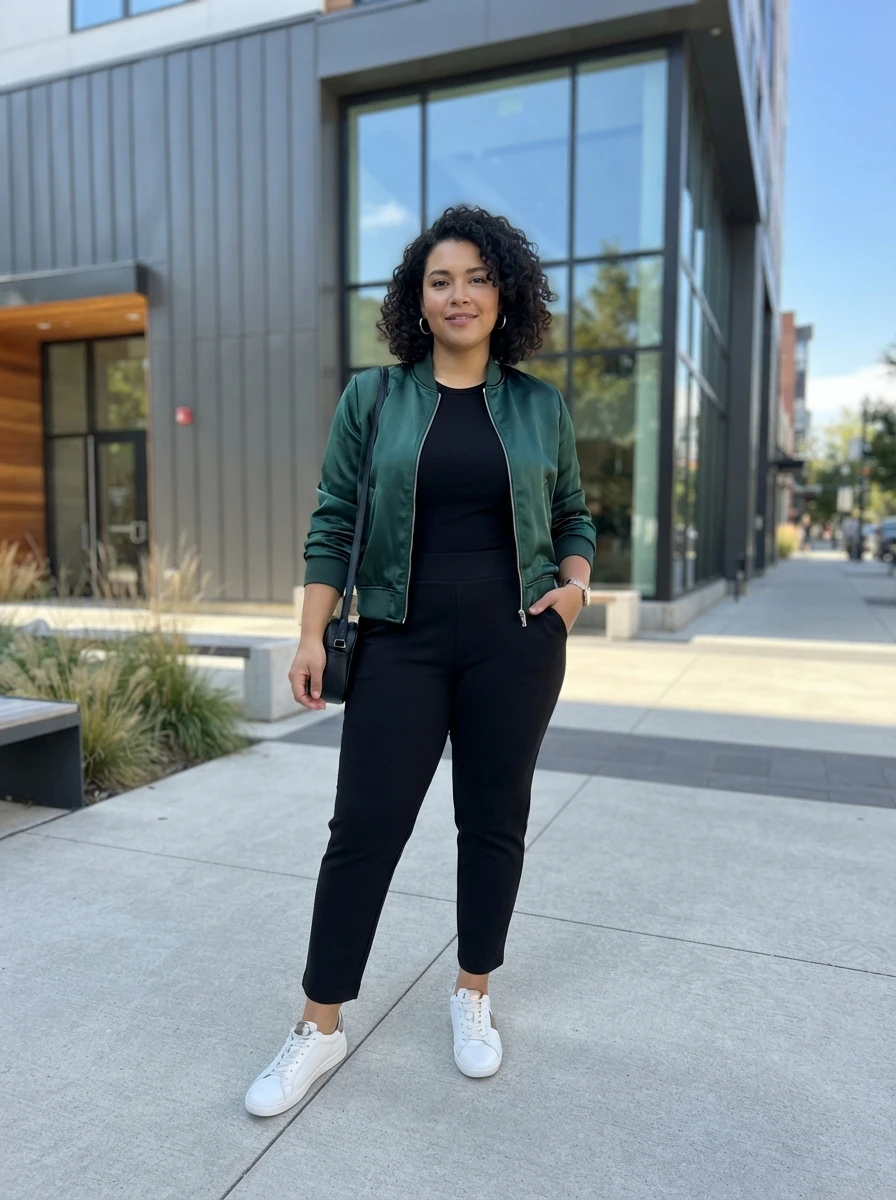 Bomber over Ponte joggers: sporty, structured, not pyjamas.
Peacoat and Corduroy Pants
Level: Intermediate.
A peacoat over corduroy pants in rust or mustard is fall texture at its most classic: the cords' ribbed nap adds depth that flat fabrics cannot. Two things to know: the double-breasted cut adds visual width across the chest, so fuller-busted frames may prefer a single-breasted front; and brush corduroy gently after washing to keep the wales from flattening.
A single-breasted coat gives fuller-busted frames the same warmth with a smoother line across the chest, and corduroy trousers with a little stretch keep the ribbed nap from pulling tight when you sit.
Care tip: brush corduroy gently with a soft clothes brush after washing, and store it folded rather than hung, so the wales keep their ridge instead of flattening under their own weight.
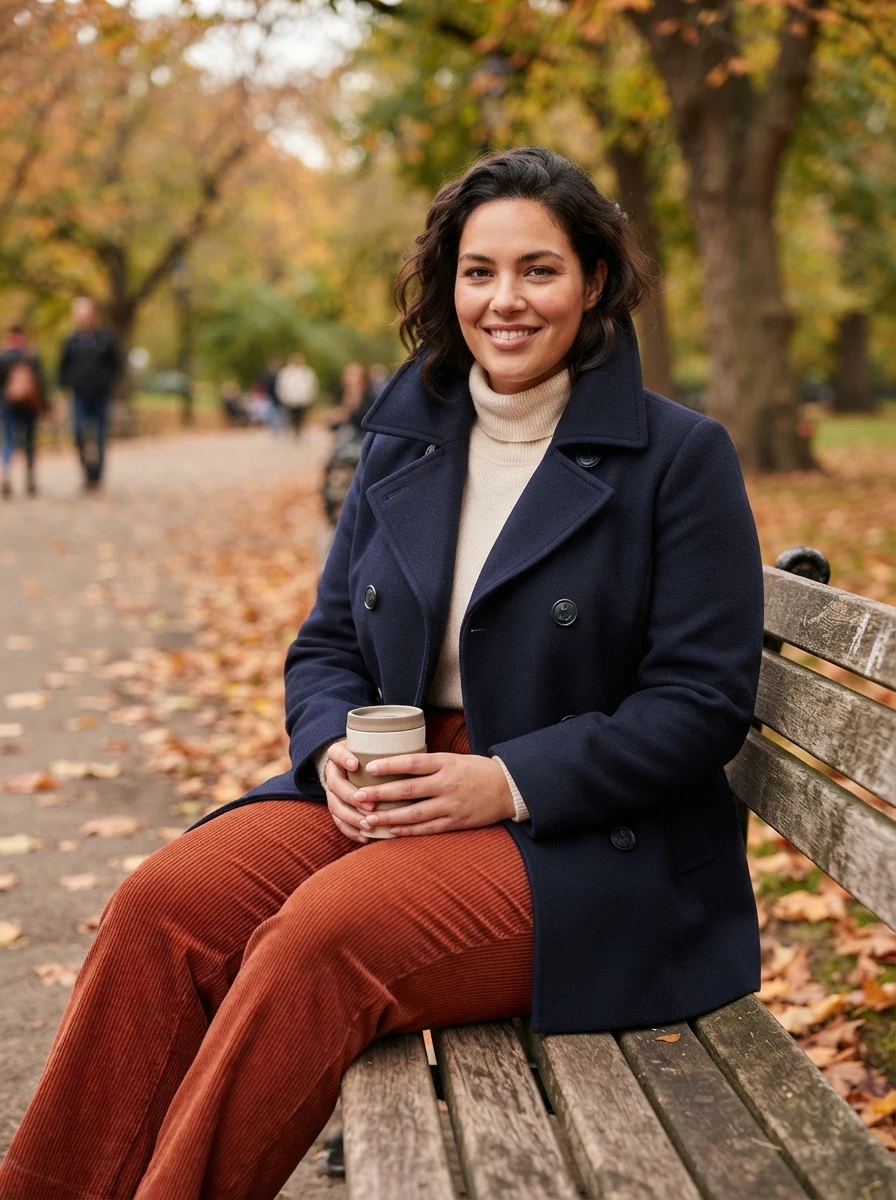 Peacoat over rust cords: nautical structure meets fall texture.
Long Cardigan and Slip Dress
Level: Beginner.
A long open cardigan over a satin slip dress is how summer dresses survive October: heavy knit against fluid fabric, grounded by ankle boots. The cardigan needs to be genuinely long (hip length or more) so the dress reads as intentional underneath, not a layering accident. Check the slip's fabric has some weight; tissue-thin rayon gets overwhelmed by the layers on top.
Choose a slip dress in a fabric with some weight so the knit does not overwhelm it, and let the cardigan fall open so the satin shows as a vertical line down the middle. On a curvy frame, adjustable straps keep the neckline where you want it, and a cardigan with deep pockets earns its place on the days you skip a bag.
Wear it with: ankle boots and a slim belt at the waist if you want the open cardigan to read as a defined silhouette rather than a loose layer.
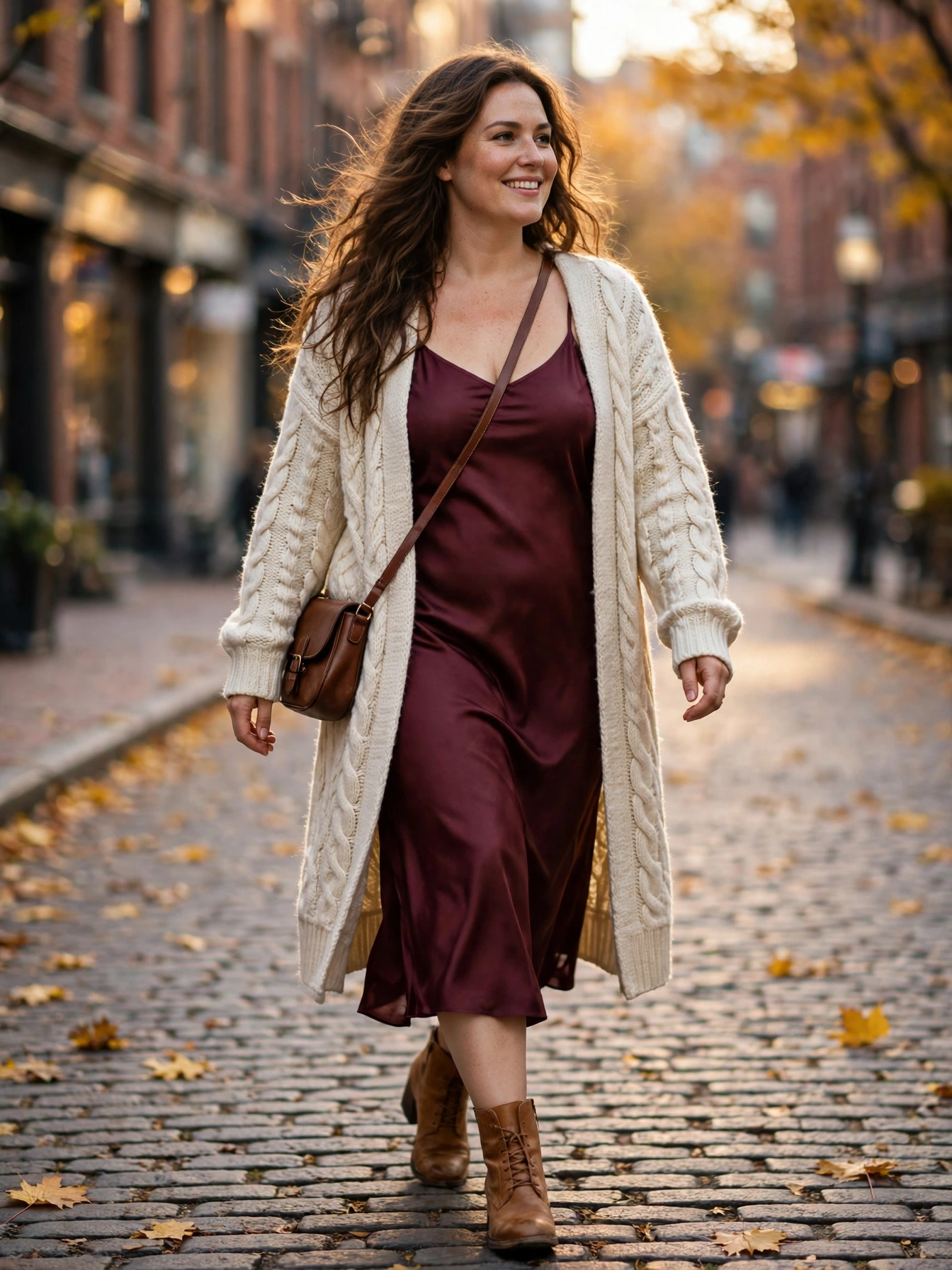 Long cream cardigan over a burgundy slip dress: weight contrast that extends summer into fall.
Common Questions About Curvy Fall Style
What is the easiest plus size fall outfit for a curvy frame?
The sweater dress with tall boots. It is one piece, one decision, and the only fit checks are the knit density and the boot shaft. Pick a dense knit that holds its shape, add a slim belt if the silhouette needs a waist, and choose boots that fit your calves without pinching. If you want a second easy option, the long cardigan over a slip dress uses the same one-and-done logic with a layer you already own.
How do I stop a cardigan from pulling across my bust?
Start with the button or closure placement. A cardigan that fastens at the bust will always pull there; an open-front cardigan, or one that fastens below the bust, sidesteps the problem entirely. Size for your bust and shoulders rather than your waist, and let the open front fall in two vertical panels. If a favorite cardigan already gaps, a small snap or a strip of fashion tape at the pull point holds it flat without changing the fit anywhere else.
How do I layer without looking bulky?
Put the thinnest fabrics closest to your body and the bulkiest piece on the outside. A fitted modal tank or long-sleeve tee as a base, a mid-weight knit or shirt in the middle, and the coat, vest, or heavy cardigan outermost keeps volume away from your frame. The one-volume rule from the proportion section does most of the work: if you are already wearing a chunky knit, the layer over it should be open and unstructured, a duster cardigan or an unbelted coat, rather than a second fitted, bulky piece fighting for the same space. MasterClass has a clear guide to layering clothes that covers the same thin-to-thick order.
Which fall fabrics actually flatter a curvy figure?
Fabrics that skim: dense knits, stable jersey, corduroy with a little stretch, Ponte, and satin with real weight. The common thread is structure without stiffness. A tight, dense knit holds its shape through a day of sitting and standing, while a loose, thin knit sags by lunch. Corduroy's ribbed nap adds depth without bulk, and a satin with weight drapes instead of collapsing. Avoid tissue-thin rayon under heavy layers and shiny faux leather in daylight; both create the problems the rest of the outfit is trying to solve.
Can curvy women wear oversized pieces?
Yes, anchored. An oversized top works when the bottom is narrow and something marks your shape: a half tuck, a belt at the waist, pushed-up sleeves showing the wrist, or an ankle showing below a cropped hem. What makes oversized look sloppy is not the size but the absence of any reference point for where your body is. A poncho over skinny jeans with the neckline showing reads as deliberate; the same poncho over wide trousers with no waist definition reads as a blanket.
Can I wear cream or white after September?
Yes, paired with fall textures. A cream cable knit with dark-wash denim, a tan trench over a rust dress, or an ivory turtleneck tucked into chocolate corduroy all read as seasonal, because the texture does the seasonal work. The old rule was about fabric weight, not color: thin white linen in October looks leftover, but a heavy cream knit looks like fall. Keep the light shade in one piece and ground the rest of the outfit in warm, earthy tones.
What should I look for in fall jeans and trousers?
Rise first, everything else second. A high or very high rise that sits above the fullest part of the belly prevents the two classic failures: digging in front and gaping behind. Look for 1, 3% elastane in denim and a touch of stretch in corduroy and twill, enough for movement, not so much that the fabric bags out by evening. Always do the sit test in the fitting room, check that back pockets lie flat, and remember that a dark wash is the hardest-working option because it pairs with every texture and color in this guide.
Your October Checklist
Before you buy anything new, run through this list with the closet you already have:
- Sit test every pair of jeans and trousers: waistband flat at the front, no gap at the back, pockets lying flat.
- Check each knit for density: hold it up and stretch it gently; a dense knit springs back, a thin one sags.
- Find one structured outer layer that fits in the shoulders: a trench, a blazer, or a moto jacket.
- Pull out one summer dress and try it under a long cardigan with ankle boots; if the fabric has weight, it survives October.
- Match one texture pair from the guide: ribbed knit with corduroy, heavy knit with a fluid skirt, matte legging with a brushed blazer.
- Pick one warm color that suits you, rust, olive, camel, or mustard, and build one outfit around it.
- Check your boots: tall boots should fit the calf without pinching, ankle boots should sit cleanly under a midi hem.
Tick off what you own, fill only the gaps, and let the fit logic do the rest. A fall wardrobe that negotiates honestly with your body does not need to be big; it needs a high rise that sits right, a knit dense enough to hold its shape, a coat that fits in the shoulders, and a boot that fits the calf. Get those four things right and the nineteen outfits above stop being a list to follow and start being variations on a system you already understand.