Chic Plus Size Winter Outfits for a Flattering Look
How to use this guide
These are editorial styling suggestions, not a one-size-fits-all formula. Adapt each look to your wardrobe, proportions, climate, comfort, budget, and the occasion; the most useful idea is the one you can genuinely wear.
What happens on a freezing morning when the outfit is warm enough but the mirror shows a shapeless rectangle? That is the real problem with winter dressing on a plus-size frame, and it has nothing to do with the cold itself. Every coat, sweater, and scarf adds a layer of volume, and somewhere between the thermal base and the third knit, the person underneath the clothes disappears.
The answer isn't fewer layers. It's better decisions about silhouette: which pieces add structure, where fabric should skim instead of cinch, and how proportion tricks — a defined shoulder, a continuous hem-to-boot line, a belted waist — keep you looking like yourself under all that warmth. Below are 26 outfit formulas, grouped by the styling logic that makes each one work, with fit notes specific to curvy bodies so you can build them from pieces you already own.
Why Winter Is Harder to Dress on a Curvy Frame
Cold-weather outfits go wrong in predictable ways, and almost all of them come down to volume without architecture. Three heavy pieces stacked with no waist, shoulder, or ankle definition will read as one big rectangle no matter how nice the individual items are. The fix is a set of repeatable principles rather than a shopping list.
Pair volume with structure. One oversized or chunky piece looks intentional when the piece next to it is fitted — a tunic-length turtleneck over slim, opaque leggings; a cocoon coat over a clean, tucked-in base. Two voluminous pieces need a mediator: a belt, a defined shoulder, or a heel that breaks the visual weight.
Let fabric skim, not cling. This is the single most useful fit rule for winter knits. A sweater that stretches across the bust or hips creates horizontal tension lines and makes the knit look too small; a knit cut with enough ease to drape past the widest point looks relaxed and deliberate. When shopping, check the shoulder seam — if it sits past your natural shoulder and the body falls straight, you have drape. If it pulls, size up or pick a different cut rather than forcing it.
Put insulation where it can't be seen. Thin heat-trapping base layers — merino thermals, fleece-lined tights, silk camisoles under blouses — do the heavy lifting of warmth without changing your silhouette. The outer layers then only need to look right, not to keep you alive. This is how people wear dresses in February and don't regret it.
Watch the rise and the hem. High-rise bottoms anchor a tucked-in top and define the waist without a belt. Skirt and dress hems that meet the top of a boot create one unbroken line from hip to floor, which elongates everything. And a coat that ends at the knee or mid-thigh is the safest length on most plus-size frames — long enough to cover the hips, short enough not to swallow you.
The Coat Makes the Look
In winter, your coat is your outfit for most of the day. Get this decision right and everything underneath matters less.
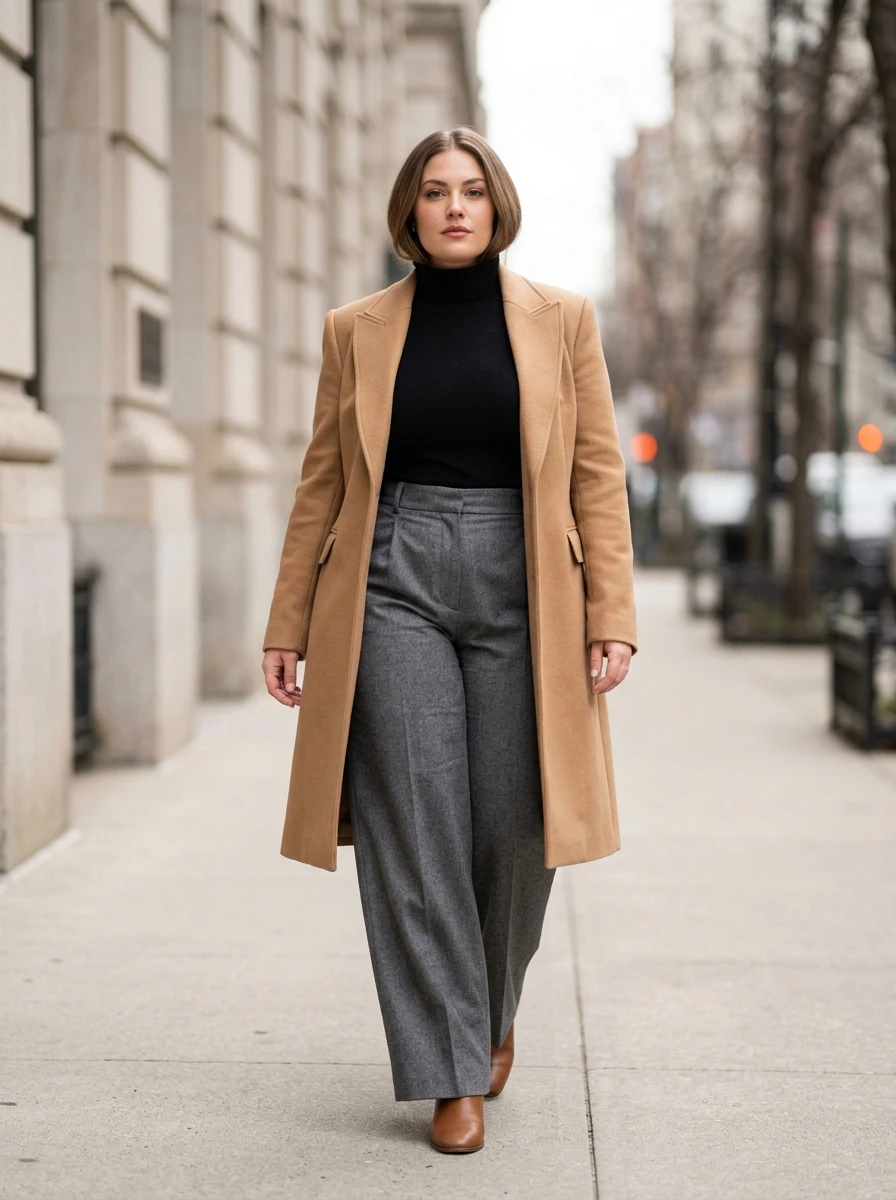
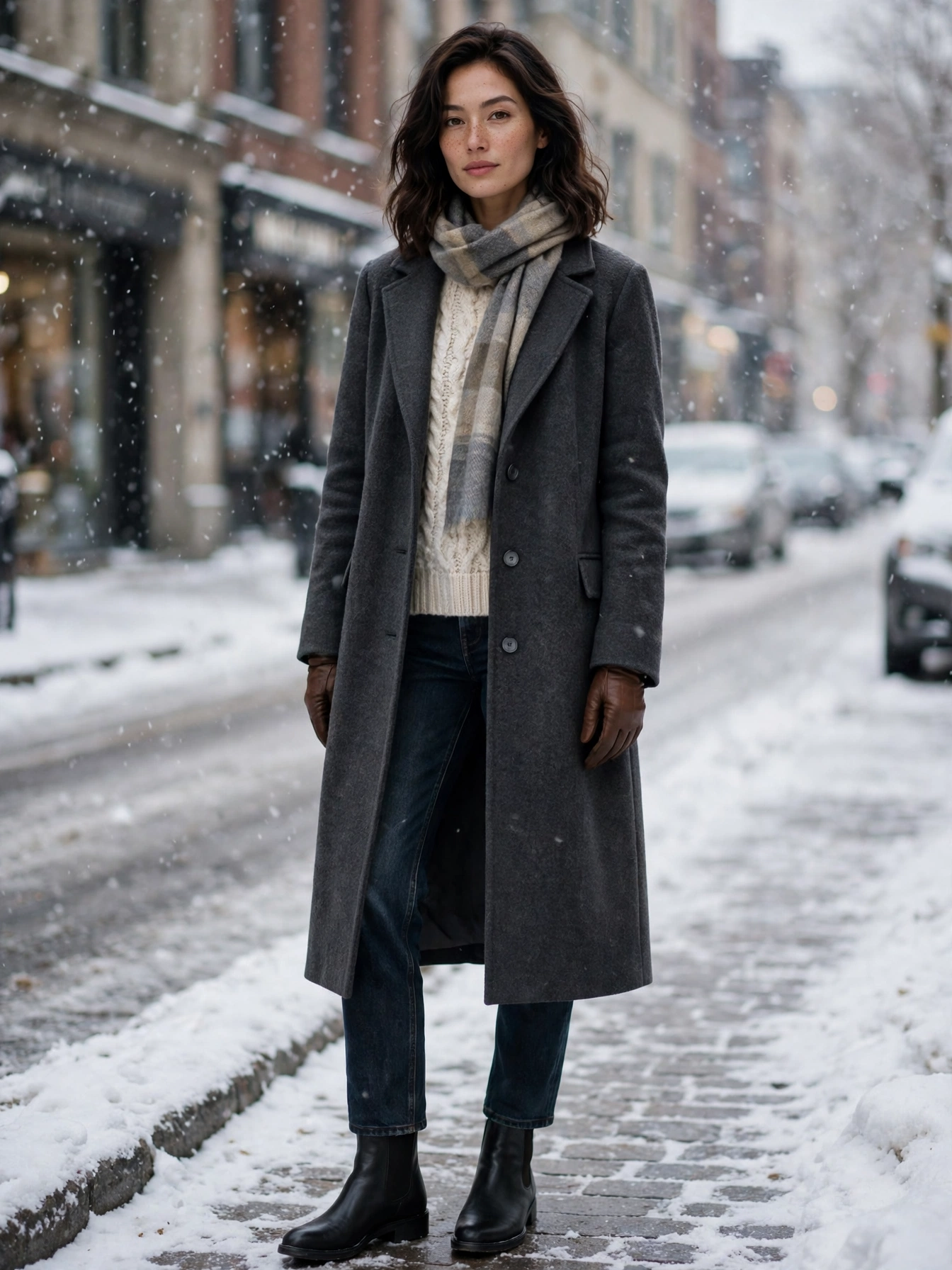
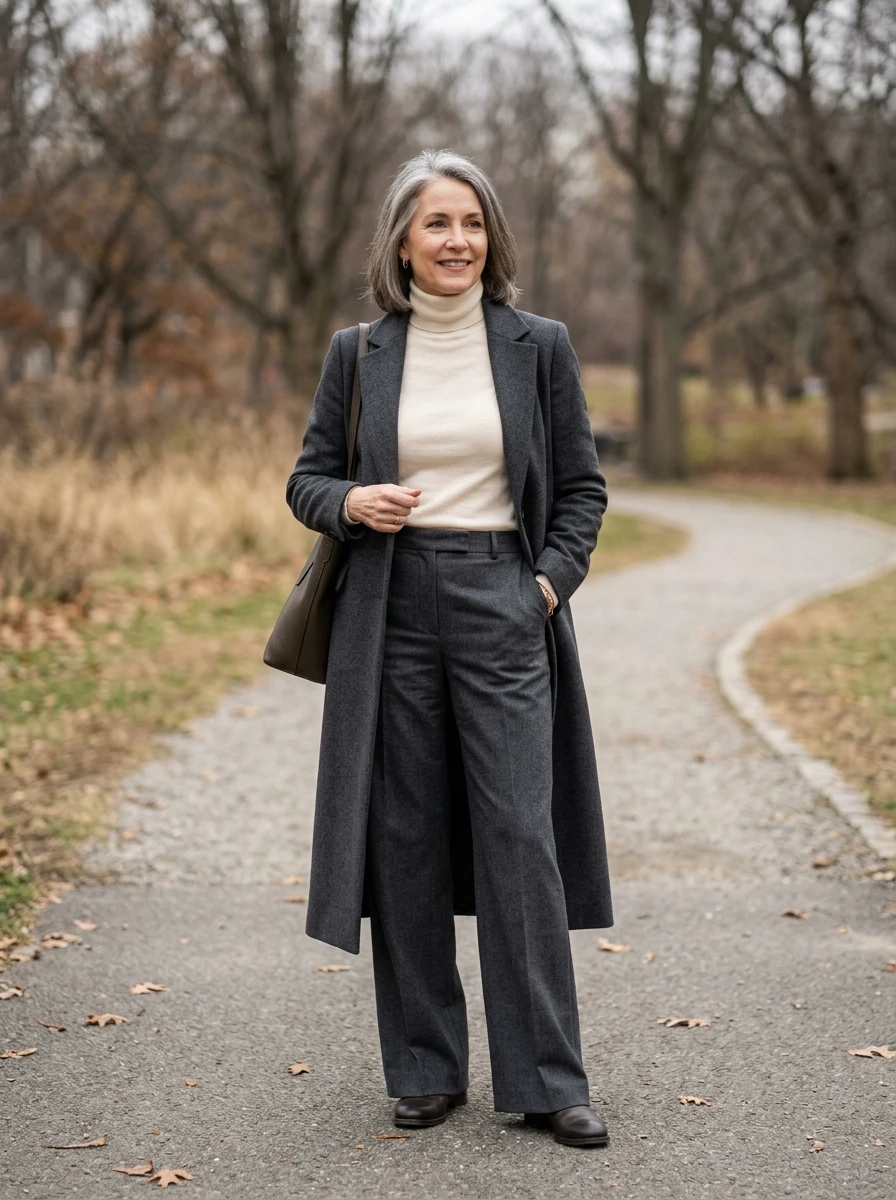
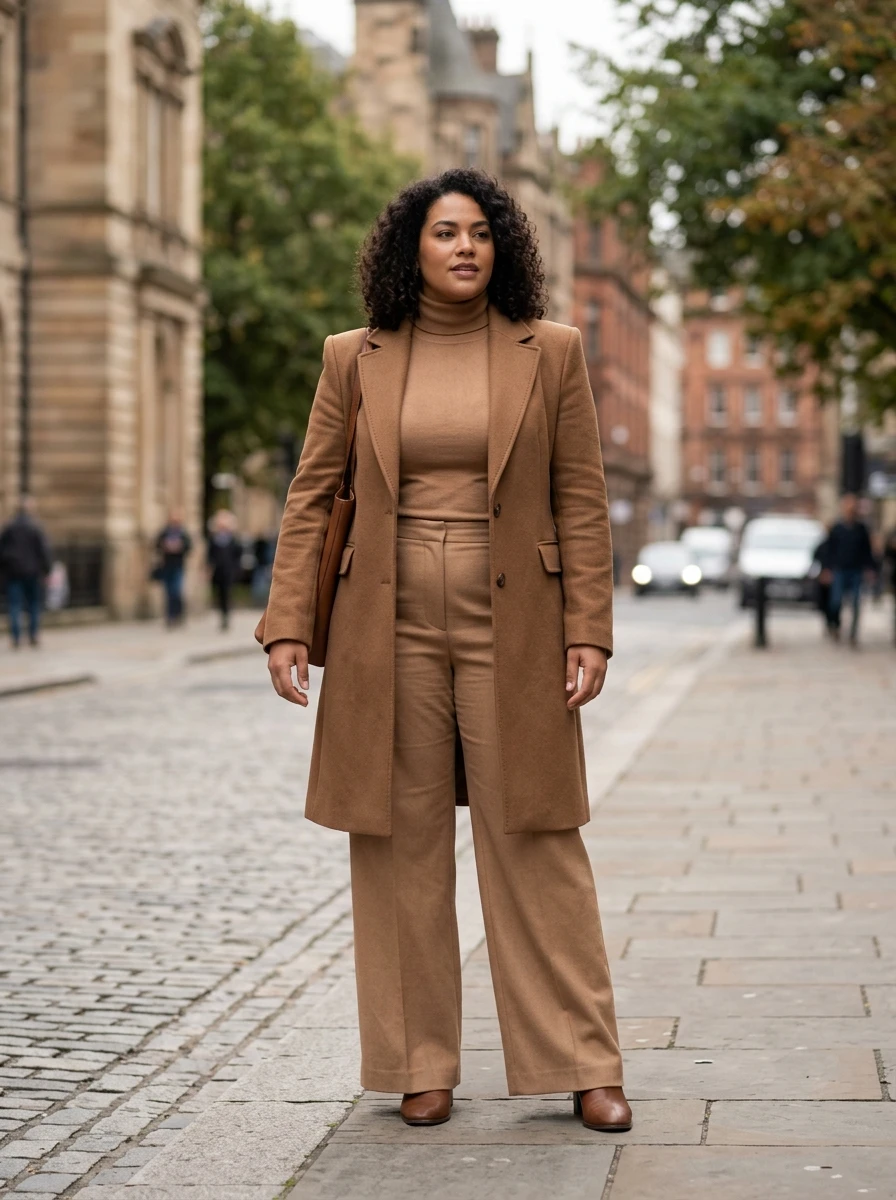
Structured wool coat and wide-leg trousers. A coat with a defined shoulder — not a sloping, dropped shoulder — builds an architectural line from the neck down, which is what balances the volume of high-waisted wide-leg trousers. Keep the whole thing monochromatic, camel on camel or charcoal on charcoal, and the eye reads one long column instead of separate pieces. Underneath, a slim fitted turtleneck provides the base layer without bulk, tucked into the trousers so the waistband marks your waist. This is the strongest professional winter formula there is: shoulders say structure, trousers say intention, and the single color says confidence.
Fit note: the coat's shoulder seam should sit at your natural shoulder even over a sweater; if it slopes past it, the coat is cut too big, not relaxed.
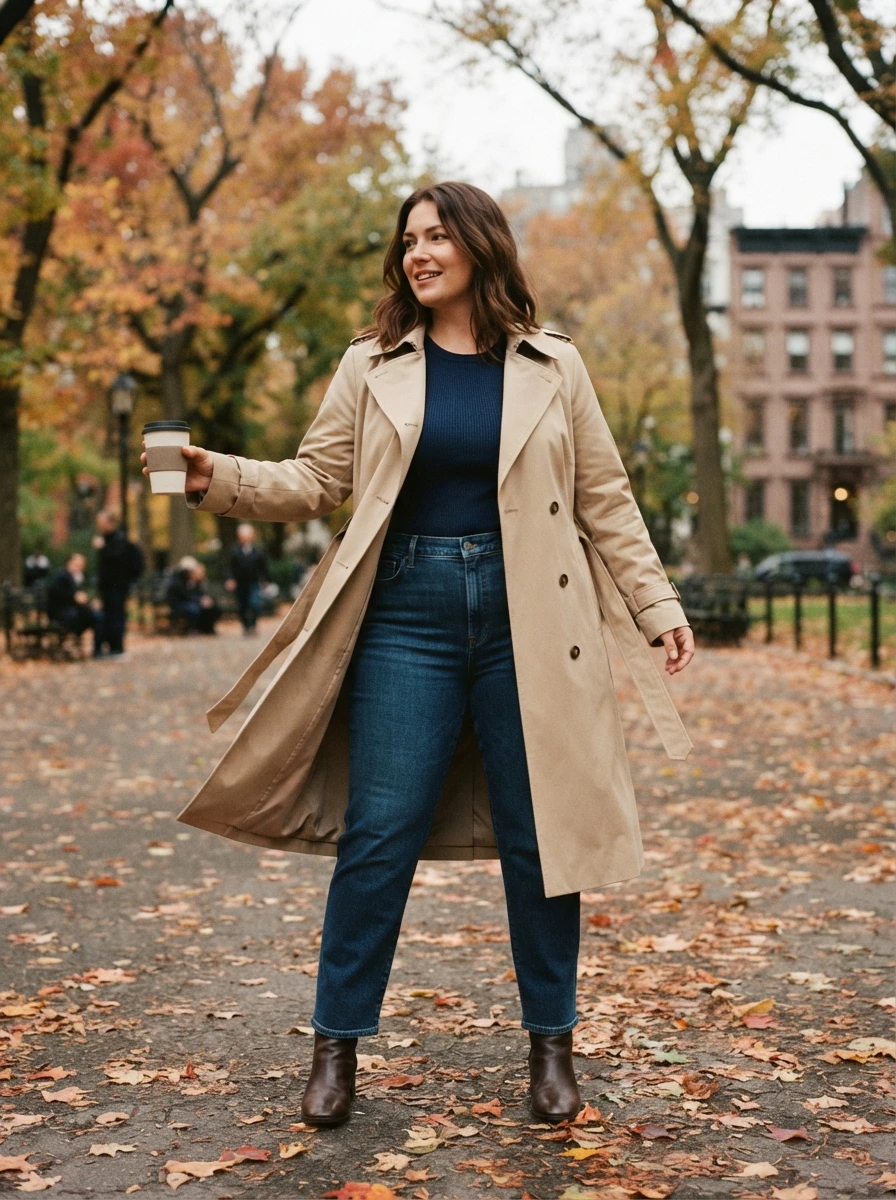
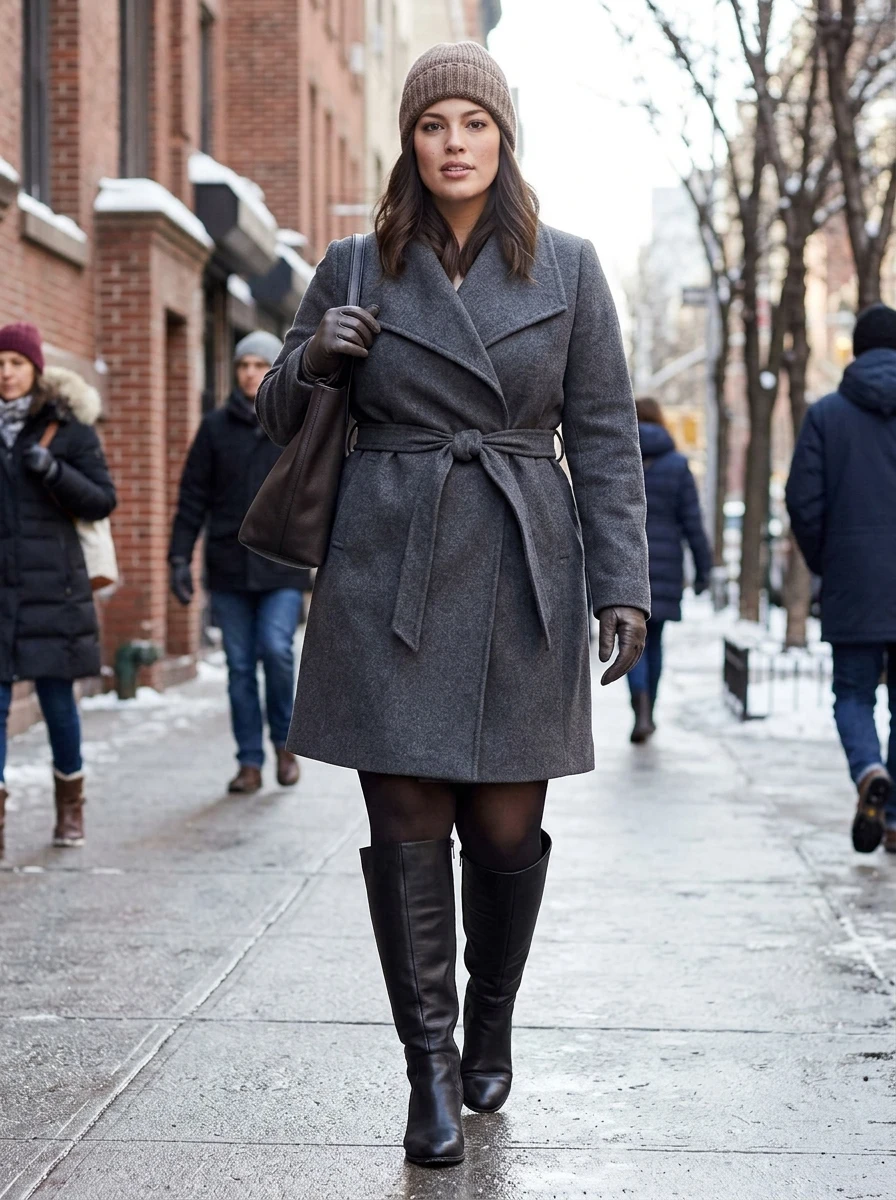
Belted wrap coat. If a tailored single-breasted coat feels stiff, a wrap coat with its own fabric belt gives you adjustable shaping — you decide where the waist sits each morning. Cinch it over a fitted dress or trousers, and pair with leather boots that hit just below the knee for a continuous leg line. Wrap coats are also forgiving across weight fluctuations, since the belt does the fitting work rather than fixed seams. A belted trench serves the same role in milder weather.
A coat in deep red or jewel tones. When the coat is the outfit, its color does the talking. A deep red wool coat over neutral cream or beige layers is one of the most reliable ways to look polished with almost no styling effort — the richness of the color carries the whole look, so keep the scarf, gloves, and boots muted and let the coat be the focal point. The same logic holds for emerald or sapphire coats: wear a jewel tone over gray trousers and a neutral sweater, keep shoes simple in black or brown, and resist the urge to match accessories exactly to the coat. One strong color plus quiet neutrals always beats a fully coordinated set.
Wear it with: muted scarf, gloves, and boots in black or brown; the coat is the focal point, so nothing else should compete with it.
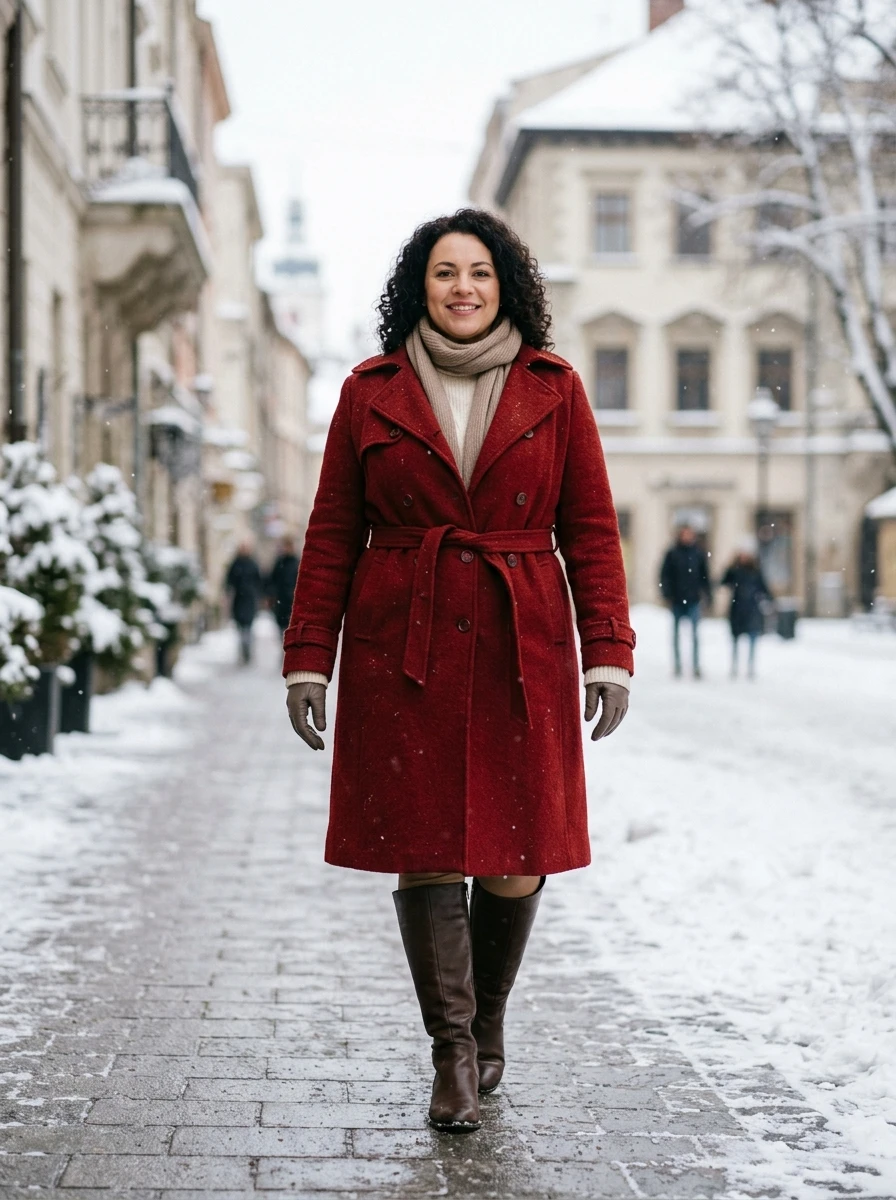
Fit notes that matter here: when trying coats, check that you can lift your arms without the whole coat riding up — you need room in the shoulders and armholes for the sweaters underneath. Princess seams or a nipped waist on a structured coat shape the torso far better than a straight-cut box coat, and if the coat pulls across the back when you move, it's too small regardless of how the front looks.
Knitwear and the Volume Equation
Oversized knits are a plus-size winter staple, but they only work when the bottom half of the outfit balances them.
Oversized turtleneck and thick leggings. This is proportion play in its purest form. A tunic-length turtleneck that covers the hips gives you the cozy, enveloping top; high-quality, thick, fully opaque leggings give you the slim base that keeps it from reading sloppy. The non-negotiable is legging density — check that they stay opaque when you bend and move, not just standing still in the fitting room. A boot with a slight heel or a pointed toe under the legging adds a finish the sneaker version lacks.
Fabric note: legging density is non-negotiable; check they stay opaque when you bend and move, not just standing still in the fitting room.
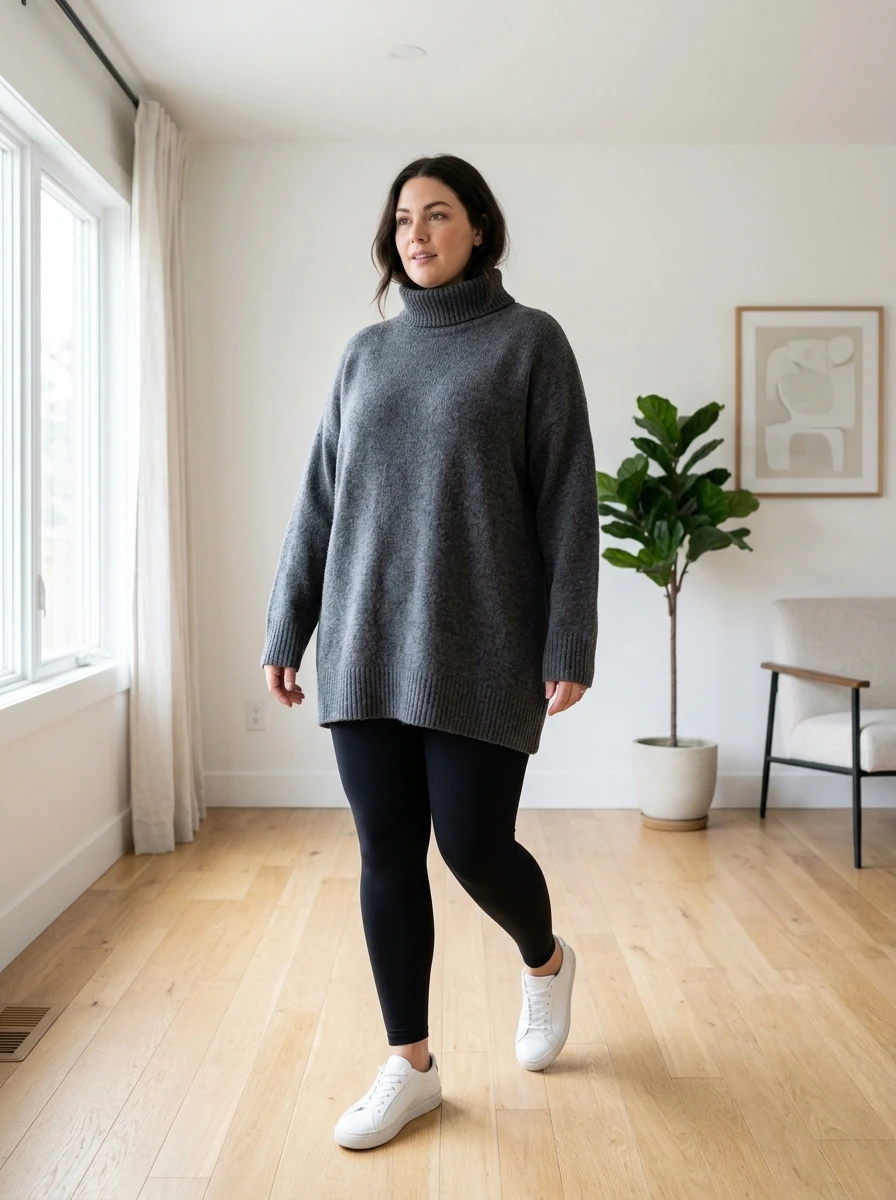
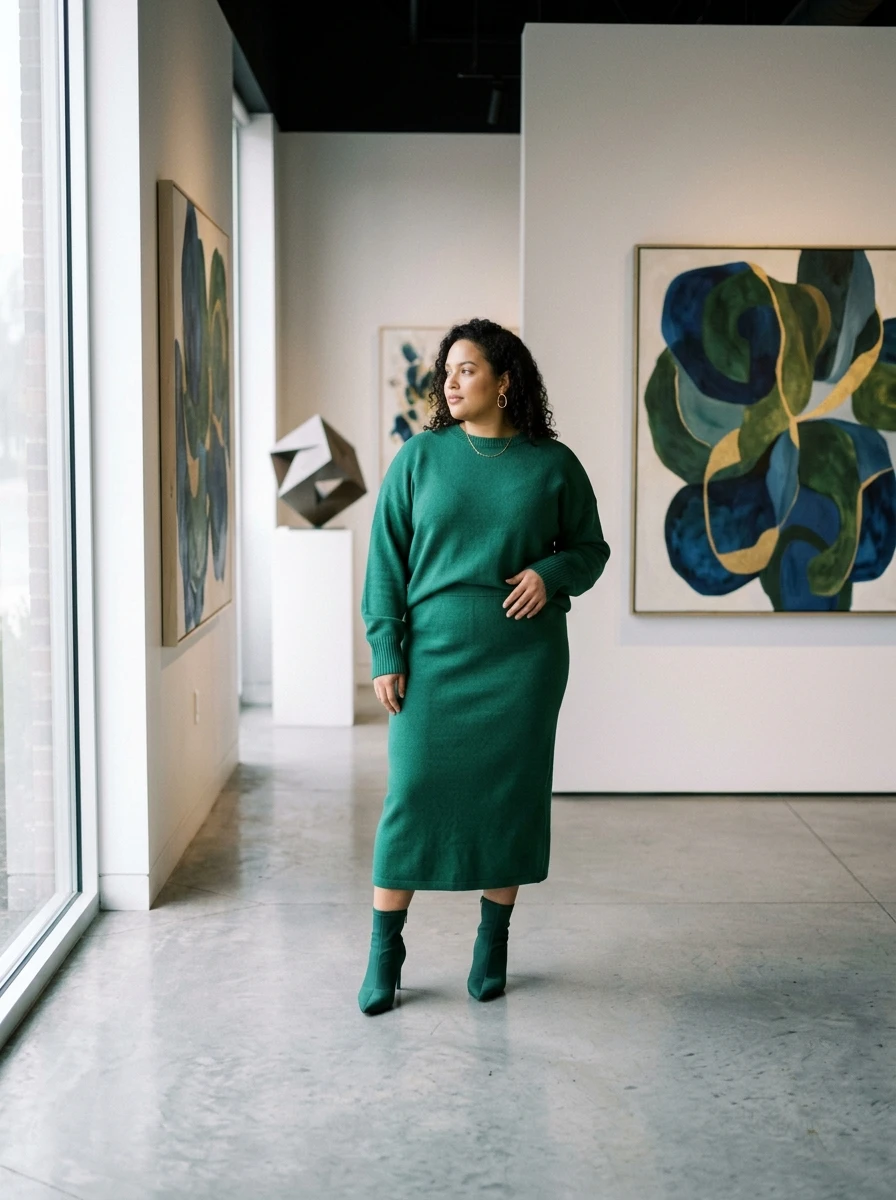
Monochromatic knit sets. Tonal dressing removes the horizontal break between top and bottom, which elongates the body — one of the simplest visual tricks in this entire guide. A matching knit top and skirt in emerald, navy, or cream reads expensive and takes about thirty seconds to put on. Look for tight rib knits that hold their shape rather than loose knits that bag out by noon, and finish with boots in a similar shade so the color column runs all the way to the ground.
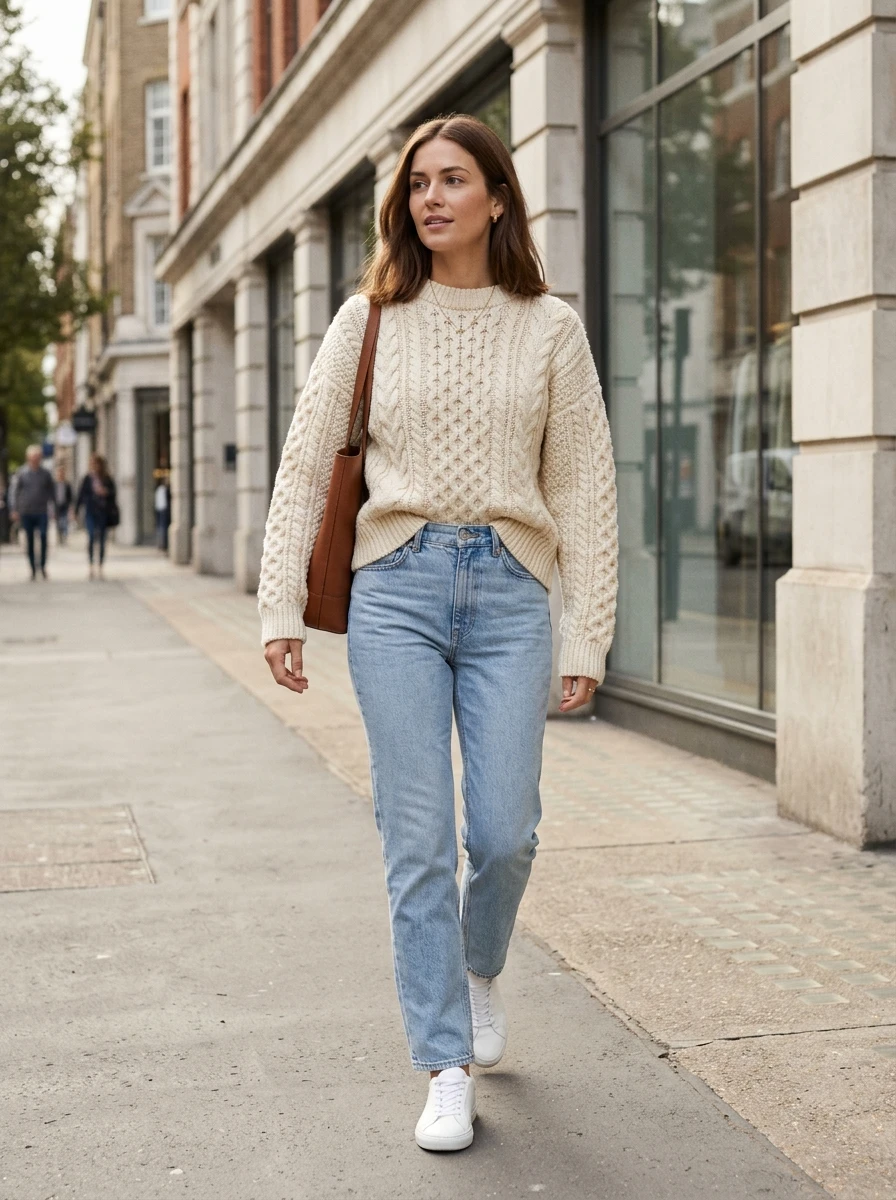
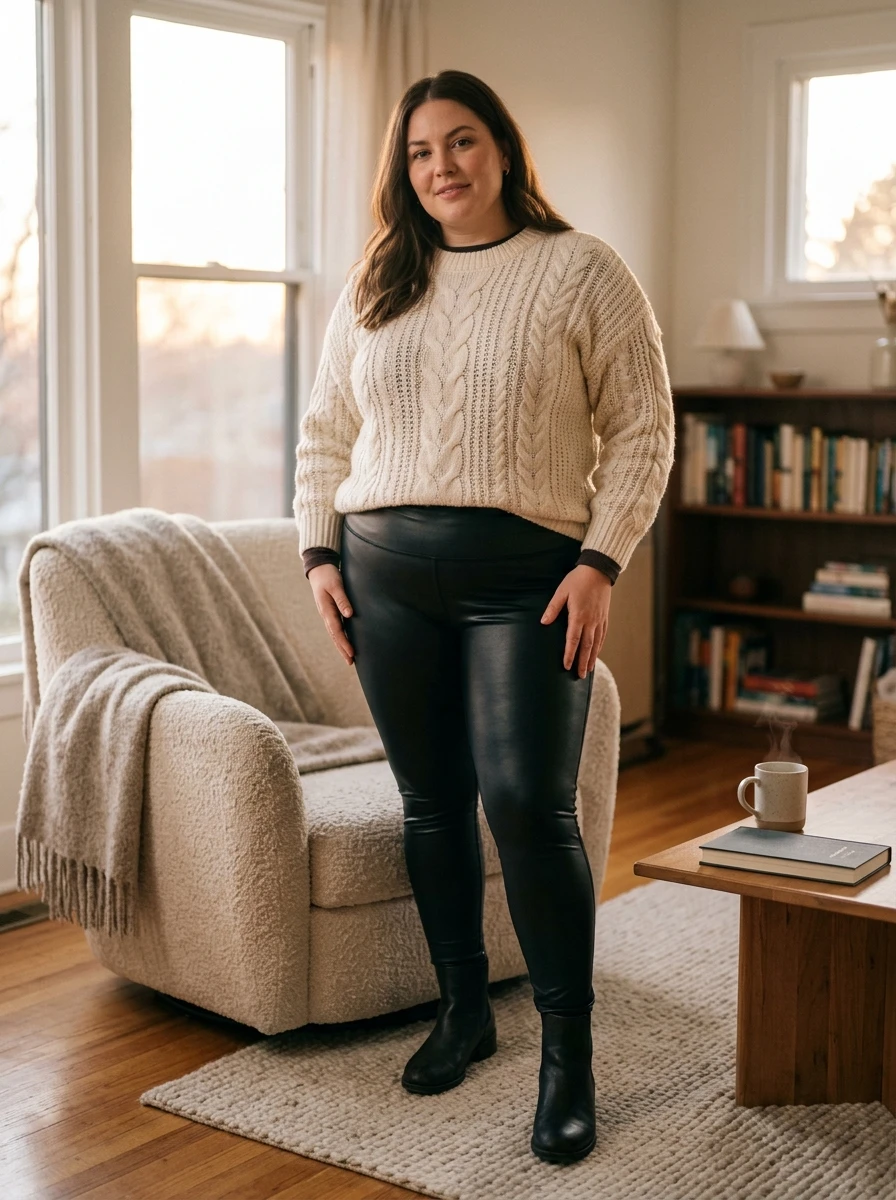
Chunky cable knit and faux leather leggings. Here the styling interest comes from texture contrast rather than color: the softness of a chunky cable knit against the sleek, light-catching finish of faux leather. The leggings' stretch keeps the look comfortable for all-day wear, while the knit does the visual heavy lifting on top. Synthetic leggings can feel cold against the skin, so a thermal base layer underneath makes this a genuine winter outfit rather than a mild-day one.
Wear it with: a thermal base layer underneath the leggings; synthetic leggings feel cold against the skin without one.
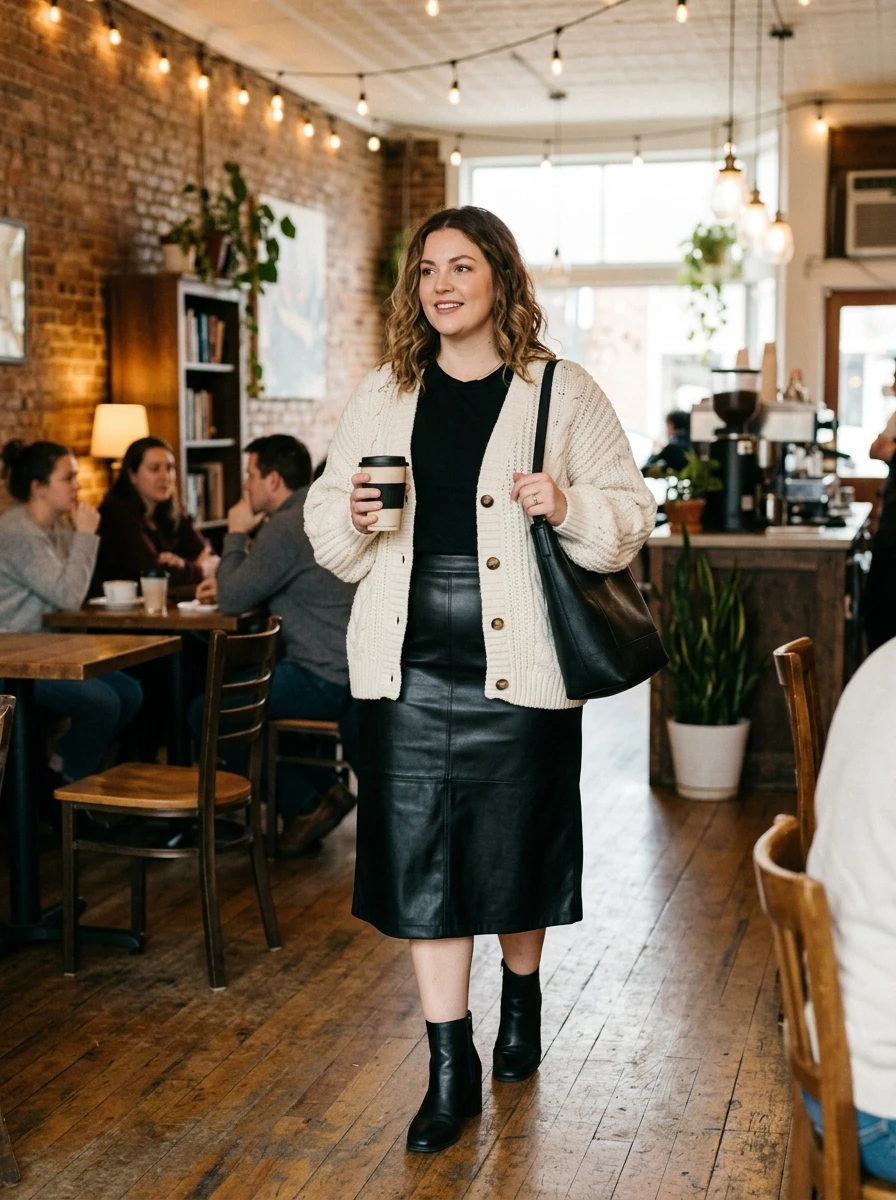
Faux leather midi skirt and chunky cardigan. For weekends, swap the leggings for a black faux leather midi skirt and top it with a thick, oversized cable-knit cardigan, buttoned partway so the front edges define a waistline rather than hanging straight. The midi length keeps the look grown-up, and ankle boots with a slight block heel keep it walkable. If leather feels too structured, a corduroy midi gives the same outfit in a softer register. Since most of these knits are wool or wool blends, keep Woolmark's wool care guide handy so a good sweater survives the season instead of pilling after three wears.
Texture Is Your Best Pattern
When you're dressing in dark winter palettes, texture does the work that prints do in summer. Mixing materials keeps an all-neutral outfit from looking flat, and it's more forgiving than pattern-mixing on a curvy frame.
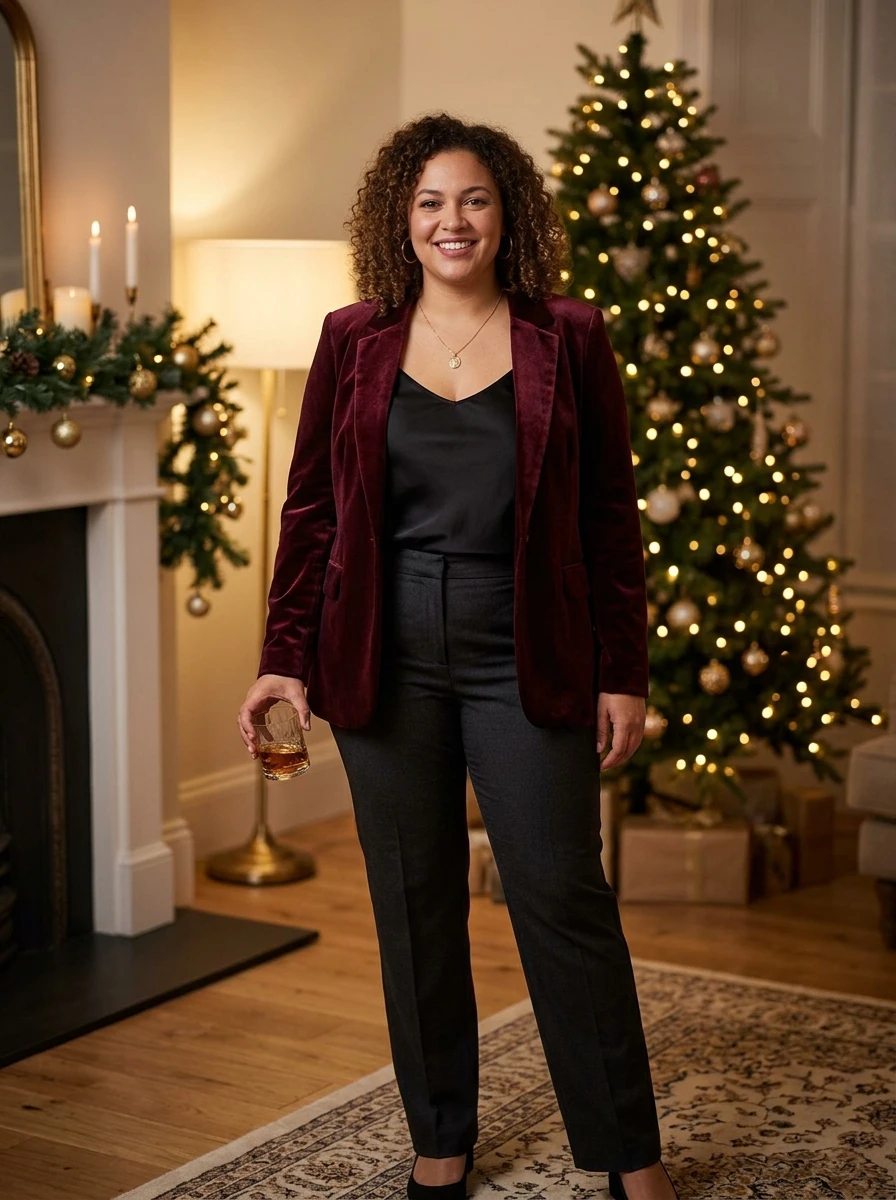
Velvet blazer. A burgundy or deep-plum velvet blazer over a simple silk camisole and tailored dark trousers turns standard evening wear into something with depth — the fabric catches light differently with every movement, so the outfit never looks static. Velvet's weight also provides real insulation against indoor chills, which matters at winter events where you leave your coat at the door. The same blazer over dark-wash straight-leg jeans and a silk camisole dresses down beautifully for dinner out.
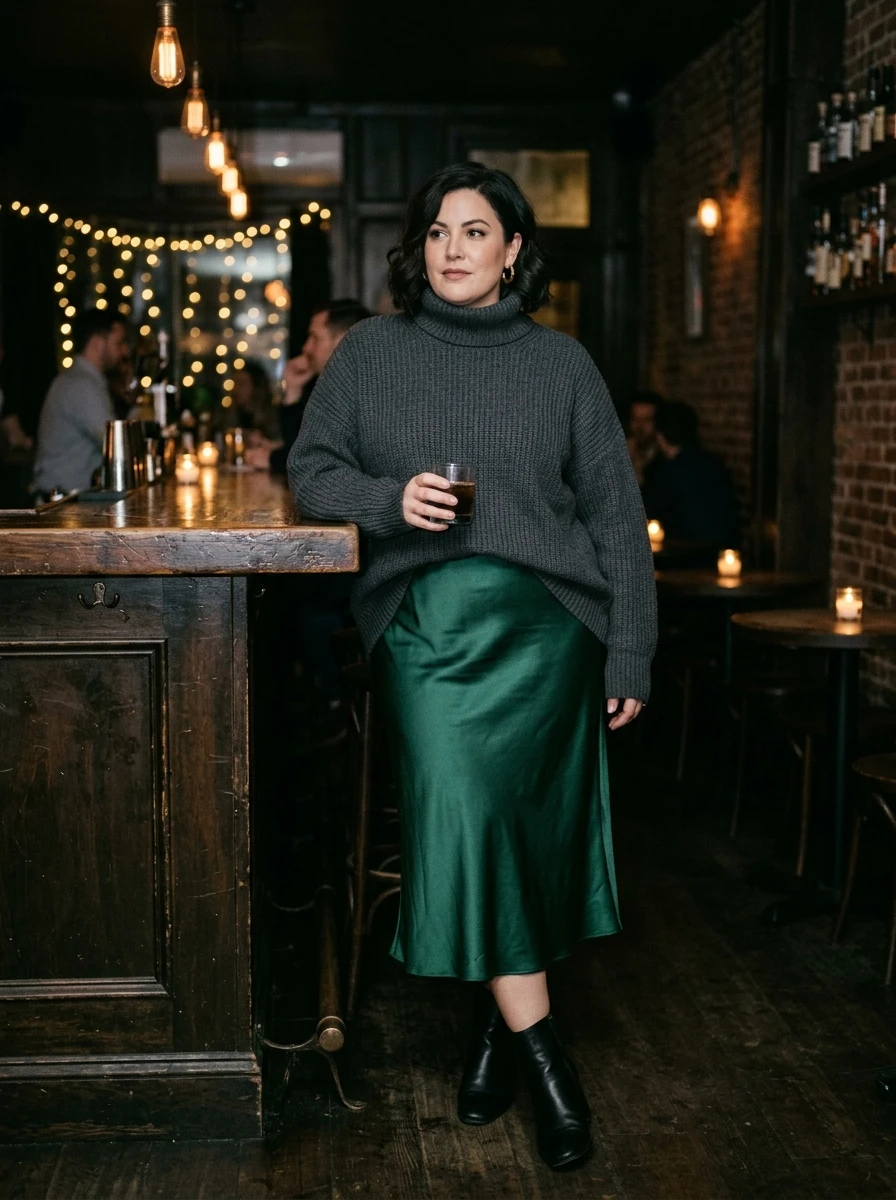
Satin slip skirt and oversized sweater. This is the high-low pairing that looks the most intentional: a satin skirt gliding smooth against a heavy, chunky sweater on top. The contrast between liquid and nubby is what makes it modern, and the play on proportions — slim, fluid bottom against voluminous top — flatters because each piece does the opposite job of the other. It works for evening events where you want to feel dressed up and stay warm, and the skirt's bias cut skims rather than clings.
Fit note: the skirt must be bias cut so it skims rather than clings; a straight-cut satin skirt pulls across the hip instead of gliding.
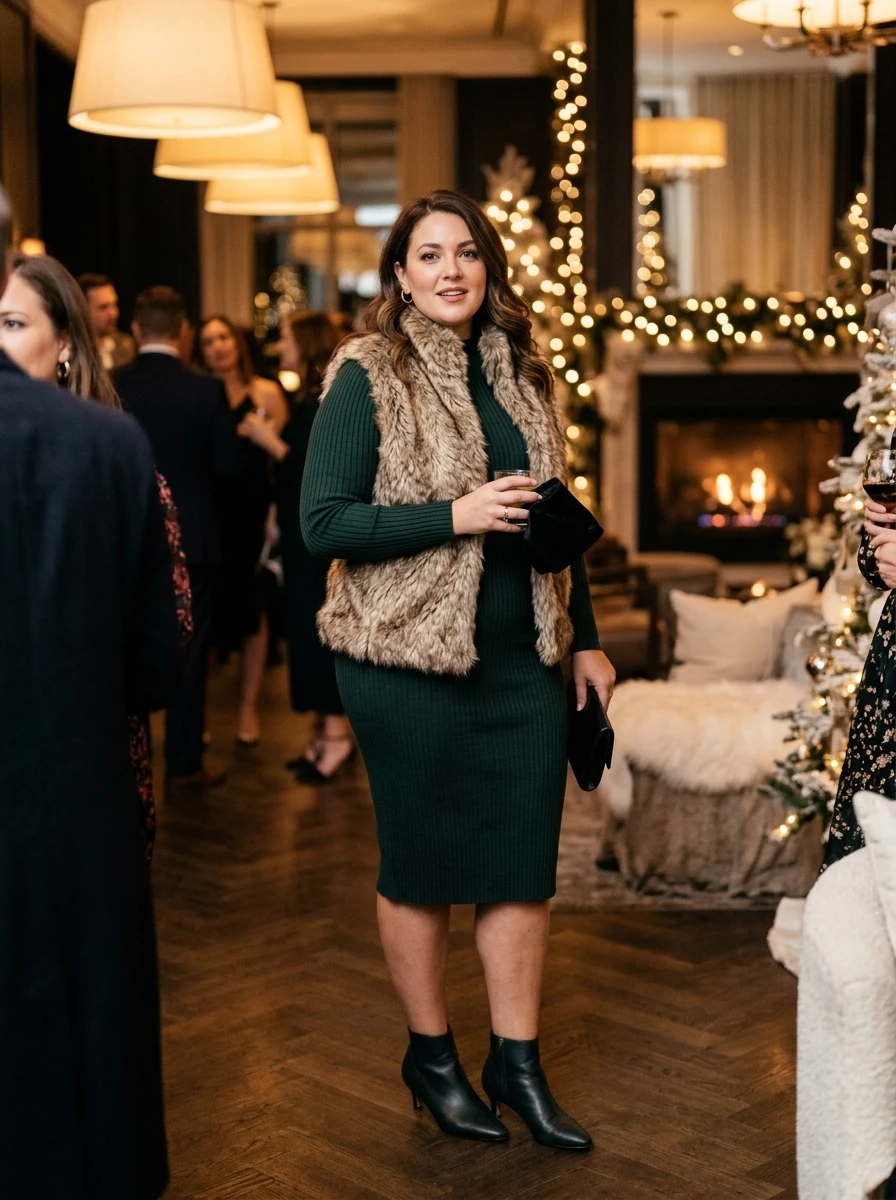
Faux fur vest over a ribbed knit dress. A faux fur vest adds warmth to your core while leaving your arms free, and over a close-fitting ribbed knit dress it creates a luxury-leaning look with almost no effort. The key is the dress underneath: it should fit close to the body so the vest's volume has something slim to sit against. Worn over a long-sleeve tee or a thin sweater, the same vest becomes a practical layer for busy days. This layering trick also works over a long-sleeve thermal dress on days when the temperature swings — the vest comes off indoors and the dress underneath still looks finished.
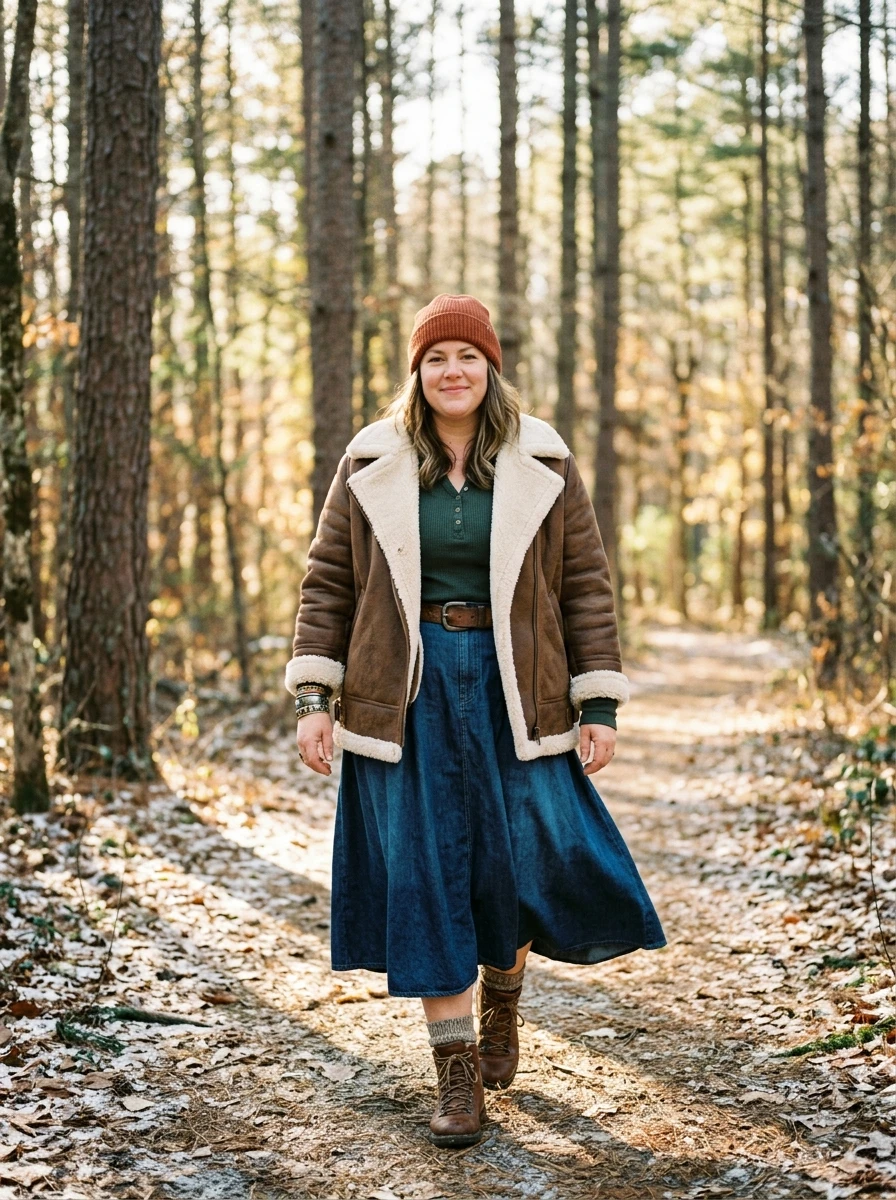
Shearling jacket and midi skirt. Rugged shearling has real substance — it's warm and visually weighty — so it pairs best with a skirt that has enough presence to balance it: a flowy midi, a denim midi, or corduroy for colder days. Layer a thermal long-sleeve top underneath the jacket and the whole outfit handles dropping temperatures. Think of it as the bohemian answer to the structured wool coat: same job, different attitude.
Wear it with: a thermal long-sleeve top underneath; the jacket alone is not enough once temperatures actually drop.
Denim, Reworked for Winter
Denim doesn't hibernate in winter — it just needs warmer company.
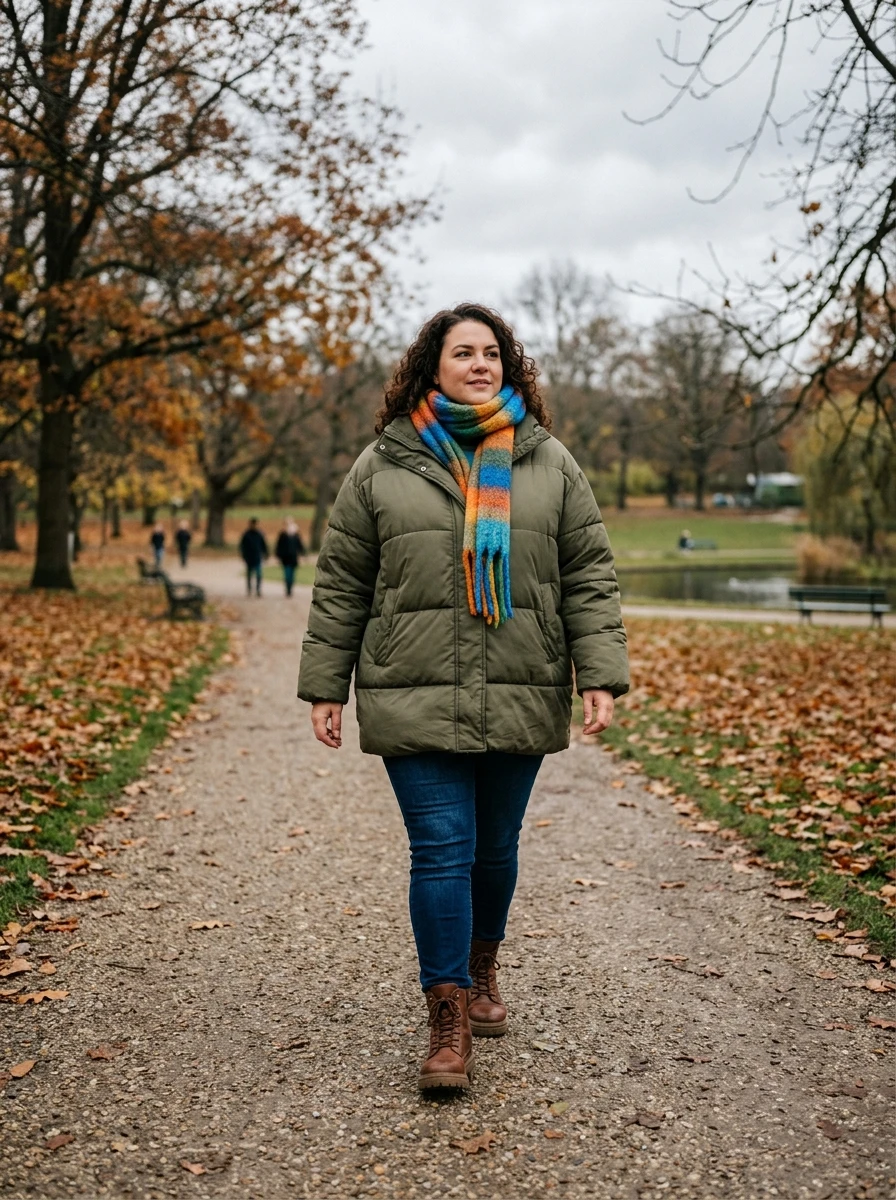
Oversized puffer and slim dark denim. A cropped oversized puffer with slim-fit dark-wash jeans is the off-duty uniform that actually holds up in real cold, provided the puffer is genuinely insulated and not just fashion-puffy. The slim jean keeps the silhouette from going full marshmallow. A colorful scarf lifts the whole thing on gray days. If you run colder, a knee-length parka is the longer-line alternative with more wind coverage.
Fabric note: the puffer must be genuinely insulated, not just fashion-puffy; check the fill and the lining before trusting it in real cold.
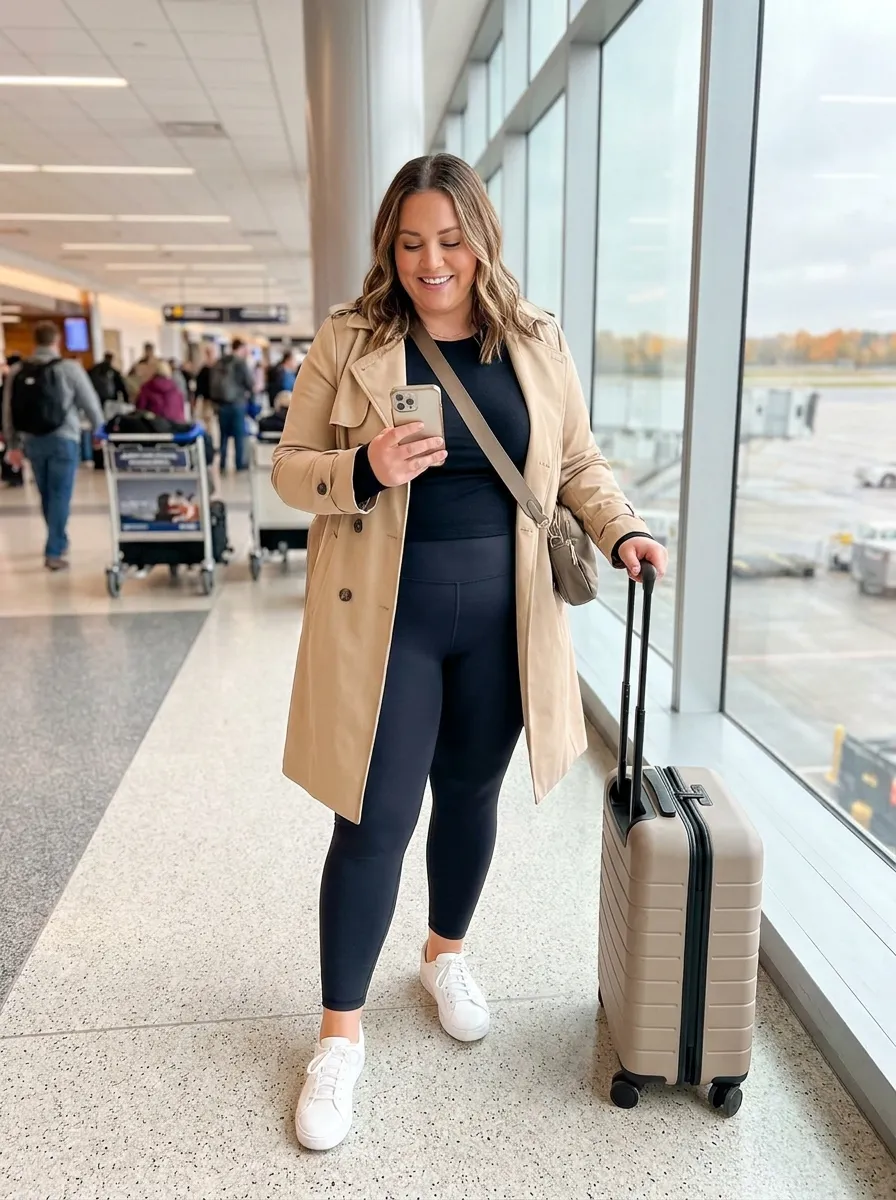
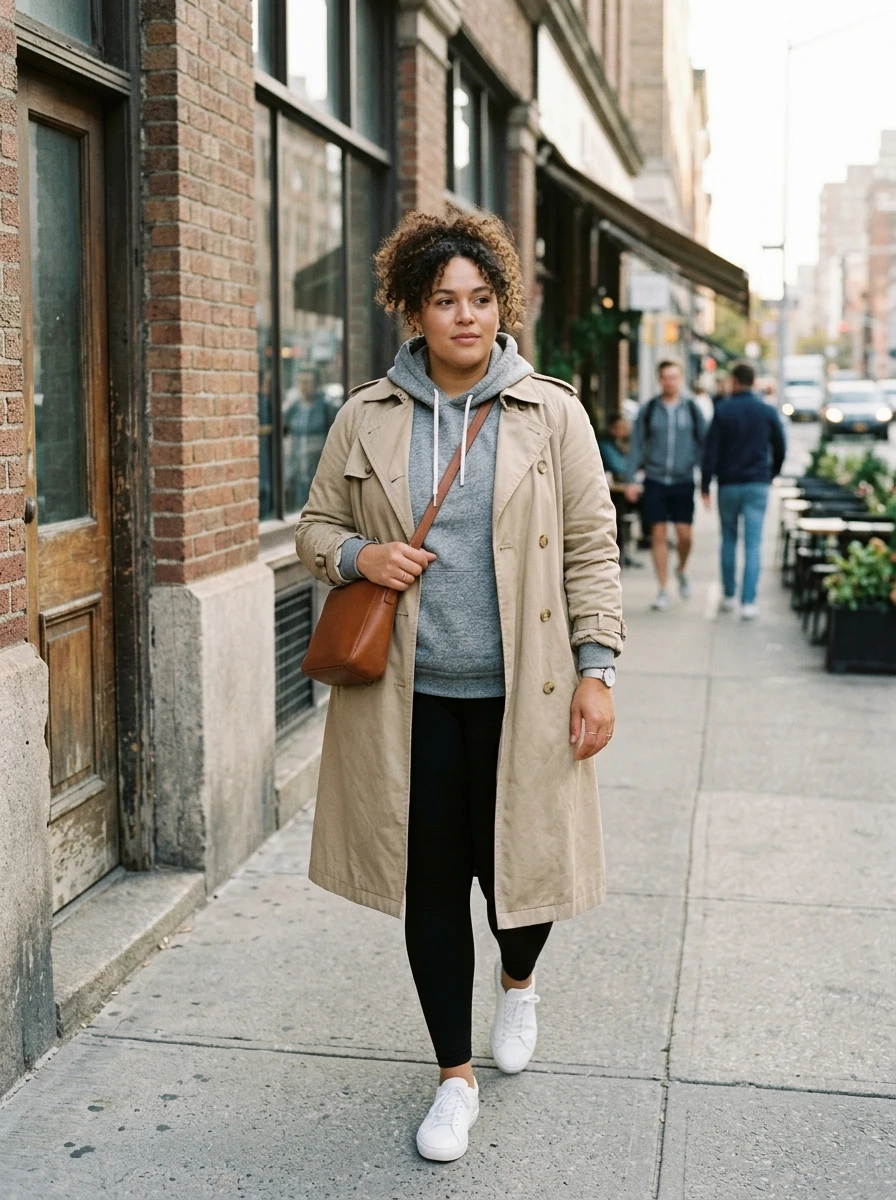
Trench coat over hoodie and leggings. The trench-over-athleisure combination works because the coat's sharp lines do all the structuring — the hoodie and leggings underneath just need to be clean and unfussy. It's a smart move for milder winter climates where a heavy coat would be overkill, and a sturdy cotton-twill or wool-blend trench from a thrift store does the job as well as a new one. Keep accessories minimal so the coat's lines stay the focus.
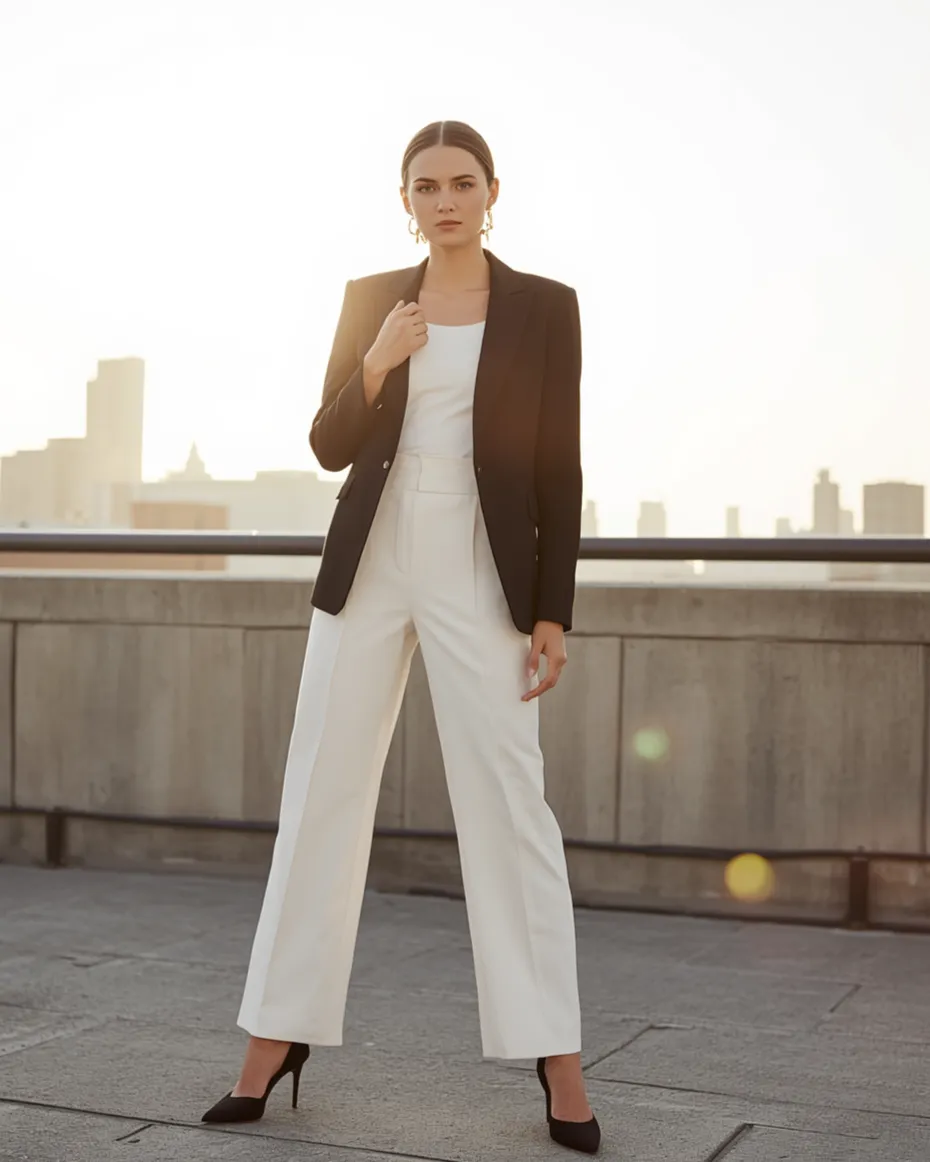
Navy blazer and light-wash denim. Navy reads crisper than black against winter light, and over light-wash denim with a white shirt it makes a polished casual-office look. Loafers or clean sneakers finish it. The blazer needs a touch of stretch so it sits comfortably over the shoulders and chest without pulling across the back — if a blazer pulls when you move, no amount of styling fixes it.
Fit note: the blazer needs a touch of stretch so it sits over shoulders and chest without pulling; if it pulls when you move, no styling fixes it.

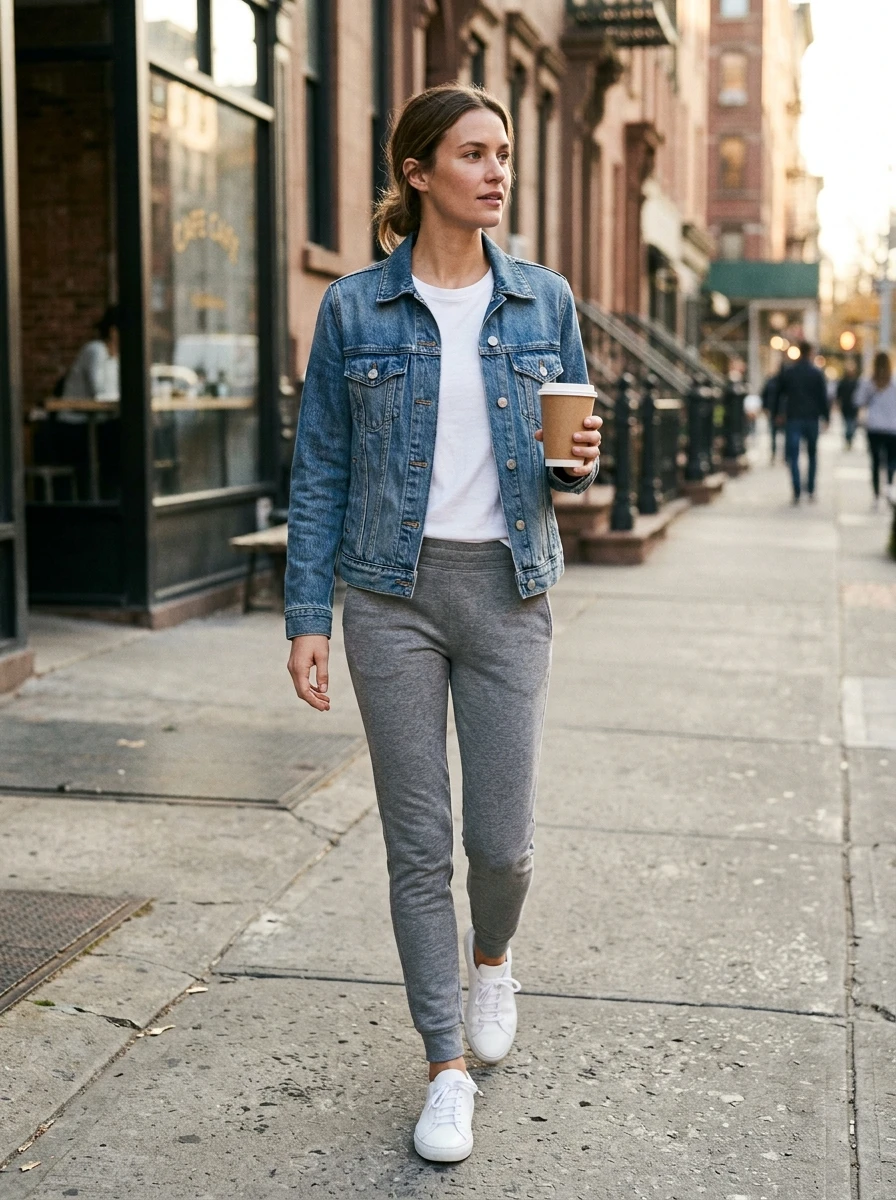
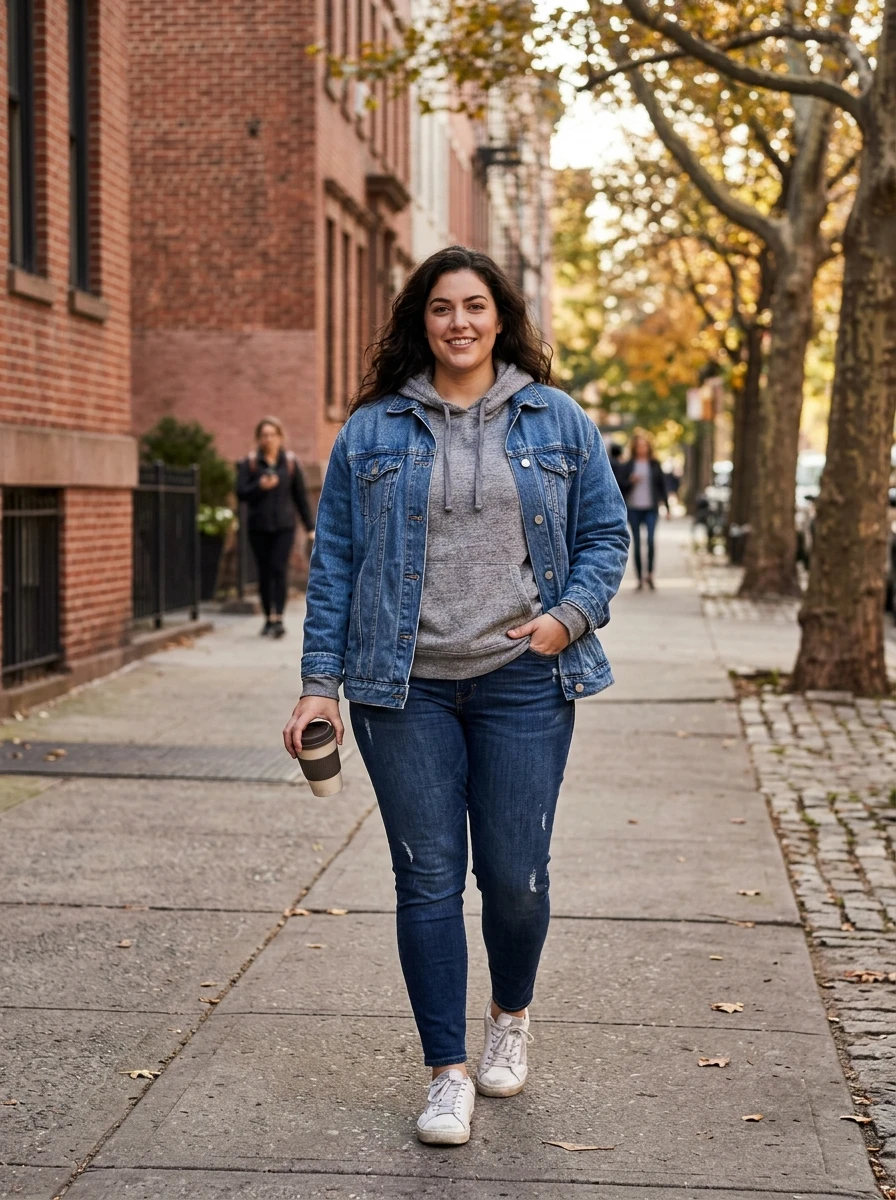
Denim jacket and hoodie. For the coldest casual days, layer a slightly oversized denim jacket over a hoodie — the jacket needs that extra room to accommodate the hoodie's thickness without straining at the buttons. It's a youthful, warm combination, and swapping the denim for a leather moto jacket gives the same layering formula a sharper edge. This is also where a slim-fit puffer vest earns its place: worn over a long-sleeve knit dress or a hoodie, it warms your core without restricting your arms, which makes it ideal for active days and fluctuating temperatures.
Dresses and Skirts Without Shivering
The secret to winter dresses is never the dress — it's what's underneath and what meets the hem.
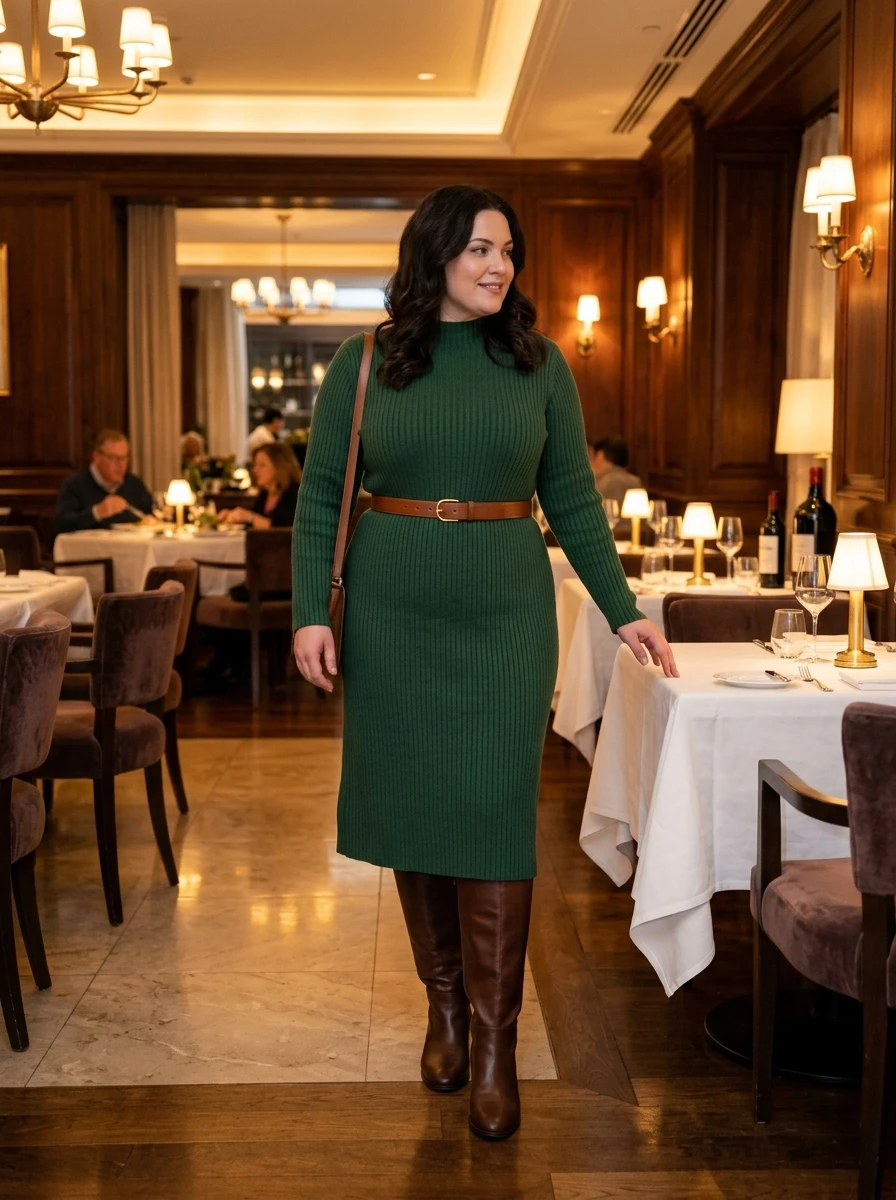
Midi sweater dress and knee-high boots. A midi sweater dress that hits just below the knee, paired with leather knee-high boots, creates a seamless line from hem to floor — the dress ends where the boot begins, so the leg reads as one long stretch. This is the formula for dinner plans and evenings out: warm, polished, and genuinely simple. If the dress runs shapeless, a belt at the waist adds definition; if the knit clings, a slip underneath smooths the foundation. For maximum leg coverage, over-the-knee boots extend that continuous line even further and pair just as well with a midi-length dress.
Fit note: if the dress runs shapeless, add a belt at the waist; if the knit clings, a slip underneath smooths the foundation.
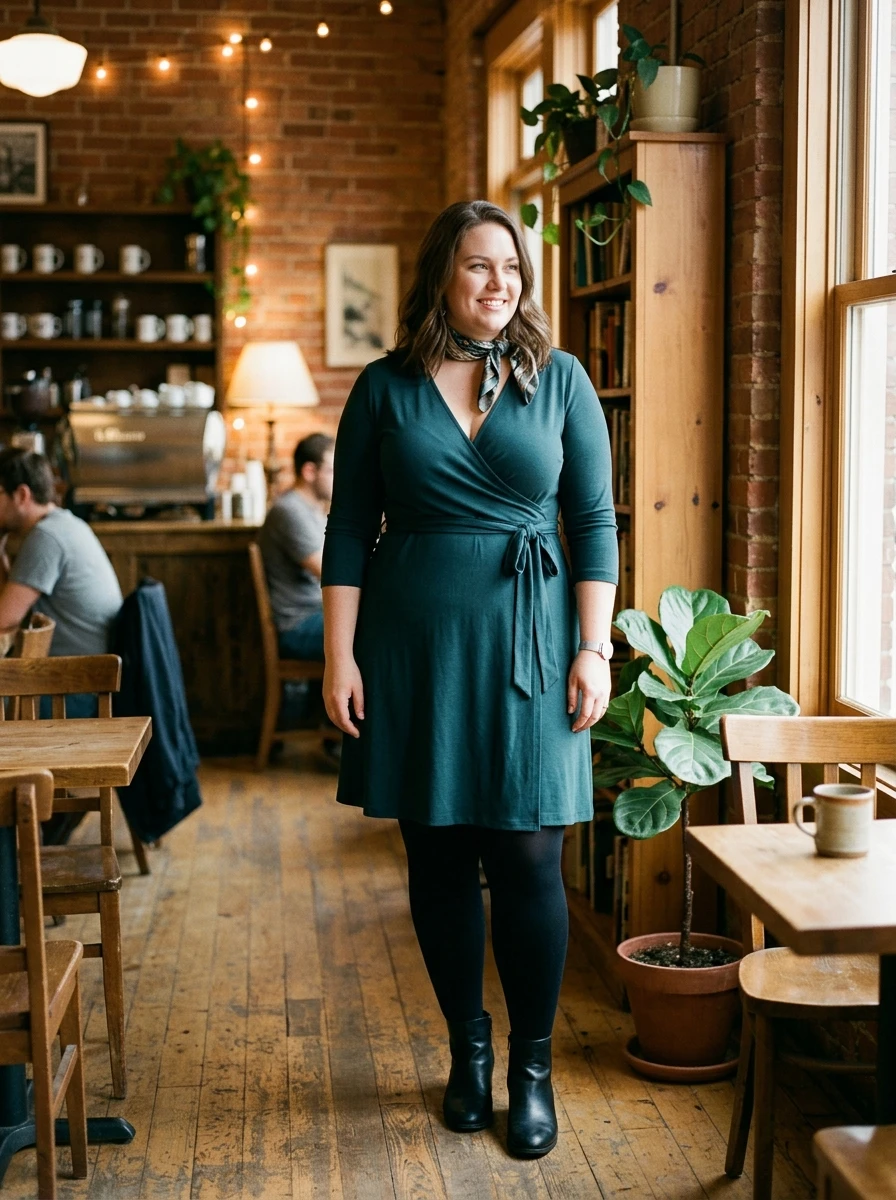
Wrap dress and opaque thermal tights. A wrap dress is one of the most reliable silhouettes for a curvy frame: the V-neckline works with scarves, the tie waist lets you set your own definition, and the skirt skims rather than squeezes. In winter, opaque thermal tights underneath turn it into a legitimate cold-weather outfit without adding visible bulk to the legs. It moves easily from office to weekend brunch, and the wrap's adjustable fit means it accommodates the layers underneath.
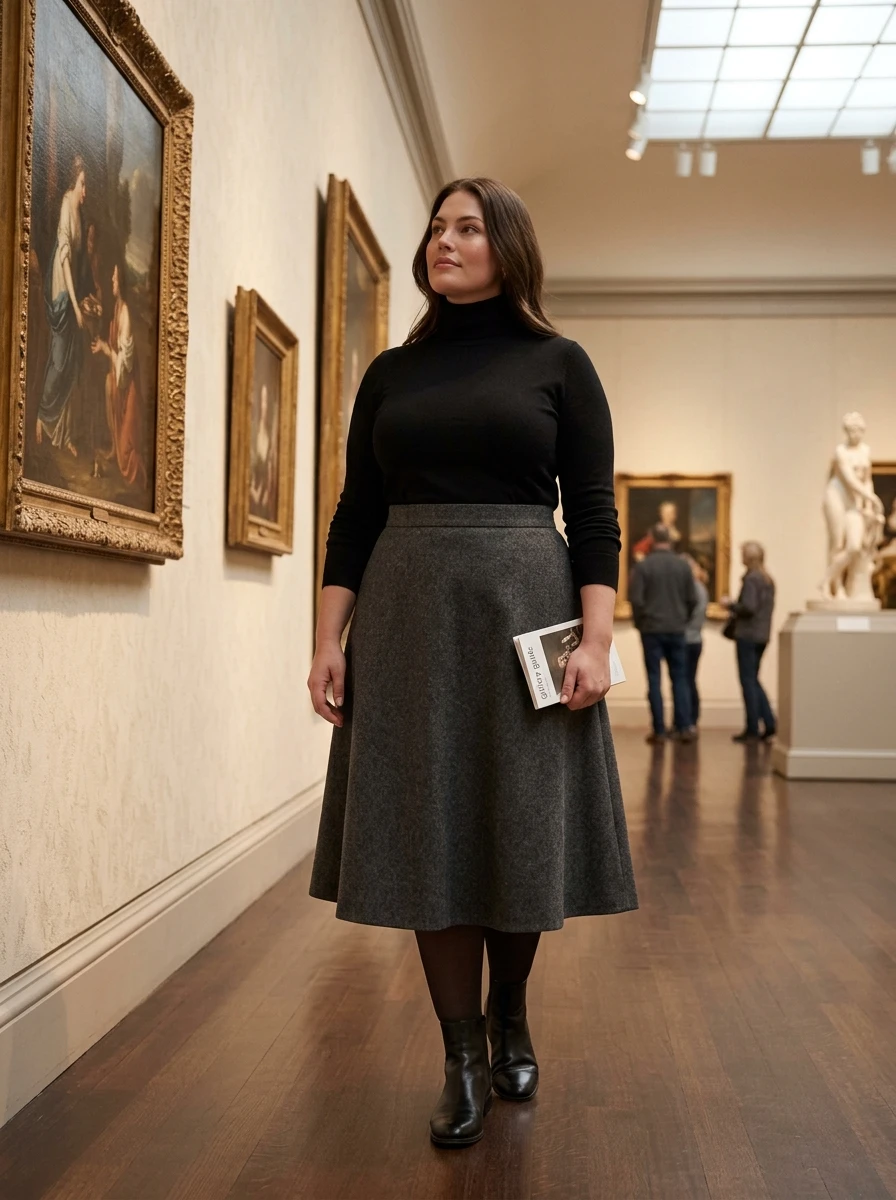
Wool A-line skirt and fitted turtleneck. An A-line wool skirt gives room through the hips while a fitted turtleneck tucked in keeps the top half streamlined — structure on top, ease on the bottom, the reverse of the oversized-sweater formula and just as effective. Charcoal wool with a black turtleneck is a strong neutral pairing for museum visits or lunch dates, and the heavy wool fabric holds its shape all day. Fleece-lined tights underneath make it a true winter outfit.
Wear it with: fleece-lined tights underneath; the heavy wool skirt holds its shape all day, and the tights make it a true winter outfit.
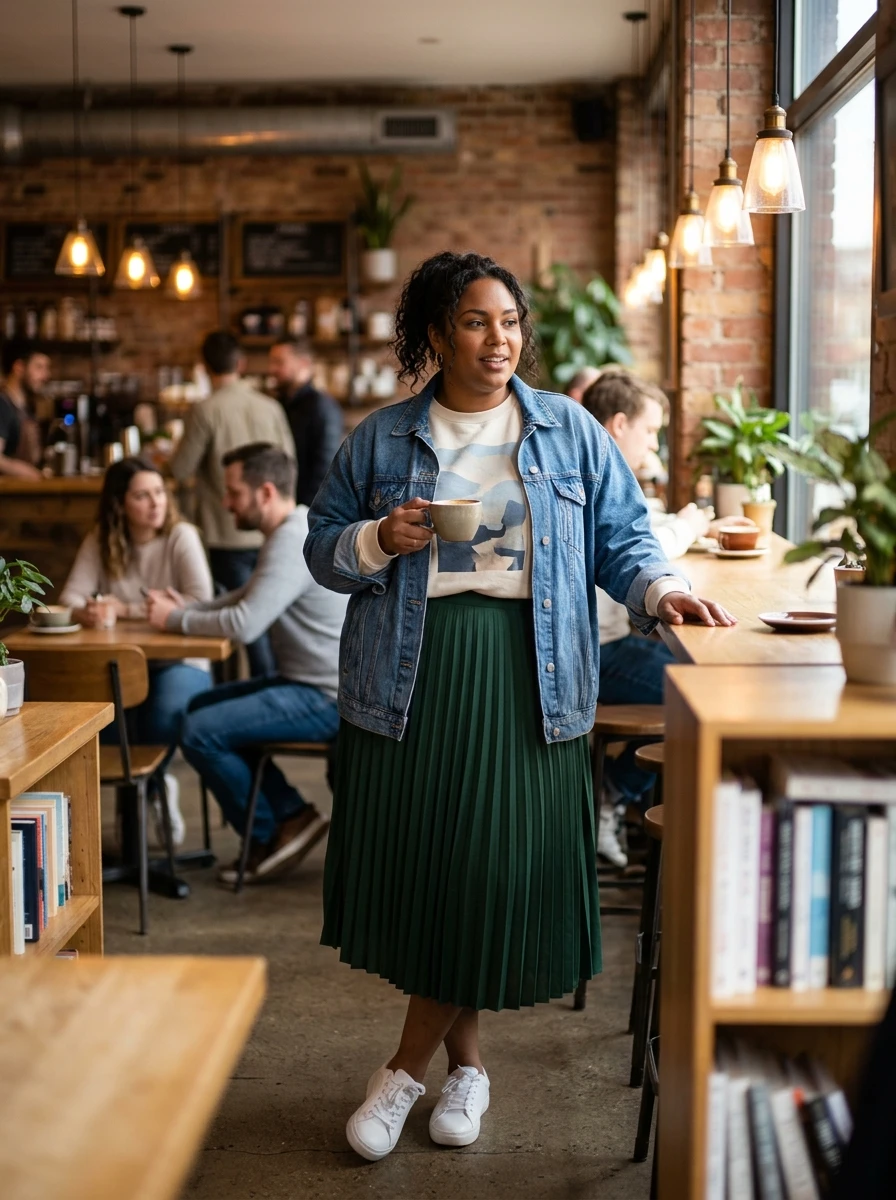
Graphic sweatshirt and pleated midi skirt. Tucking a graphic sweatshirt into a midi pleated skirt shouldn't work, but it does — the pleats give the skirt structure and movement, the tucked sweatshirt defines the waist, and the whole thing reads creative rather than sloppy. The sweatshirt needs to be a medium weight so it tucks neatly without bunching. Layer a denim jacket over it for the day, or a leather moto jacket when you want edge.
Fabric note: the sweatshirt must be medium weight; a heavy one bunches at the tuck, and a thin one loses its shape by noon.
Trousers Worth Owning
Good winter trousers do two jobs: they look like proper trousers, and they secretly keep you warm.
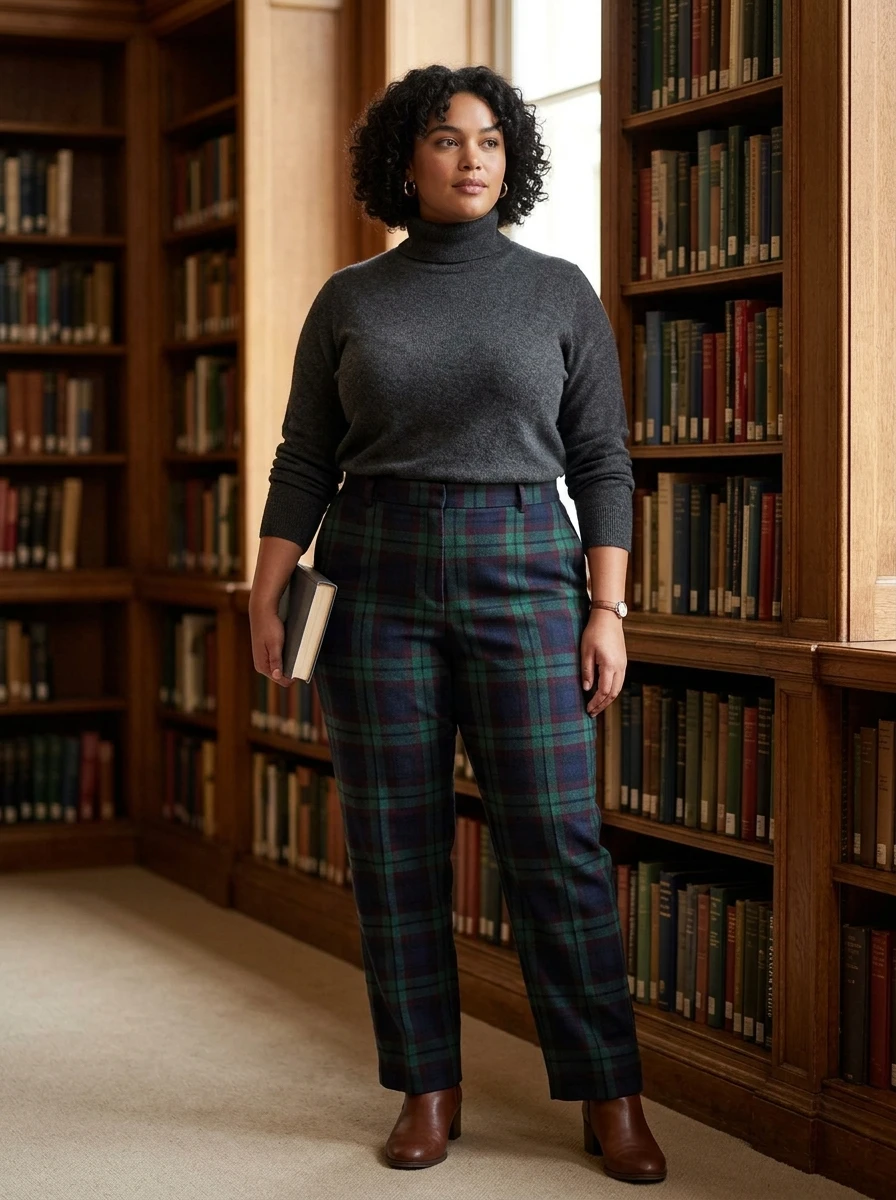
Plaid trousers and a solid turtleneck. Plaid adds classic pattern interest to a winter rotation, and it behaves best when everything else stays quiet — a solid turtleneck tucked in, minimal jewelry, simple boots. The tuck is doing real work here: it marks the waist and keeps the patterned trouser from overwhelming the frame. Vintage wool plaid trousers are worth hunting for; the fabric is durable and the cuts tend to have the higher rises that work well on curvy bodies.
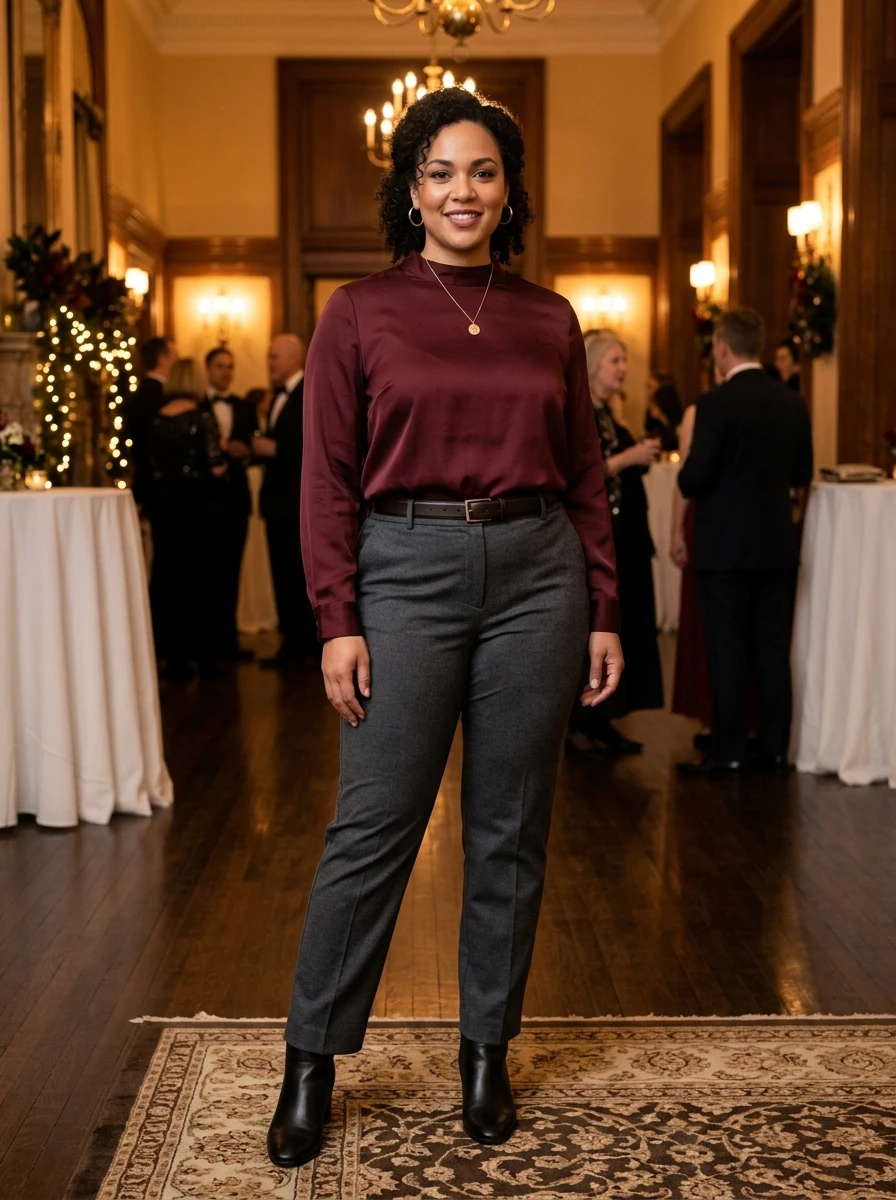
Fleece-lined trousers and a silk blouse. This is hidden warmth at its best: trousers that look like ordinary dress slacks but are lined with fleece, paired with a tucked-in silk blouse. The contrast between the hardworking pant and the delicate top creates a balanced, polished look that handles formal winter events — office parties, dinners — without you quietly freezing through them. Nobody needs to know about the fleece.
Fabric note: fleece-lined trousers look like ordinary dress slacks; the warmth is invisible, which is exactly the point.
Plaid blazer and black trousers. A plaid blazer over black trousers and a black shell is a timeless professional combination — the blazer carries all the visual interest, so the base stays simple. Choose a blazer with a bit of stretch so it fits over the shoulders and bust without pulling, and finish with loafers for a smart-casual feel. Earth-toned layering works on the same principle from the casual side: rust, tan, and brown layered together — a mock-neck top under a wool vest with cords and suede ankle boots — create a warm, cohesive palette where the color variety itself is the styling, no patterns required.
Fit note: choose a blazer with a bit of stretch so it fits over shoulders and bust without pulling across the back.

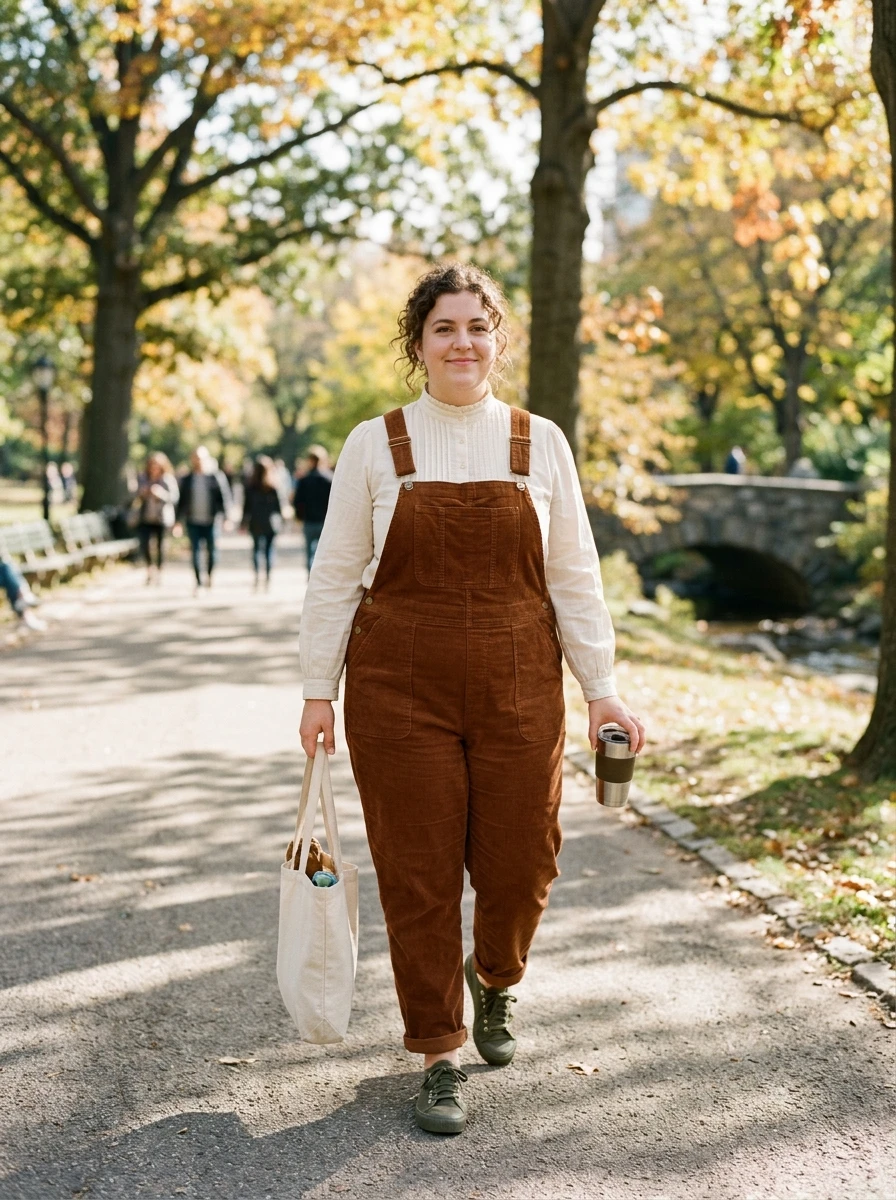
Corduroy, two ways. Corduroy overalls over a high-neck blouse are playful and genuinely practical — the bib silhouette leaves plenty of room for layering underneath, and the high neckline peeking out keeps it from reading juvenile. For something more unexpected, a wide-leg corduroy jumpsuit over a thin long-sleeve turtleneck is a one-piece winter solution: the wide leg balances the torso, the turtleneck adds warmth, and a belt can define the waist if the jumpsuit lacks shape. Corduroy's ribbed texture also adds the visual interest that flat fabrics lack in winter.
Outerwear for the Coldest Days
When the temperature drops past the point where style feels optional, reach for outerwear engineered for the job.
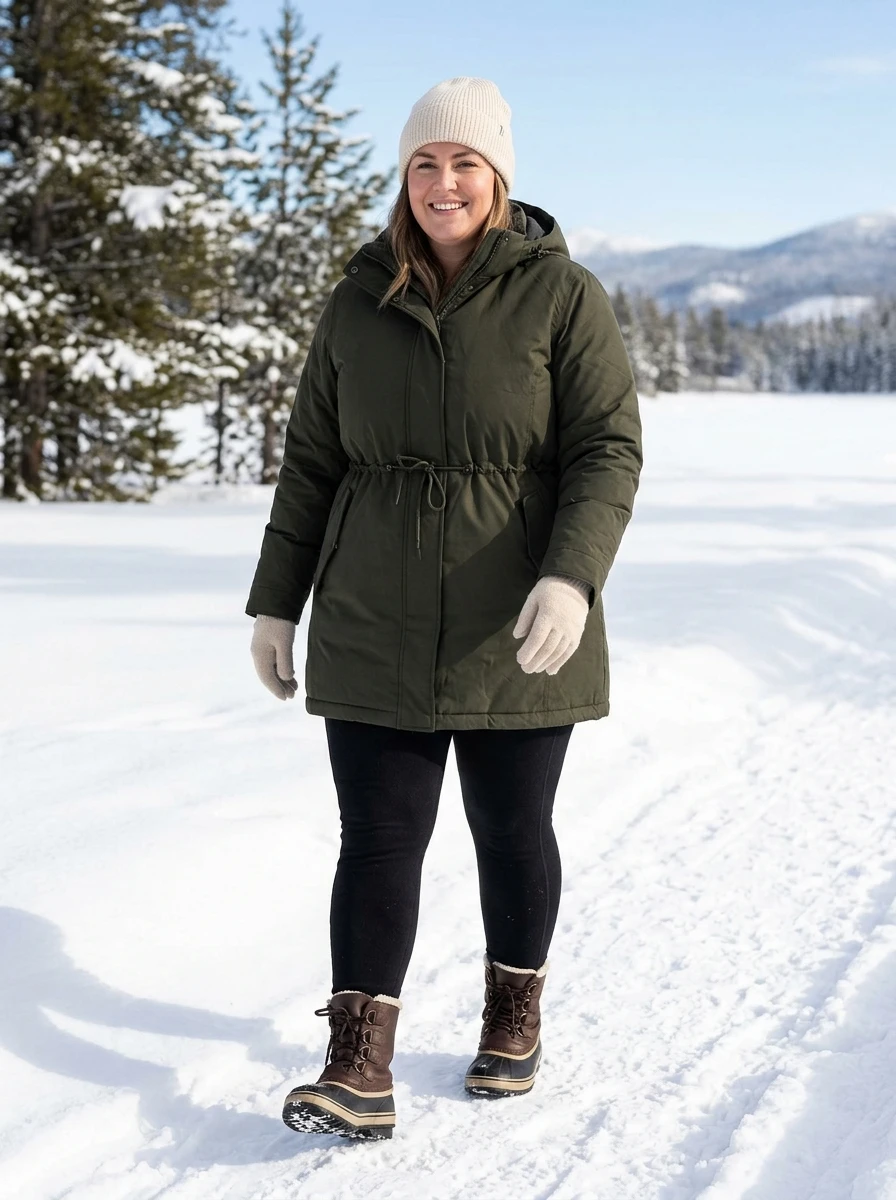
Cinched-waist parka and fleece-lined leggings. A parka with a cinched or belted waist defines your shape even in heavy winter gear — the drawstring or belt is doing the same job as the wrap coat's tie, just in expedition-weight fabric. Pair it with thick fleece-lined leggings and sturdy winter boots with good traction, and you have the reliable uniform for long days outside. Because the parka is the focal point, everything else can stay simple.
Wear it with: thick fleece-lined leggings and sturdy winter boots with good traction; the parka is the focal point, so the rest stays simple.
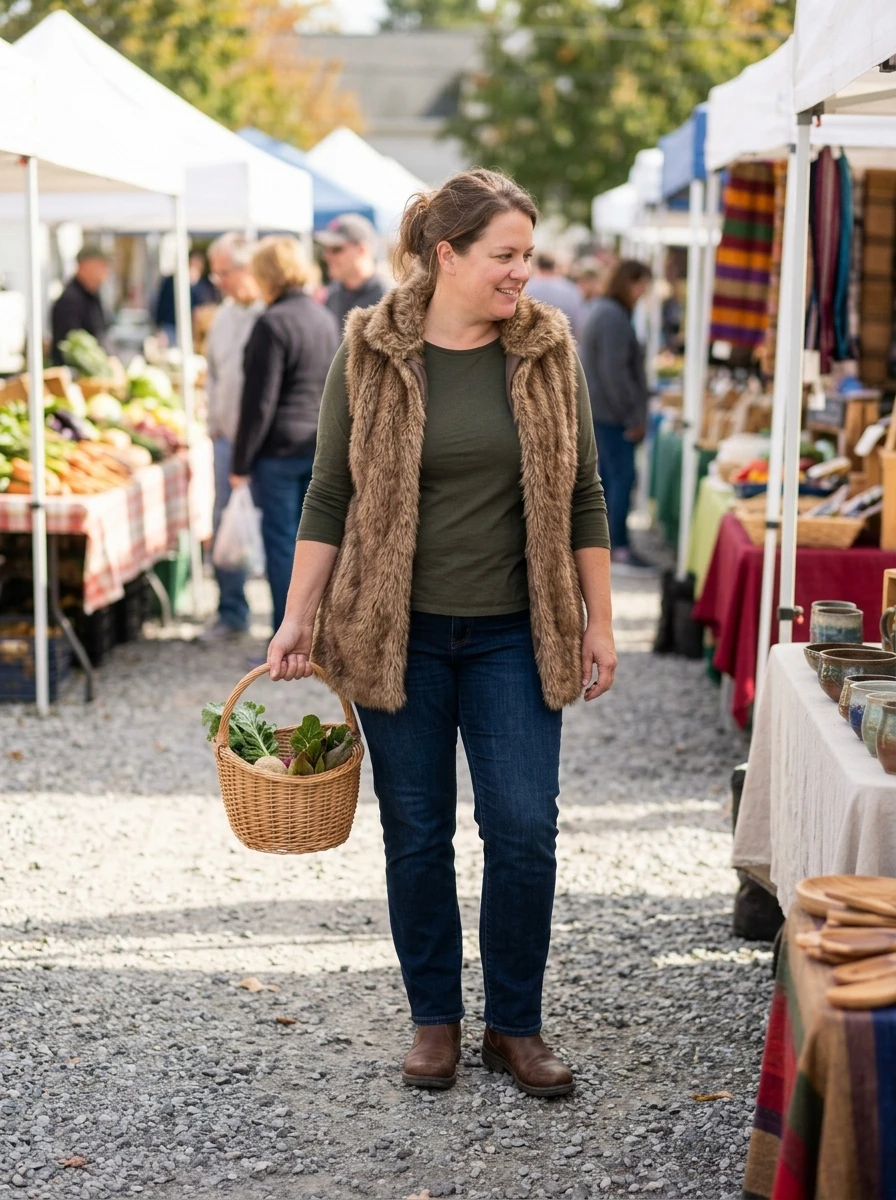
Faux fur vest as a mid-layer. Don't overlook the vest as serious outerwear strategy: worn over a long-sleeve tee or thin sweater, it insulates your core — where you lose the most heat — while leaving your arms free for driving, shopping, and everything active winter days demand. It's the layer you reach for when a full coat is too much and a sweater alone is too little.
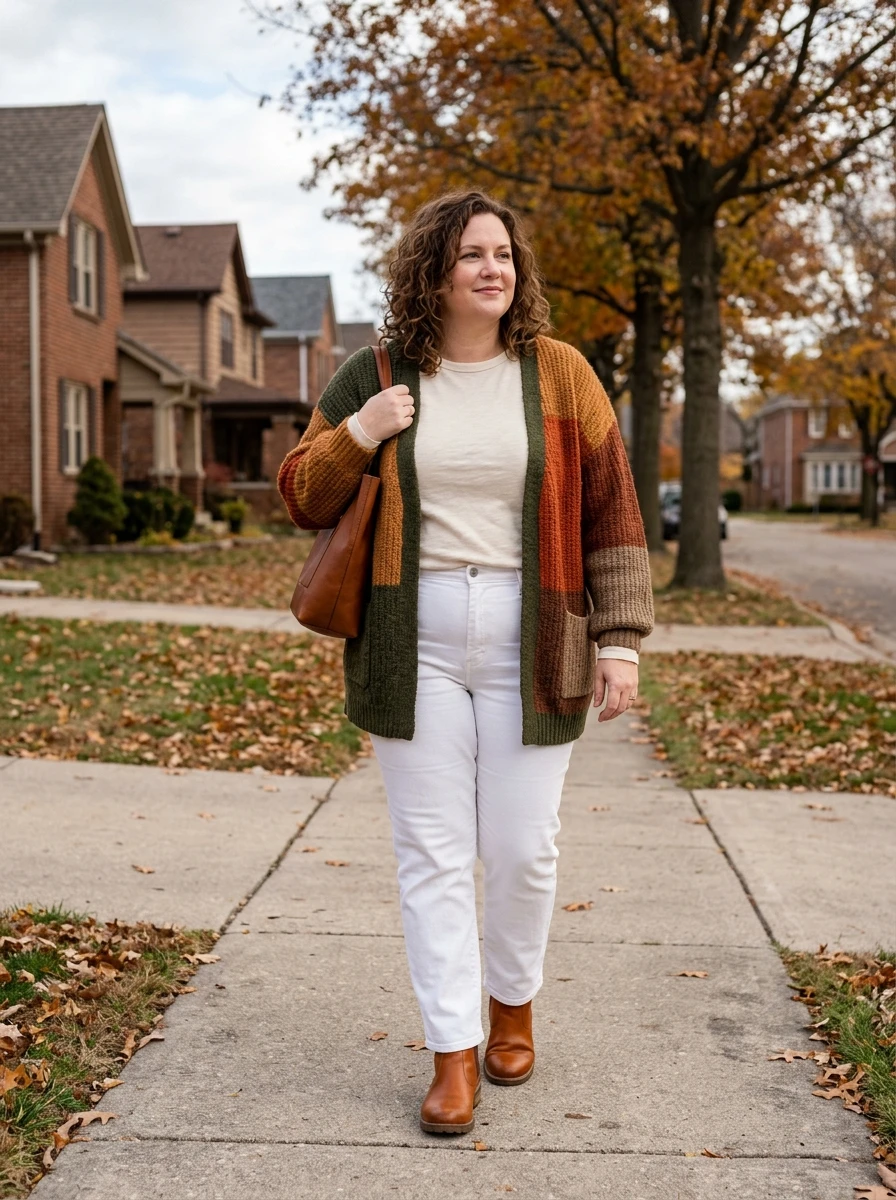
Color-blocked cardigan and white jeans. White denim in winter works when the rest of the outfit commits to the season: a heavy color-blocked cardigan in earth tones on top, tan or cognac boots below. The boots matter — they ground the white denim and tie it to the warmth of the knit. Keep the palette in the brown family and the whole thing reads intentional rather than summery.
Fit note: the boots ground the white denim, so keep them in tan or cognac; pale shoes would push the whole outfit back toward summer.
Fit Notes Specific to Plus-Size Bodies
A few construction details make the difference between winter clothes that fight your body and ones that work with it. Rise: high-rise trousers and jeans anchor tucked-in tops and define the waist without hardware; mid-rise is fine under untucked knits, low-rise rarely helps anyone in winter. Drape vs. cling: knits should fall from the bust or shoulder without stretching — if you see horizontal pull lines, the piece is too small or the wrong cut, not a sign you need shapewear. Skim vs. cinch: let skirts and wide-leg trousers skim past the hip; reserve cinching for the waist itself, via belts, ties, wrap closures, or elasticated waists that sit at your natural waistline rather than squeezing below it. Structure where it counts: defined shoulders in coats and blazers, a collar or neckline with some presence (turtleneck, high neck, V-neck), and shoes with visual weight (boots, loafers) keep an outfit from dissolving into softness. And when boots are part of the formula, make sure the calf actually fits — a knee-high boot that strains at the calf breaks the clean hem-to-boot line this whole guide is built on, so check calf measurements, not just foot size.
Common Questions About Plus Size Winter Outfits
What keeps winter layers from looking bulky?
Use the volume-with-structure rule: pair one oversized or chunky piece with something fitted, and give the outfit one clear definition point — a belted waist, a defined shoulder, or a tucked-in top. Build warmth from thin insulating base layers (merino thermals, fleece-lined tights) rather than stacking multiple heavy knits, and the silhouette stays clean.
Which fabrics keep you warm without adding bulk?
Merino wool and cashmere insulate well at relatively thin gauges, which is why a fine merino turtleneck under a blazer beats a chunky acrylic sweater for warmth-to-bulk ratio. For outerwear, down or quality synthetic fill traps heat efficiently. Fleece-lined trousers and thermal tights add serious warmth invisibly, and tightly woven wool — in coats, blazers, and A-line skirts — blocks wind far better than loose knits.
Can skirts and dresses work in the coldest months?
Yes — the formula is a heavier skirt fabric (wool, corduroy, or a substantial knit), opaque fleece-lined or thermal tights, and boots that meet the hem. A midi hem meeting a knee-high boot creates an unbroken line that keeps you warm and looks streamlined. Add a long coat and the exposed-leg question mostly disappears.
How do I choose a winter coat for a curvy frame?
Prioritize shoulder fit first — you should be able to layer a sweater underneath without the coat riding up when you move your arms. Defined or belted waists (wrap coats, belted trenches, cinched parkas) shape the torso better than straight cuts. Knee to mid-thigh length covers the hips without overwhelming shorter frames, and princess seams give shaping that a boxy cut can't.
Which boots work best for winter on wider calves?
Look for knee-high boots that publish calf circumference measurements and offer wide-calf options — the boot should close comfortably over your thickest winter layers, not strain. A block heel gives stability on ice, rubber soles give traction, and waterproof leather or treated synthetics handle slush. Ankle boots with a slightly wider shaft work over slim jeans and leggings when knee-highs aren't practical.
Your Winter Wardrobe Checklist
You don't need twenty-six new outfits — you need the handful of formulas that solve your actual mornings. Before winter starts, check off these five decisions:
- Coat first: one coat with a defined shoulder or belted waist, knee to mid-thigh, that fits over a sweater.
- One knit proportion: an oversized top with a slim base, or a fitted top with a full bottom, never volume on both halves.
- One texture pairing: velvet, satin, faux fur, or shearling against a matte knit, so neutrals never look flat.
- One dress-or-skirt formula: backed by thermal tights and boots that meet the hem.
- Hidden warmth: merino thermals, fleece-lined tights, and fleece-lined trousers doing the insulating where nobody can see it.
The throughline of everything here is simple: warmth comes from smart layers you can't see, and style comes from silhouette decisions you make on purpose — a defined shoulder, a waist you chose, a hem that meets a boot. Dress the architecture first, and the cold stops dictating how you look.