Fall Casual Dresses for Pregnant Women: A Comfort-First Guide to Bump-Friendly Style
How to use this guide
These are editorial styling suggestions, not a one-size-fits-all formula. Adapt each look to your wardrobe, proportions, climate, comfort, budget, and the occasion; the most useful idea is the one you can genuinely wear.
Picture a crisp October morning: the air finally has a bite, the leaves are turning, and you reach for a favorite fall dress — only to find it pulls across the middle, rides up when you walk, or presses exactly where it shouldn't. Sound familiar? Dressing a pregnant body for fall is a different problem than regular fall dressing. Your center of gravity has shifted forward, your feet swell by afternoon, your skin runs warmer than usual, and your torso is a different shape than it was last month. Generic fall advice ignores all of that. This guide doesn't.
Every dress below is judged on what actually matters when you're pregnant: does the cut make room for a growing bump without pulling? Does the fabric stretch and recover, or bag out by noon? Can you sit, walk, and bend in it? And will you still reach for it after the baby arrives? Those are the questions that separate a genuinely useful maternity dress from a regular dress someone labeled "bump friendly."
How to Judge Any Dress in Ten Seconds
Before the outfits, the principles — because once you know these, you can evaluate any dress on a rack in seconds.
Bump room comes from three sources: stretch fabric that grows with you (ribbed knits, jersey), adjustable shaping (wrap ties, empire waists, smocking), or intentional volume (swing and tiered cuts that were never meant to touch the waist). A dress with none of these three will fight your body by the third trimester.
The waistline question is really a pressure question. Anything pressing directly on the bump — tight waistbands, rigid belts, non-stretch seaming at the midsection — gets uncomfortable fast. The most flattering maternity lines sit either above the bump (empire) or float past it (swing, tiered, trapeze).
Fabric recovery matters more than fabric softness. A dress can feel soft in the fitting room and still be unwearable by 3 p.m. if the knit doesn't snap back. Ribbed knits and ponte recover; cheap jersey bags at the knees and seat. Scrunch the fabric in your hand — if it springs back, it will survive a day on a pregnant body. For the health side of dressing while pregnant, the NHS pregnancy guidance covers what to expect trimester by trimester, so style choices sit on top of solid general advice.
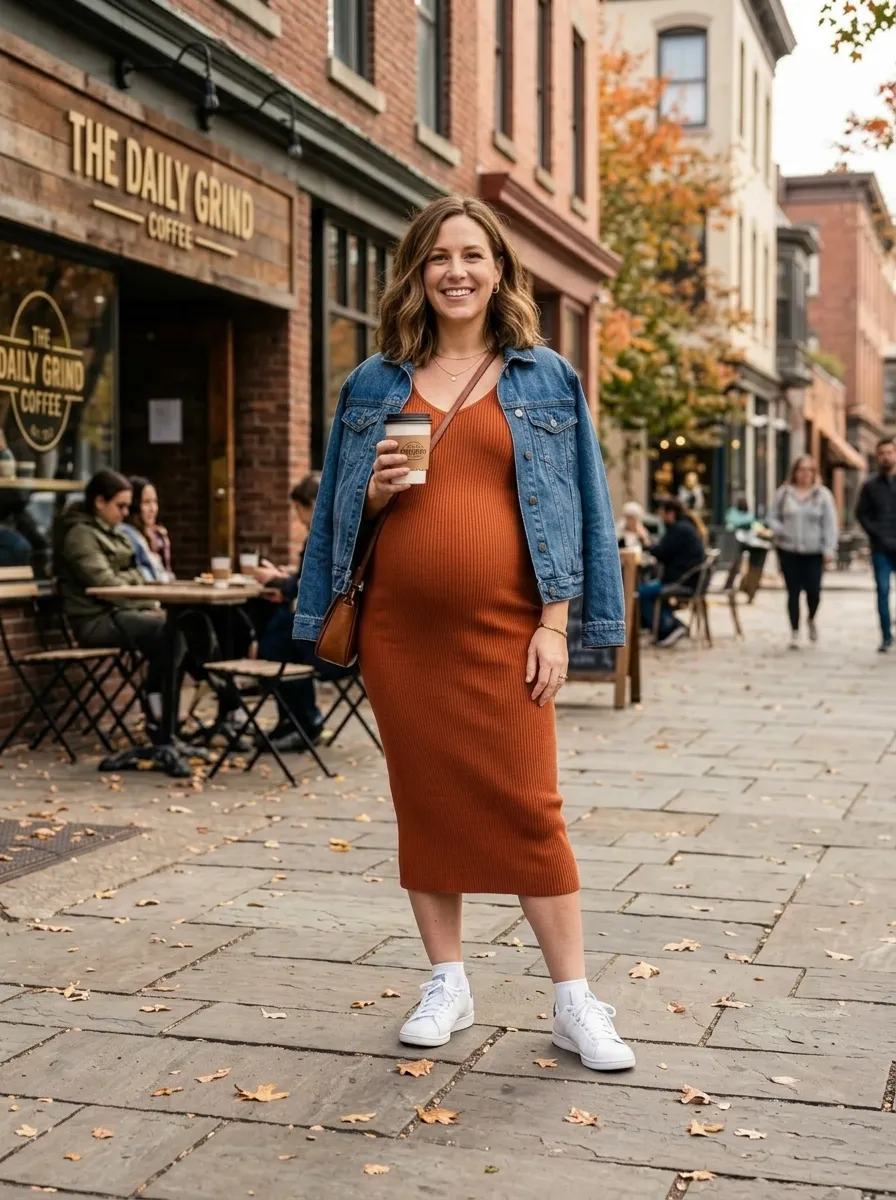
Ribbed Knit Midi Dress with Denim Jacket
The ribbed knit does the bump-accommodation work here: ribs stretch horizontally much further than flat jersey before they distort, so the dress grows with you instead of going sheer or saggy. The denim jacket adds the structure the soft dress lacks — defined shoulders and a collar give the outfit a frame. Keep the jacket open or half buttoned; buttoning it over the bump pulls the placket and gaps. White sneakers keep the base practical for days when you're on your feet.
Fit note: if the ribbing goes translucent when stretched across the bump, size up — the knit has hit its limit.
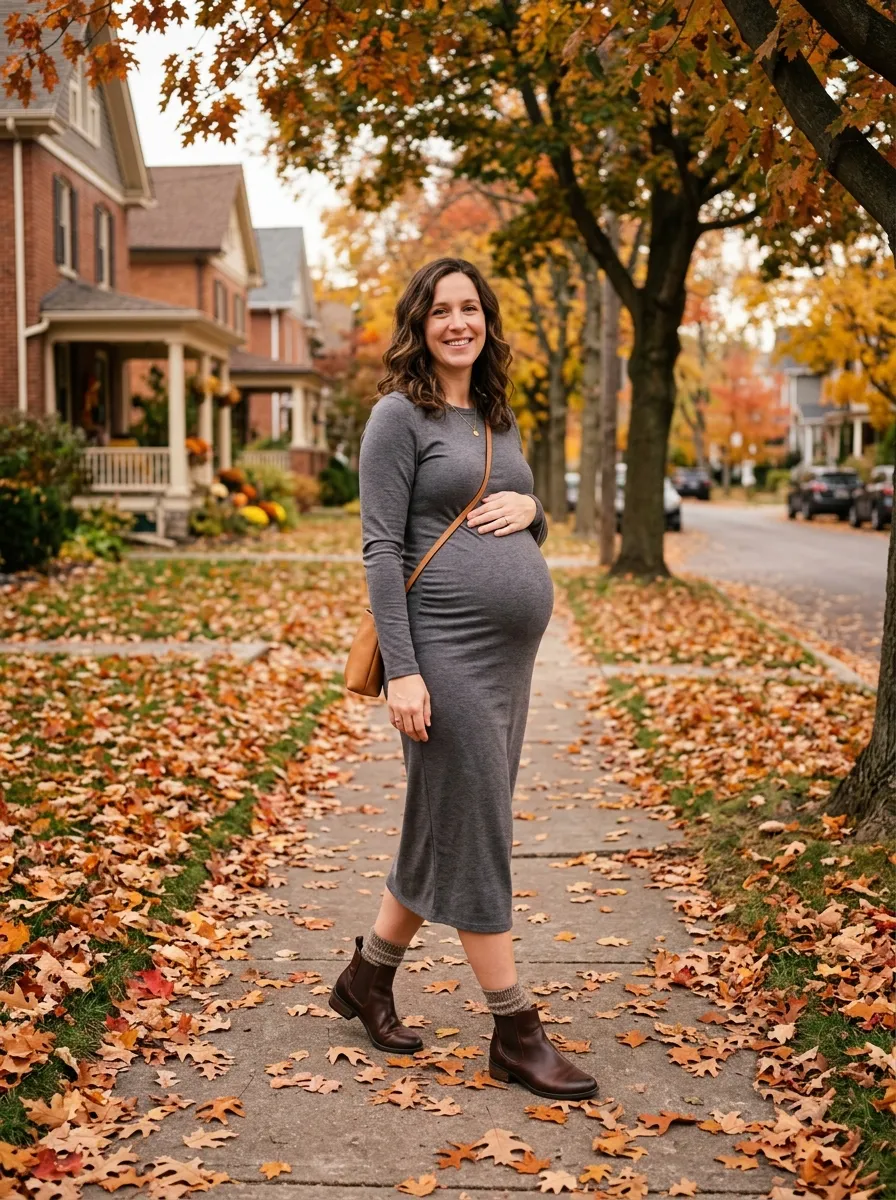
Long Sleeve T Shirt Dress with Ankle Boots
A t-shirt dress works pregnant for one reason: there is no waistline to fight. The silhouette runs straight from shoulder to hem, and the bump simply fills the available space. What to check is the knit weight — a substantial cotton-modal blend holds its shape all day, while thin jersey clings to every line and rides up when you walk. Ankle boots add polish and, practically, a low stable heel is kinder than flats when your arches are under extra load.
This is a second-trimester sweet spot: comfortable now, still wearable later if the knit has enough stretch.
Fabric note: look for a cotton-modal or cotton-spandex blend with a bit of weight; pure thin jersey is the version that clings and creeps up.
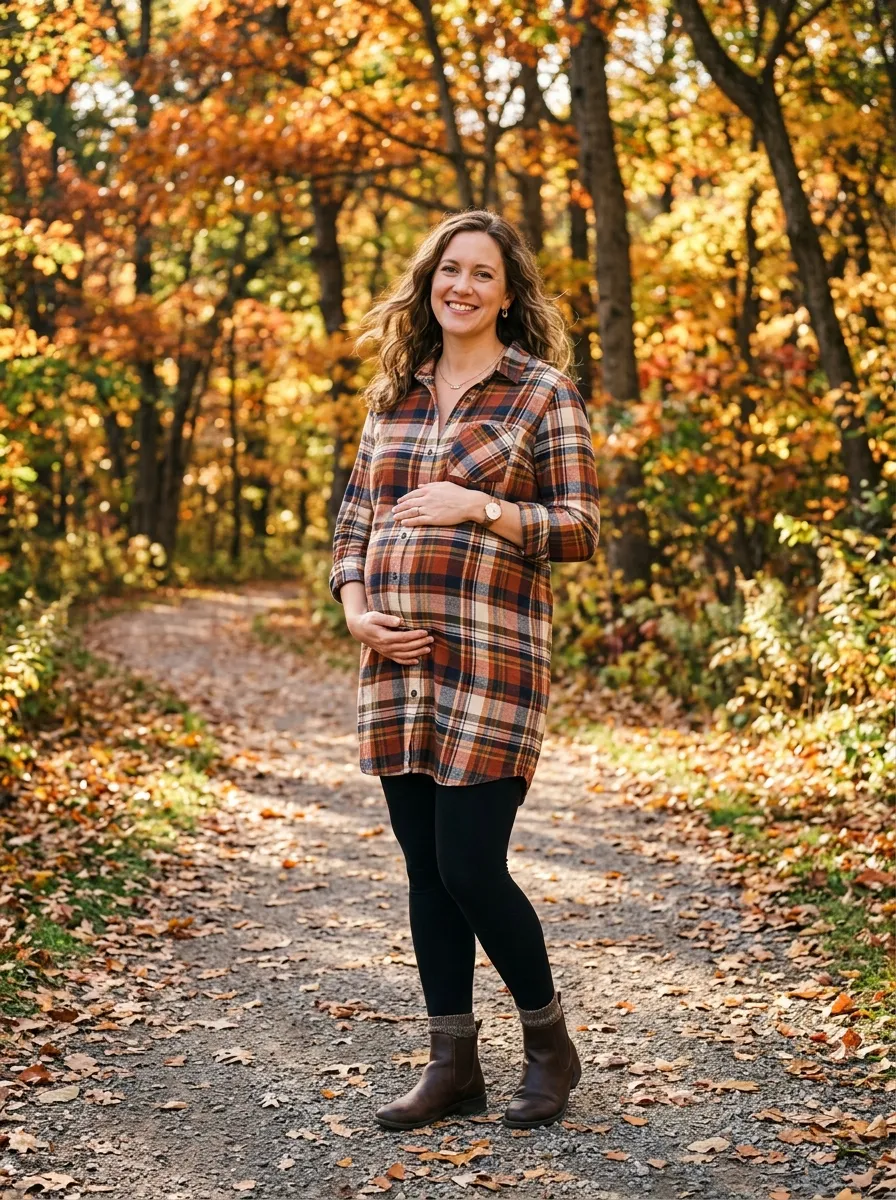
Button Down Shirt Dress with Leggings
The shirt dress earns its place through adjustability. Worn open over a tee and maternity leggings, it becomes a duster, with no bump interaction at all. Buttoned, it's a dress, and the buttons become your fit gauge: if they pull at the bust or bump, size up rather than fighting it. Maternity leggings underneath solve the coverage question that gets real in the third trimester, when hemlines ride up as the bump pushes fabric forward.
This is also one of the few dress outfits that works for video calls and office days — the collar reads as put together even when everything else is about comfort.
Wear it with: opaque maternity leggings and a low boot; the leggings handle coverage so the dress length stops being a worry.
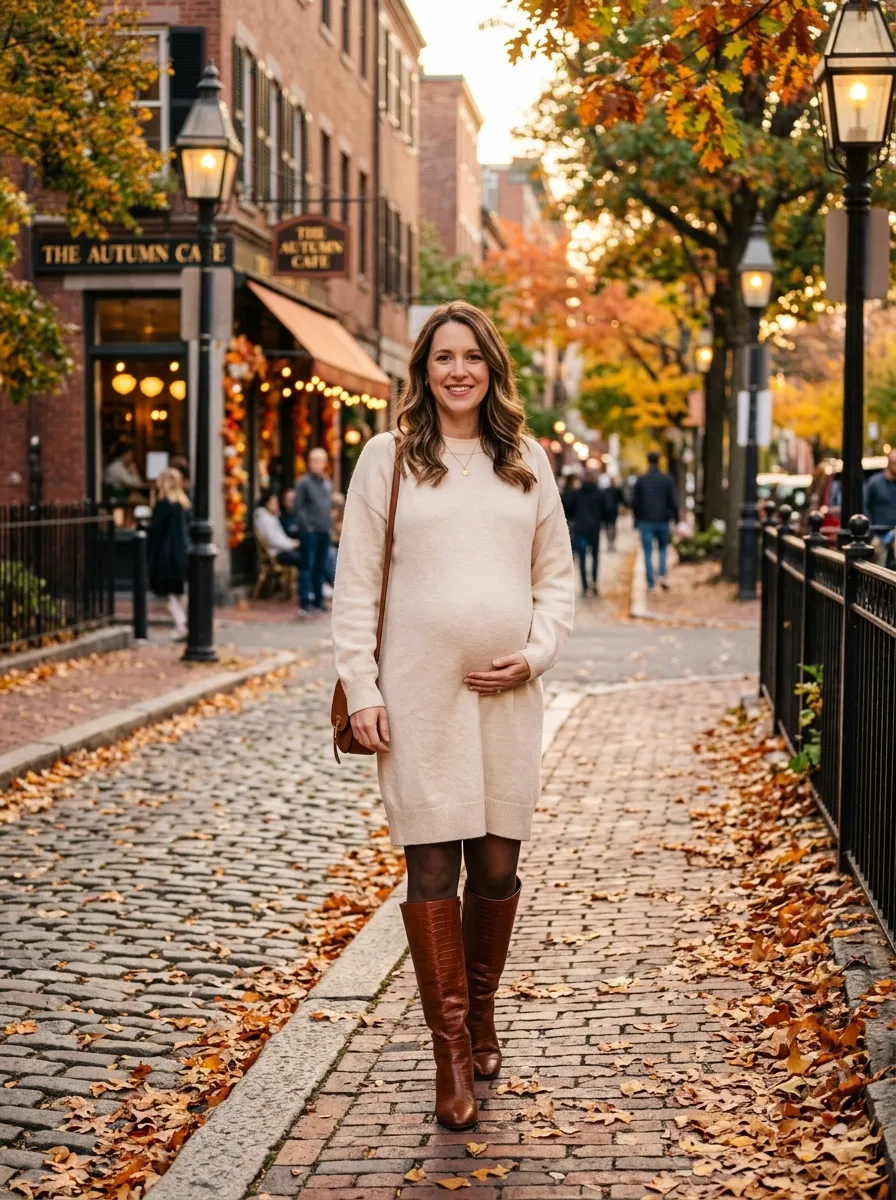
Sweater Dress with Knee High Boots
Sweater dresses and pregnancy are a natural match because knit is inherently forgiving — but the knit choice matters enormously. A loose-gauge chunky knit drapes over the bump without clinging; a fine-gauge bodycon knit will map every curve, which is fine if that's the look you want, less fine if you don't. The real decision is fiber: wool can itch against pregnancy-sensitized skin, so cotton-cashmere or cotton-modal blends are the comfortable choice.
Knee-high boots do double duty: warmth as temperatures drop, and a long vertical line that balances the softness of the knit. For more sweater dress styling, see these ways to style a sweater dress.
Fabric note: cotton-cashmere and cotton-modal blends are the safe bets; pure wool is the one to test against your skin before committing to a full day.
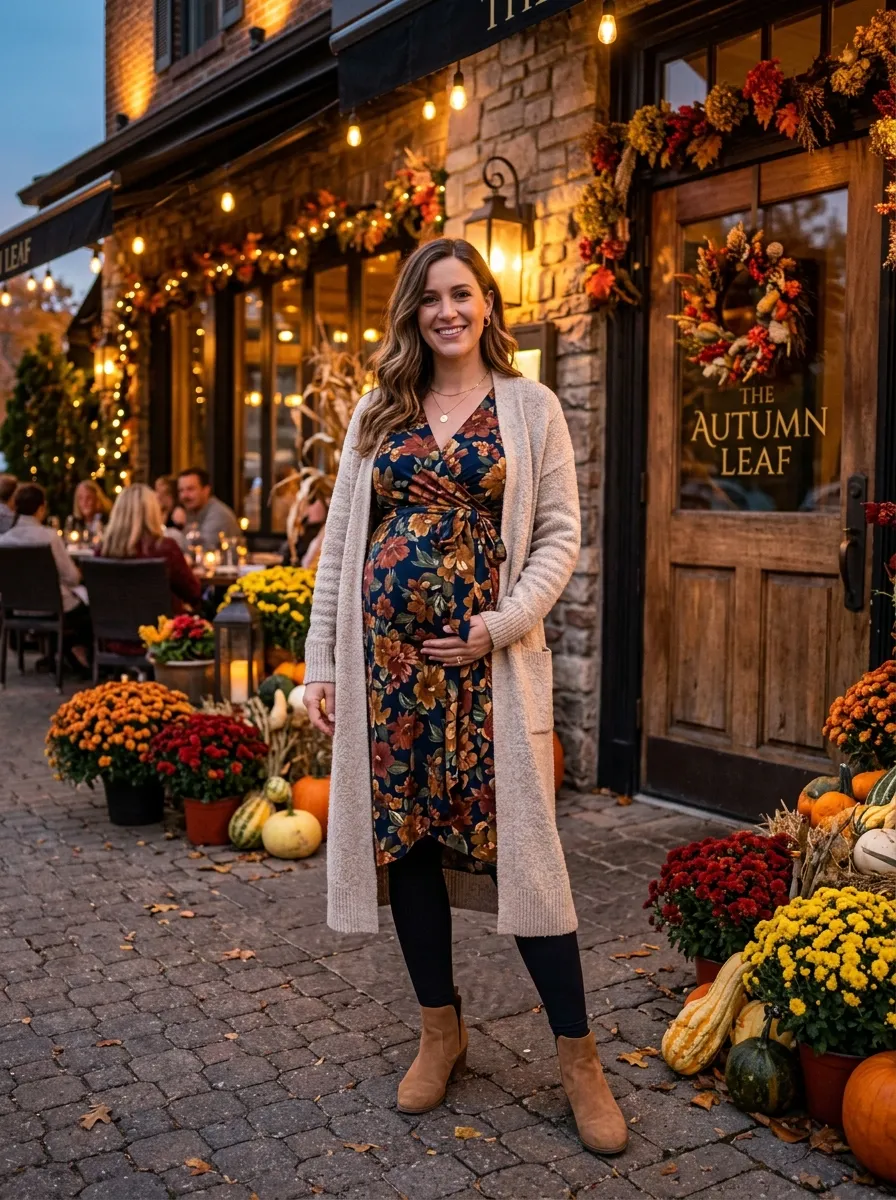
Wrap Dress with a Long Cardigan
The wrap dress is arguably the single best maternity silhouette ever designed, because the fit is continuously adjustable — you retie it as you grow — and the V-neckline draws the eye up toward the face instead of letting it settle on the midsection. Tie the sash above the bump, at the empire line, never across it. The long cardigan adds warmth without a single pressure point: no waistband, no buttons pulling, just drape.
This combination also transitions to postpartum beautifully, since wrap dresses accommodate nursing access, making it one of the highest cost-per-wear pieces on this list.
Fit note: the sash belongs at the empire line, just under the bust — tied across the bump it becomes a pressure band by mid-afternoon.
Maxi Dress with a Cropped Leather Jacket
A jersey maxi is the lowest-effort pregnant outfit that exists: one piece, no waistband, full coverage. The cropped leather jacket is what keeps it from reading as "I gave up" — it adds edge, defines the shoulder line, and, crucially, ends above the bump so it never competes with it. The maxi length needs attention as your center of gravity shifts: a hem that dragged slightly pre-pregnancy becomes a genuine trip hazard in the third trimester. If it's pooling at all, hem it or choose the ankle-grazing length.
Care tip: wipe the jacket down after rainy days and let it air dry — damp leather stiffens and loses its drape, which is exactly what you don't want over a bump.
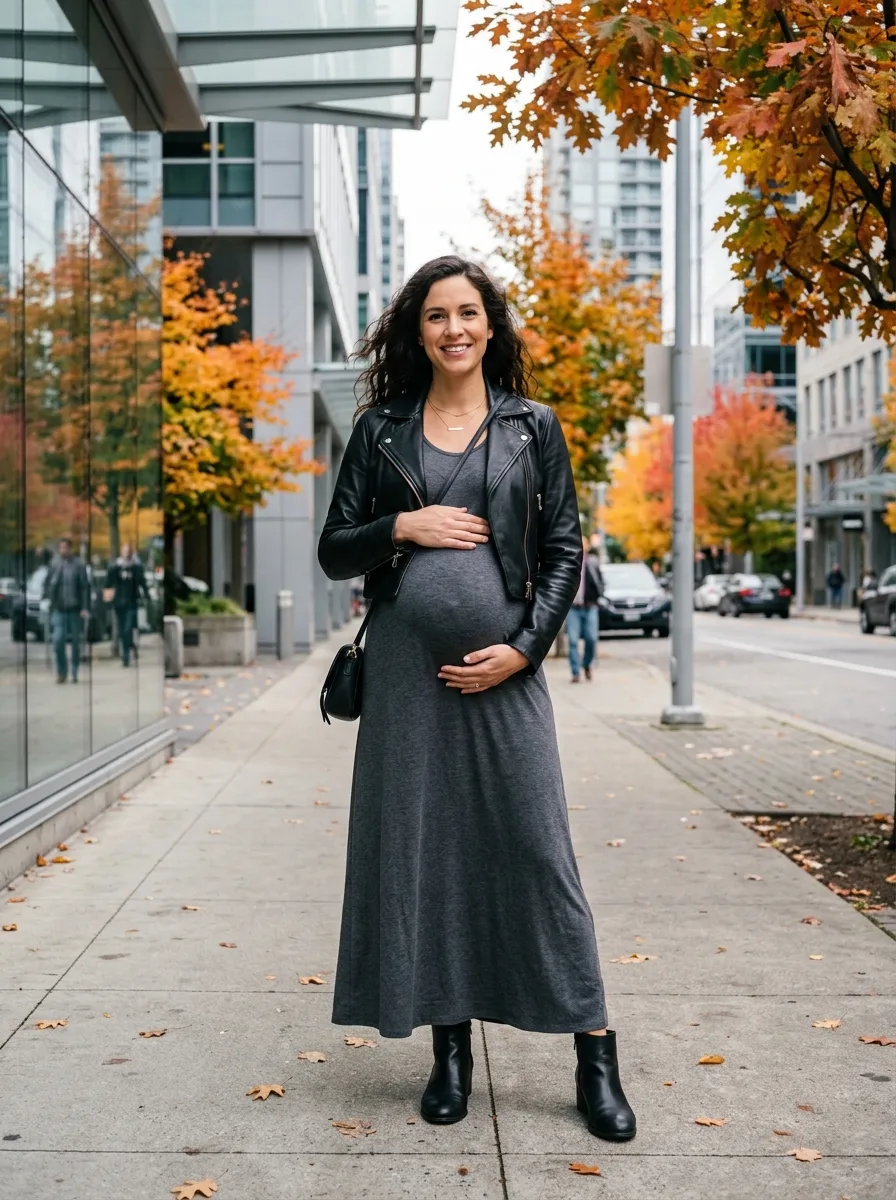
Corduroy Pinafore Dress with a Turtleneck
The pinafore works pregnant because the fit happens at the shoulders and the body of the dress hangs free — the bump never encounters a single seam it has to negotiate. Adjustable straps are the feature to look for; they let you lengthen the dress as your torso effectively shortens (the bump pushes everything up). Corduroy is a strong fall choice because the texture adds visual interest without needing prints, and it's durable enough to survive the extra friction pregnancy puts on clothing.
A thin turtleneck underneath, not a chunky one, keeps the layering from adding bulk at the straps.
Fit note: adjustable straps are non-negotiable here — fixed straps leave you no way to compensate as the bump pushes the hemline up.
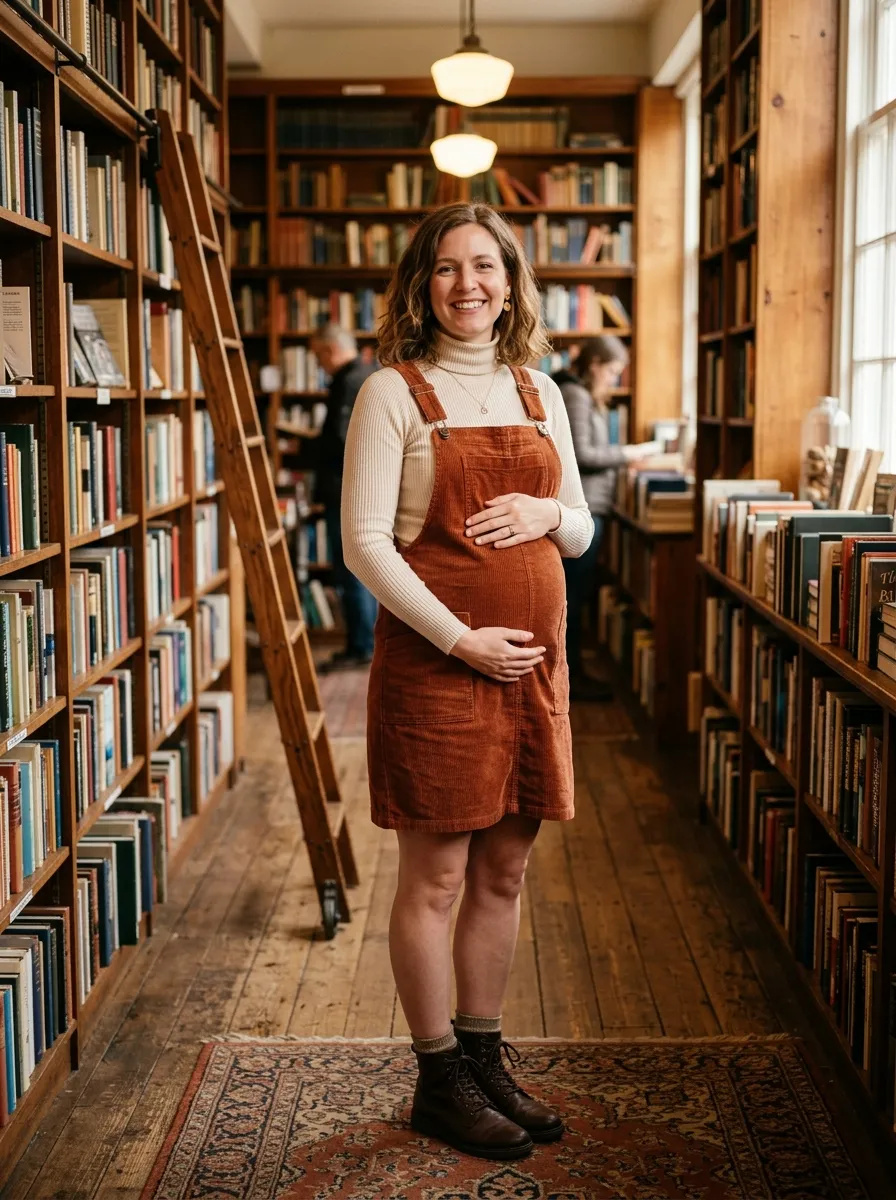
Flannel Shirt Dress with Combat Boots
Flannel's softness is genuinely soothing on sensitive pregnancy skin, and the shirt-dress cut gives you the open-or-buttoned versatility from outfit 3. The styling move that makes this work: tie the waist at the back instead of the front. A front tie presses on the bump; a back tie gives you the shaping without the pressure.
Combat boots are the right shoe here for a reason beyond aesthetics — the ankle support and lug soles are genuinely useful when your balance is compromised and fall sidewalks are slick with leaves.
Wear it with: the waist tie knotted at the back, and thick socks inside the boots for extra cushioning on long walks.
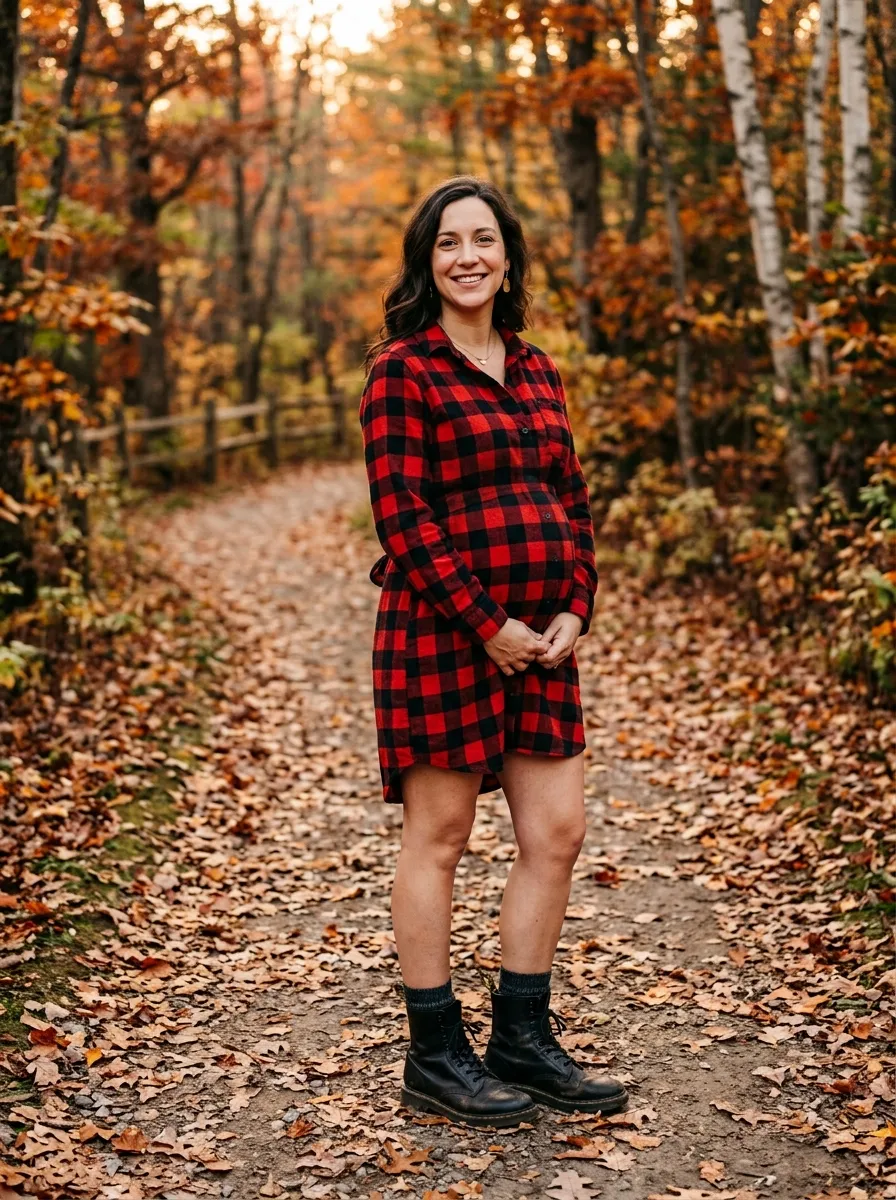
Velvet Slip Dress with a Chunky Knit Sweater
Wearing the sweater over the slip dress — sweater as the "top," dress as the "skirt" — is a clever way to get two garments out of pieces you already own. For pregnancy specifically, this works because neither piece has a defined waist: the sweater skims, the dress flows, and the bump fills the space between them without resistance. Velvet's pile can show pressure marks, so this is a shorter-duration outfit, perfect for a dinner or event, less ideal for a ten-hour day.
The sweater's weight also matters: a heavy knit will drag the slip dress's straps, so keep the knit medium weight.
Care tip: hang velvet rather than folding it, and steam out pressure marks instead of ironing — direct heat crushes the pile permanently.
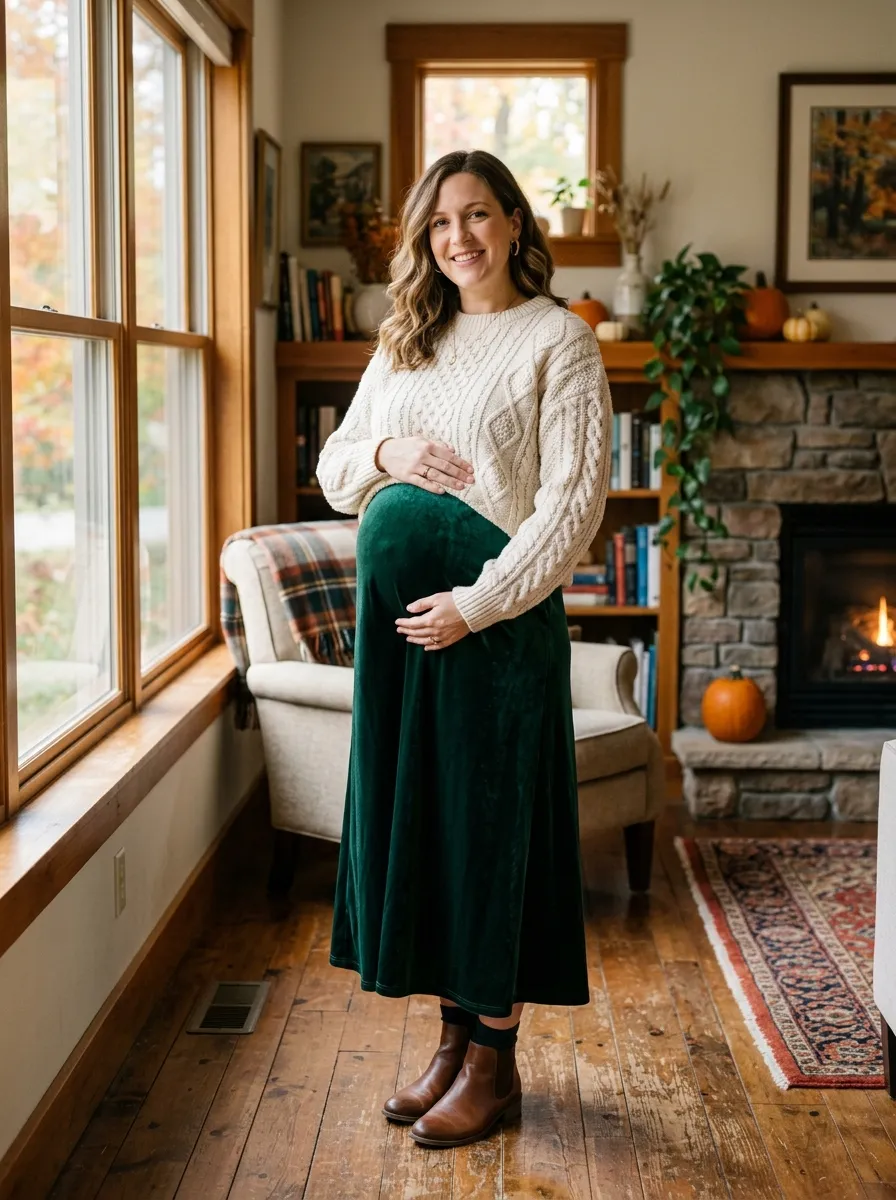
Denim Shirt Dress with Patterned Tights
Denim reads as structured, but a shirt dress in lightweight denim (not rigid jeans weight) actually moves well — the key is the fabric weight, which should feel like a heavy shirt, not like jeans. The patterned tights aren't just decoration: opaque tights add real warmth as fall progresses, and the pattern draws the eye down the leg, balancing the visual weight of the bump up top.
This is a good third-trimester option because the shirt-dress buttons give you the same fit gauge as outfit 3, and the A-line cut never binds.
Fabric note: lightweight denim with a touch of stretch is the version that works; rigid, heavyweight denim will gap at the buttons and fight the bump.
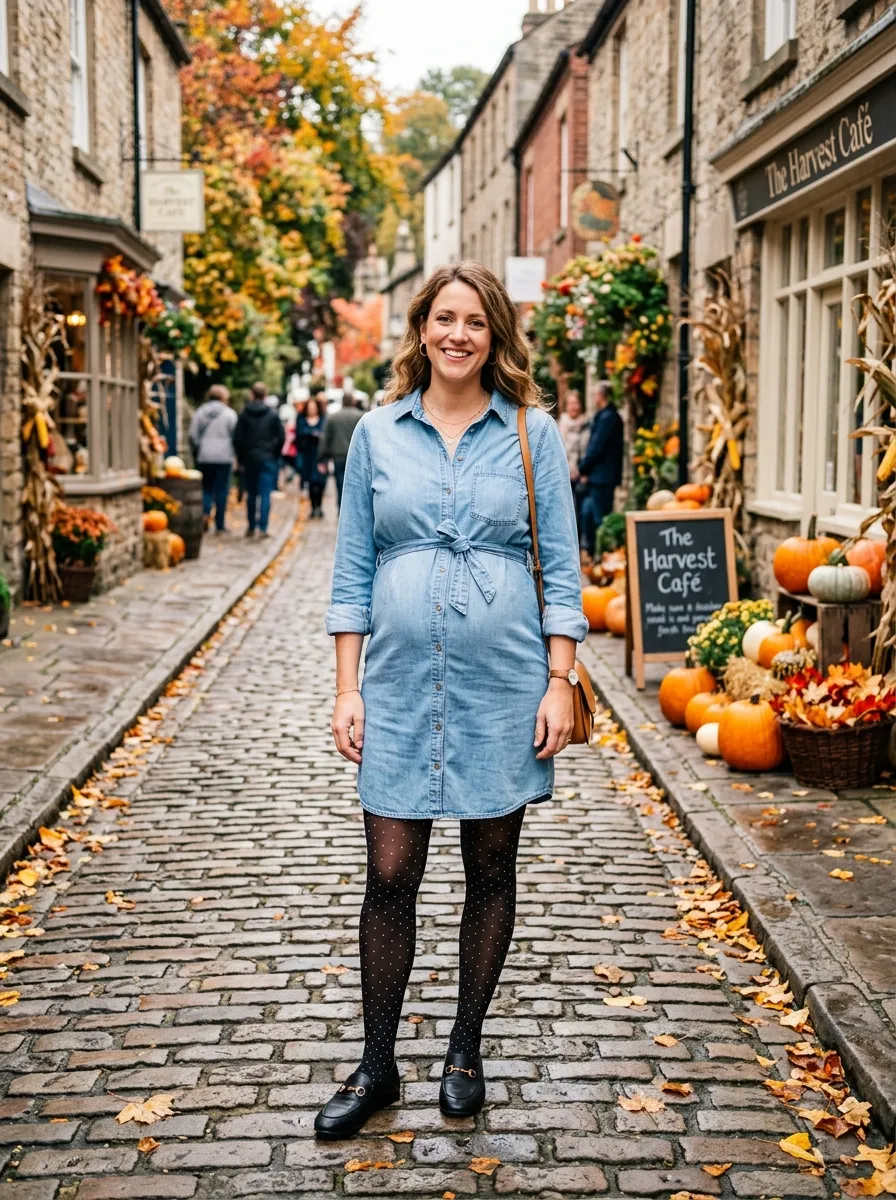
Swing Dress with a Denim Vest
The swing silhouette — narrow at the shoulders, widening toward the hem — is one of the few cuts that looks the same pregnant as not pregnant, because it was never relying on the waist to begin with. The denim vest breaks up the volume and adds a vertical line down the front, which keeps the swing shape from reading as a tent.
Practical note for later pregnancy: swing hems catch the wind, and a gust revealing more than intended is a real concern. Bike shorts underneath solve it completely and add thigh comfort for walking.
Fit note: if the swing dress has pockets, use them — they anchor the fabric and stop the hem from billowing in the wind.
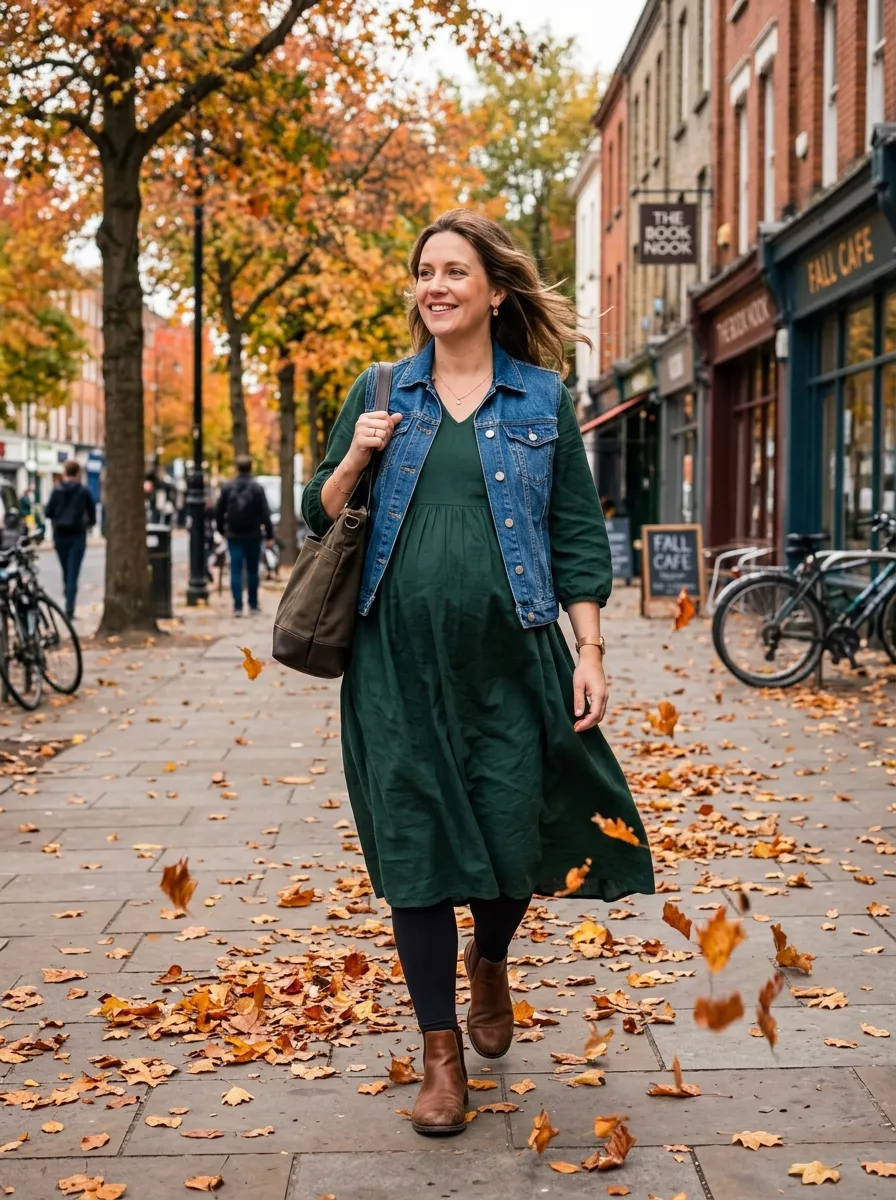
Floral Midi Dress with a Suede Jacket
Deep autumnal florals — burgundy, forest, mustard on dark grounds — keep a floral dress seasonally grounded in fall. The suede jacket adds the texture contrast that makes the outfit feel styled rather than just "a dress." Suede's vulnerability is water, so this is a fair-weather fall outfit; one unexpected rain shower can spot it. For pregnancy, the midi length is the practical sweet spot: long enough for coverage as hemlines shift, short enough to never be a trip hazard.
Wear it with: a suede-protector spray applied the day before, and keep a foldable umbrella in your bag — suede and surprise rain are a bad combination.
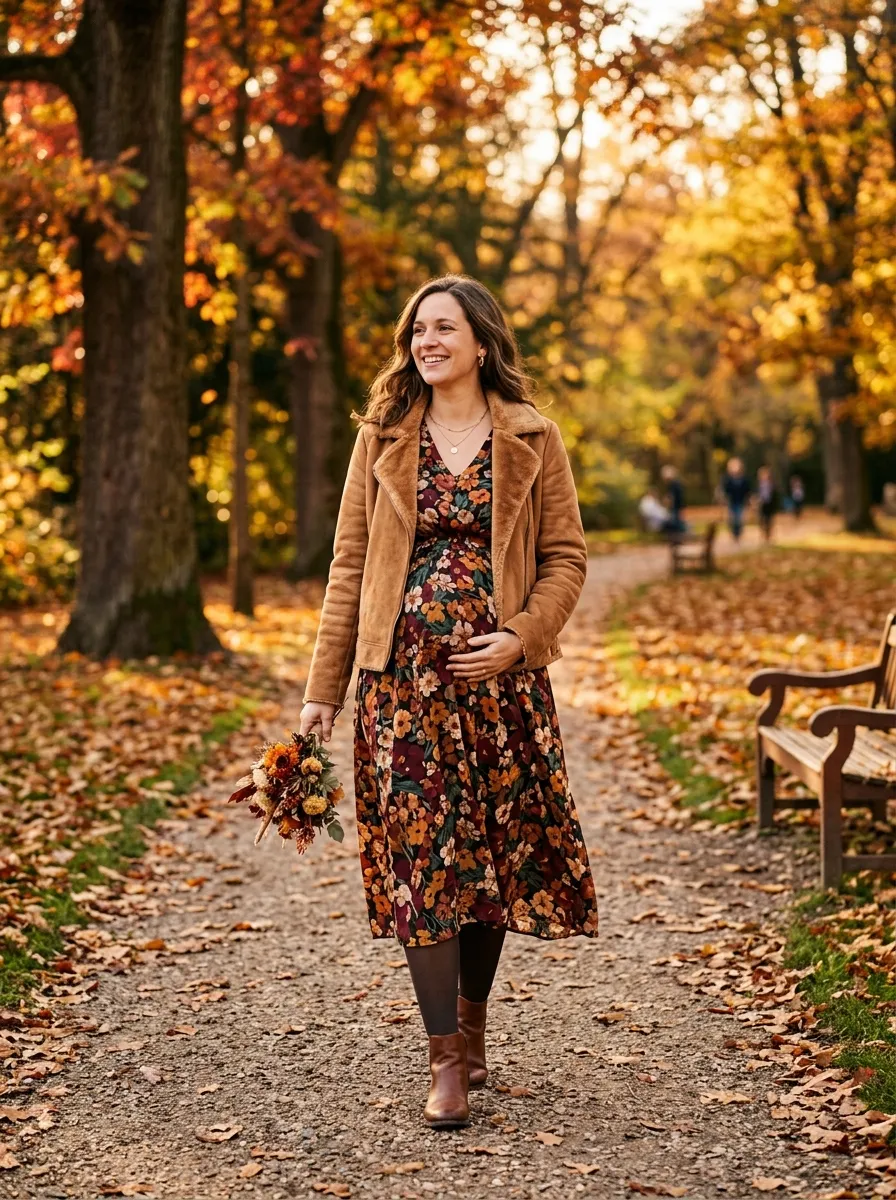
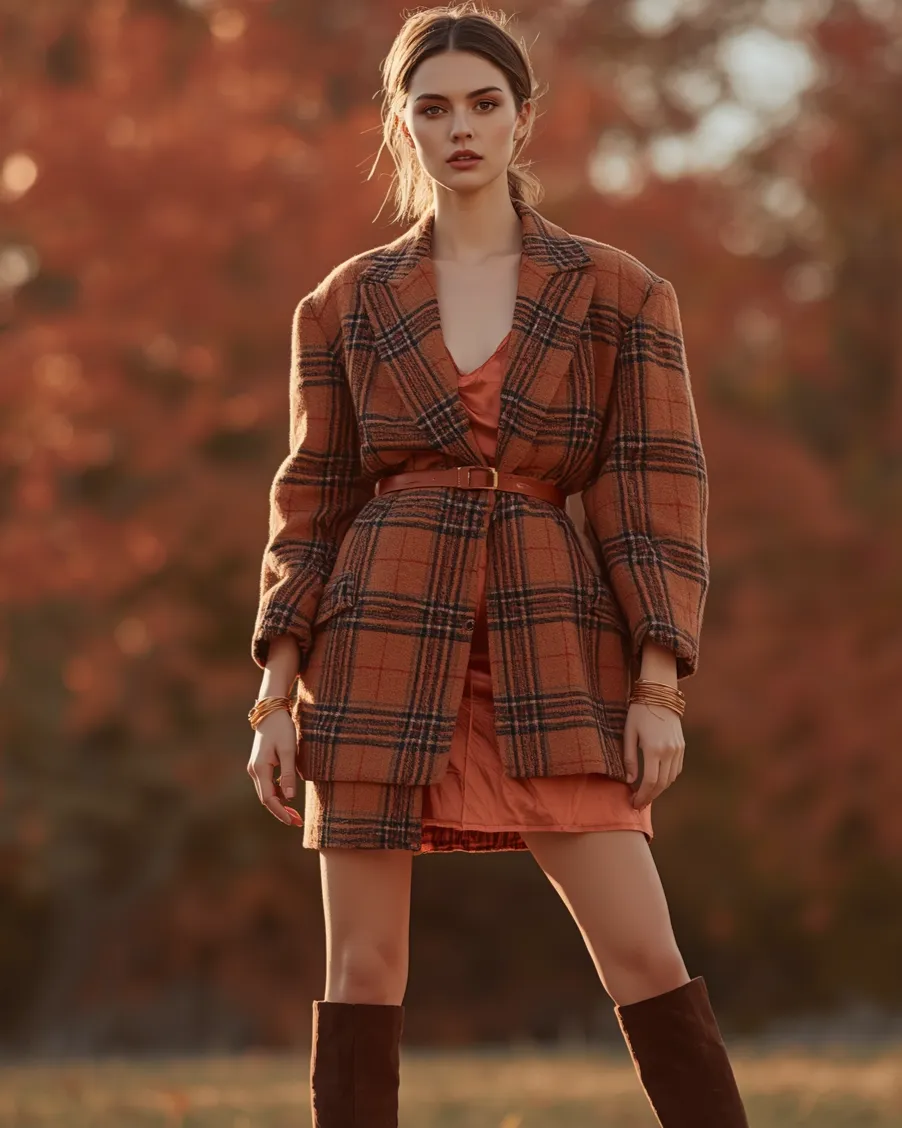
Bodycon Dress with an Oversized Blazer
The bodycon-plus-blazer formula is about contrast: the dress shows the bump proudly, the blazer adds professional structure around it. This is the outfit for the pregnant woman who is tired of being dressed in tents — it says the bump is the point. The blazer must be genuinely oversized, not just "your size in a blazer": it needs to close (or nearly close) over the bump without pulling, which usually means sizing up one or two from your pre-pregnancy size.
Unstructured, unlined blazers drape better over a bump than stiff padded-shoulder ones. For blazer styling beyond pregnancy, see these ways to style a black blazer.
Fit note: size the blazer to close over the bump, not to your pre-pregnancy shoulders — one to two sizes up is normal here, not a mistake.
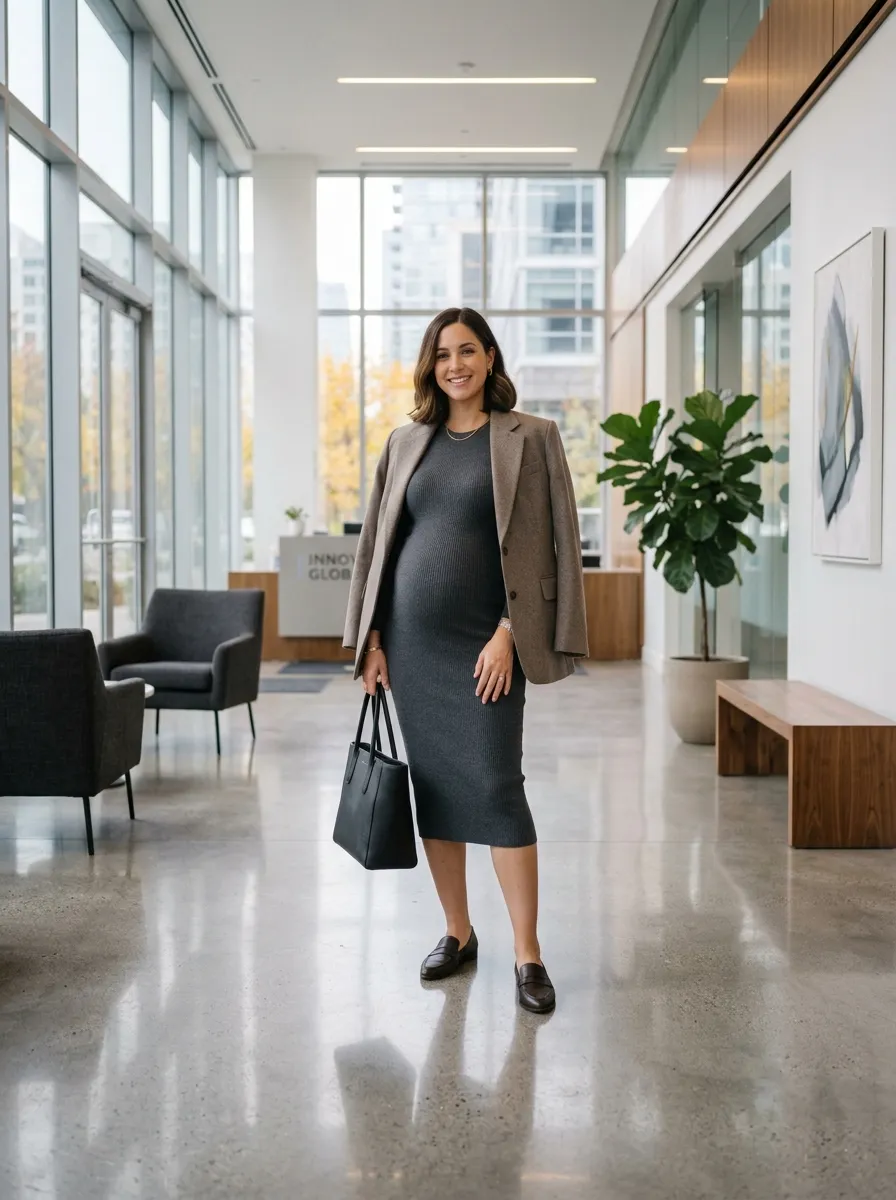
Tiered Smock Dress with Chelsea Boots
Tiered smock dresses are a maternity cheat code: the tiers are cut to flare from an empire or shoulder yoke, which means the dress was designed to never touch the midsection. It fits at 20 weeks and at 38 weeks with zero adjustments. The smocking (the elastic shirring) usually sits at the bust or back, well above the bump. Chelsea boots are the ideal shoe pairing for a purely practical reason — in the third trimester, bending to zip boots gets genuinely difficult, and pull-on Chelseas eliminate that struggle entirely.
Care tip: wash smocked dresses on a gentle cycle and air dry; high dryer heat degrades the elastic shirring that makes the fit work.
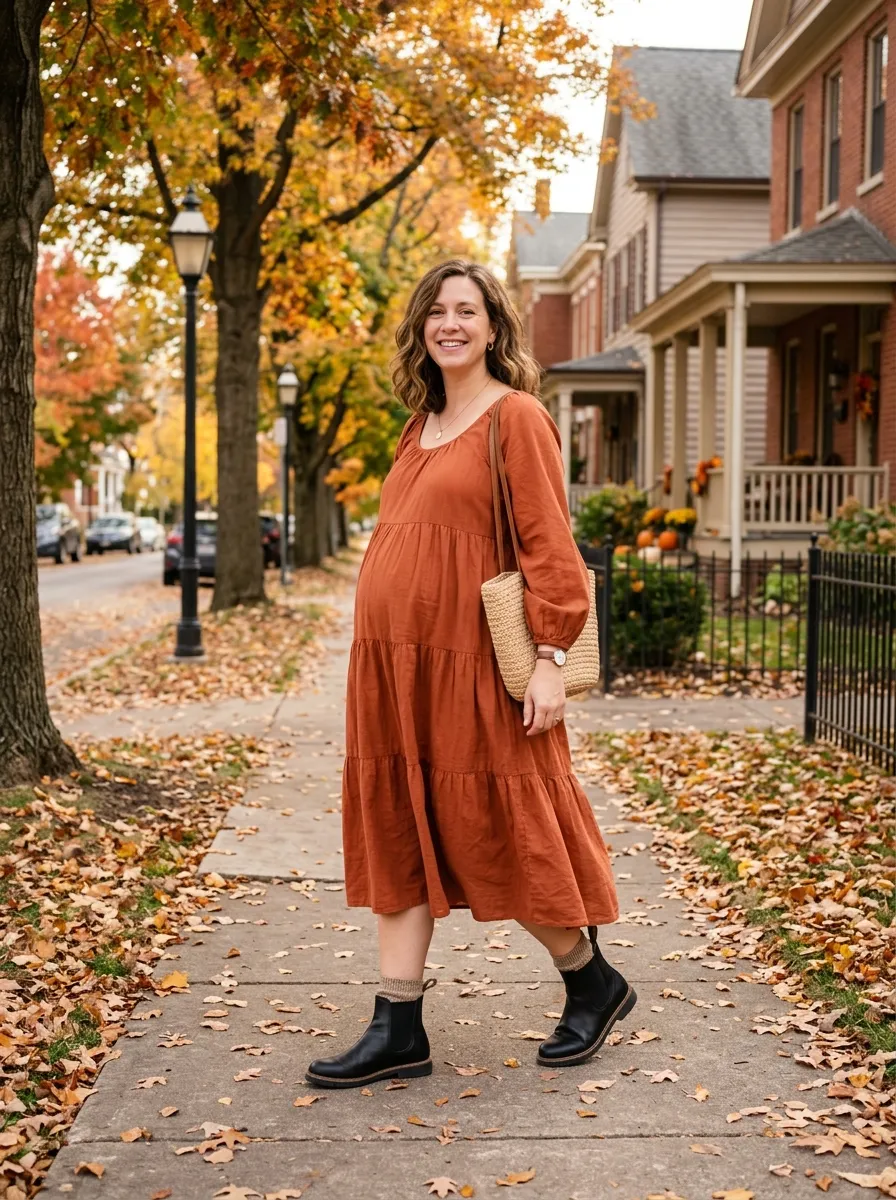
Turtleneck Sweater Dress with a Belt
The belt-above-the-bump styling creates an empire line, which is the most flattering horizontal line available during pregnancy — it marks the narrowest point of the torso (under the bust) instead of fighting the widest. But the belt itself needs to be soft and elastic; a rigid leather belt becomes a tourniquet by hour three. Better yet, try a thin silk scarf as a sash — it gives you the visual line with zero pressure.
This is primarily a first-to-second-trimester look; by the third trimester, most women abandon the belt entirely, and that's fine.
Fit note: if the belt leaves a mark or you notice it by midday, swap it for a silk scarf sash — the line stays, the pressure goes.
For more on this, see casual outfits for women's everyday chic.
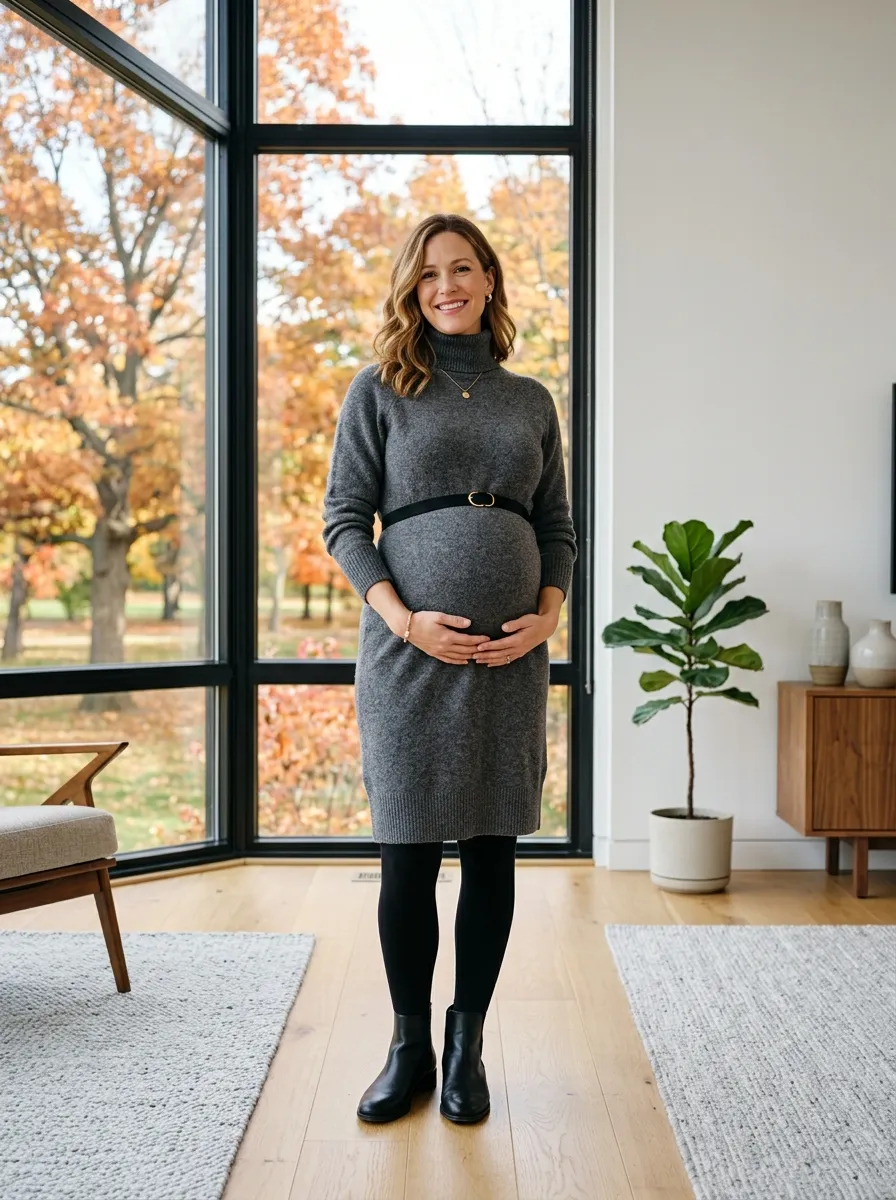
Shirt Dress with a Cropped Knit Sweater
Layering the cropped sweater over the shirt dress creates a visual two-piece: sweater as top, dress as skirt. For pregnancy, the value is temperature control — the sweater comes off when the inevitable pregnancy overheating kicks in (pregnant bodies run warm; overheating is one of the most common comfort complaints). The sweater must be genuinely cropped, ending above the bump; a regular-length sweater over a dress just adds a layer of bulk at exactly the wrong place.
Fabric note: a cotton or cotton-blend cropped sweater breathes far better than acrylic for this layer — it sits closest to your core, where the heat builds first.
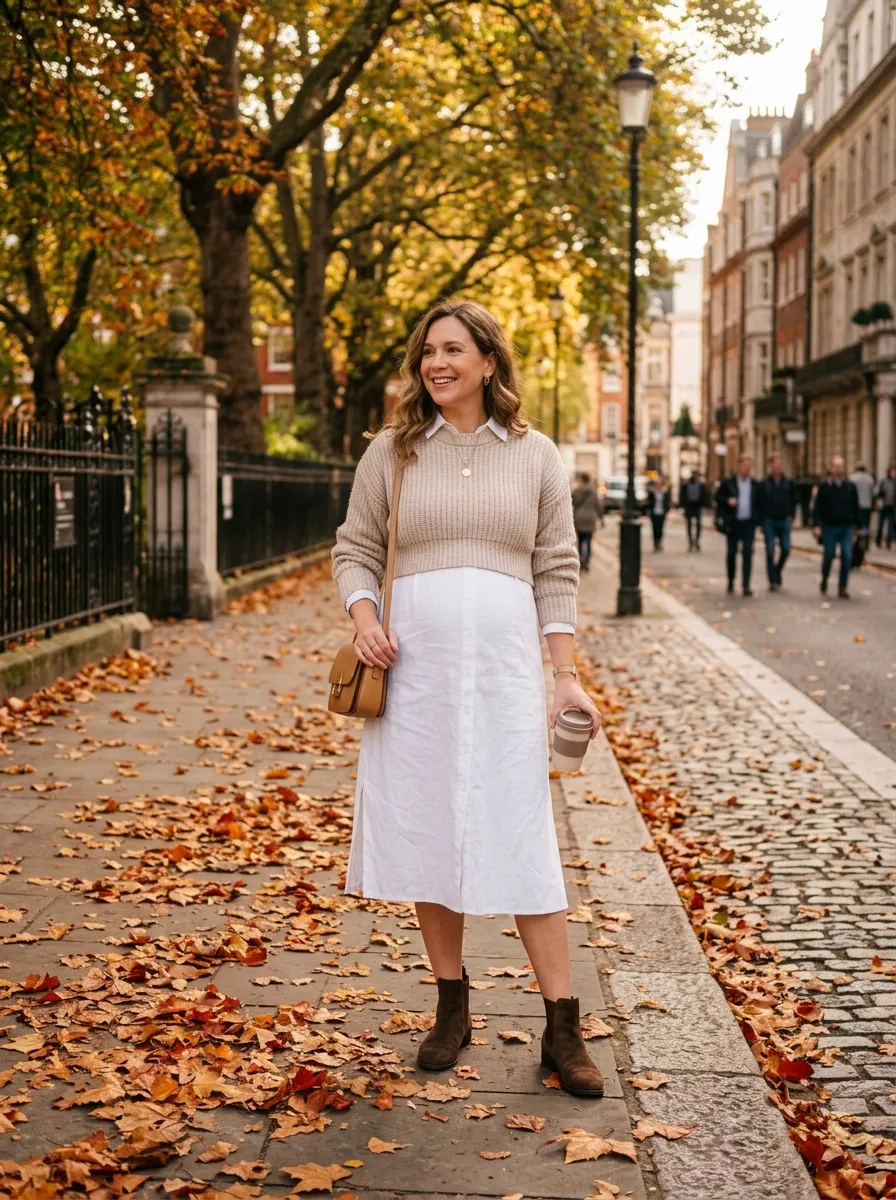
Ribbed Knit Maxi with a Long Scarf
This is the comfort-maximum outfit on the list: a ribbed maxi that stretches with you, plus a scarf that adds warmth and a vertical focal point. The scarf does real visual work — a long vertical line down the front of the body draws the eye up and down rather than letting it settle on the midsection. Keep the scarf lightweight; a heavy wool scarf adds neck and shoulder fatigue on top of everything else your body's carrying.
This is the outfit for the days when getting dressed feels like too much: one dress, one scarf, done.
Wear it with: a lightweight cotton or modal scarf in a contrasting tone — the contrast is what creates the lengthening vertical line.
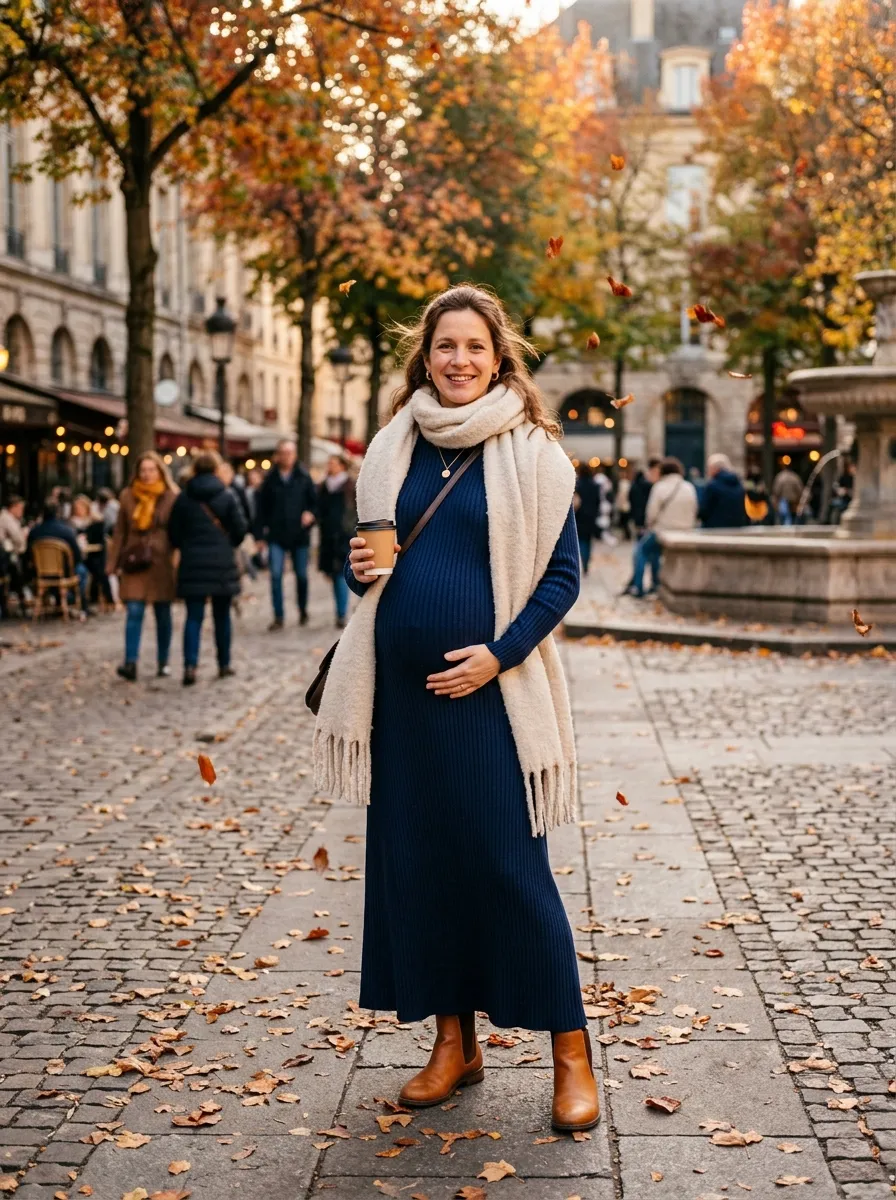
Utility Dress with Ankle Boots
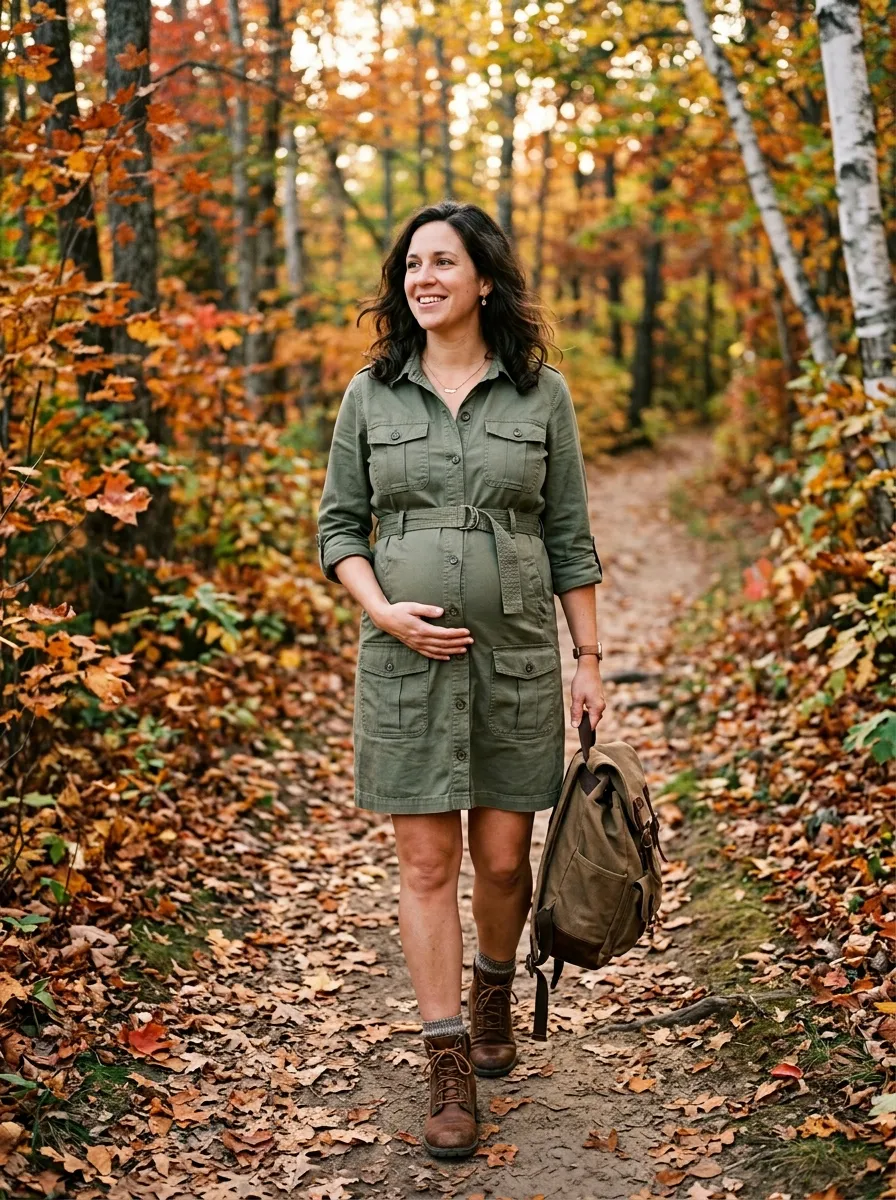
The utility dress's pockets are genuinely useful — phone, keys, lip balm, all without a bag digging into your shoulder. The button front gives you the fit gauge and ventilation control from outfit 3. The thing to check is the armhole and shoulder construction: utility styles cut for a straight-size frame can bind across the bust as it grows, so look for raglan sleeves or a relaxed shoulder line.
Ankle boots with a low block heel give you stability; stilettos and a shifting center of gravity are a bad combination on leaf-covered sidewalks.
Fit note: raglan sleeves or a dropped shoulder are what keep this from binding across a growing bust — a set-in, structured shoulder is the version to skip.
Midi Shirt Dress with a Faux Fur Vest
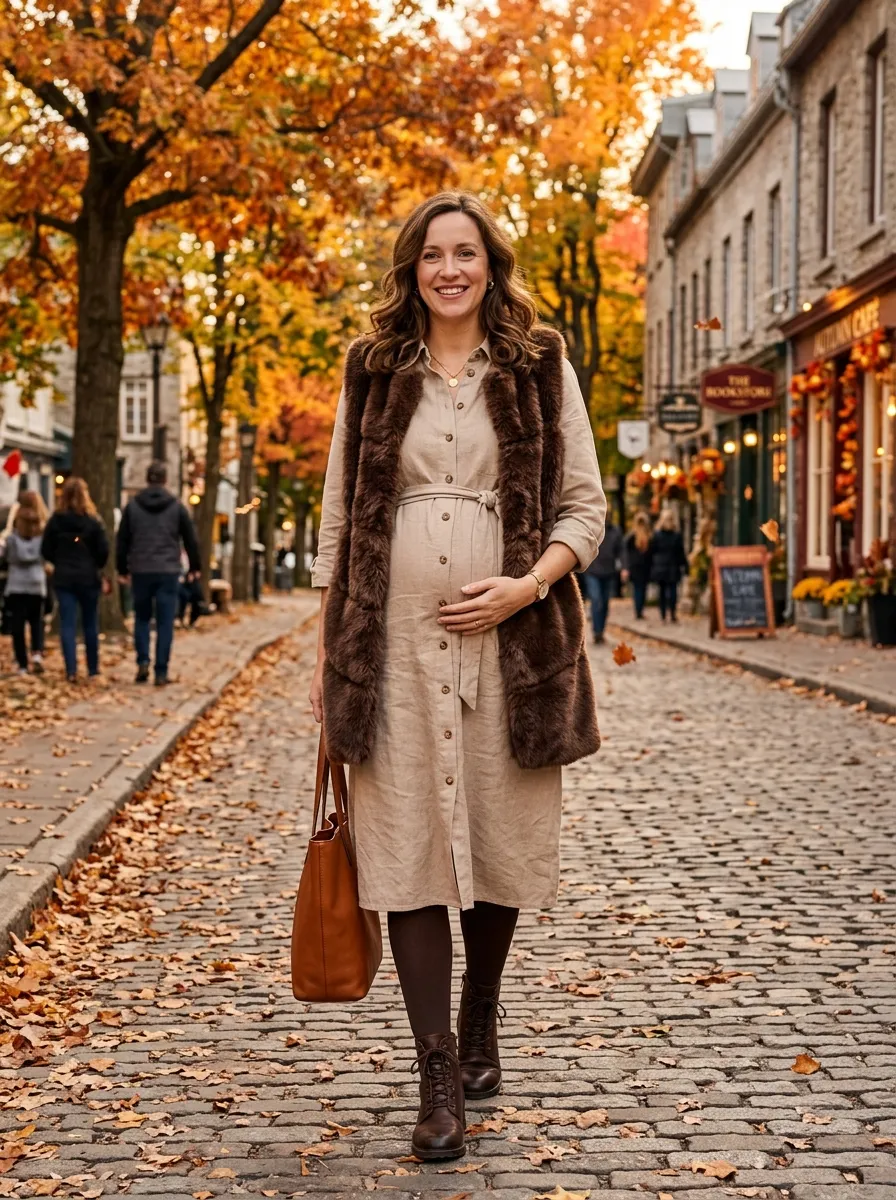
The faux fur vest is the statement piece here — it adds luxury and warmth in one layer, and because vests have no sleeves, there's zero armhole negotiation with a changing bust and shoulder line. The shirt dress underneath keeps the base simple so the vest can be the focus. This is an occasion outfit (dinners, events, photos) rather than a daily one, and that's fine — pregnancy doesn't pause your social life.
Choose faux fur with a smooth backing rather than a stiff one; it drapes better over the bump instead of tenting out from it.
Care tip: brush faux fur gently with a wide-tooth comb after wearing to keep the fibers from matting, and store it hung, never folded flat.
Common Questions About Maternity Fall Dresses
Which dress styles still fit comfortably in the third trimester?
Prioritize cuts that never relied on the waist: swing, trapeze, tiered smock, and empire-waist styles. These fit at 38 weeks the same way they fit at 20 weeks. Bodycon and wrap styles still work if the fabric has enough stretch, but anything with a fixed, non-stretch waistband is done by the third trimester — retire it without guilt.
Do I actually need a dedicated maternity wardrobe?
No — and buying one from scratch is rarely the best use of money for nine months of wear. Look in your own closet first for swing dresses, tiered styles, wrap dresses, oversized shirt dresses, and anything with smocking or an empire waist. The test is simple: does it have stretch, adjustability, or intentional volume? If yes, it's already a maternity dress.
Which fabrics hold up best on a pregnant body?
Ribbed knits, jersey with high spandex content, ponte, and cotton-modal blends — all stretch and recover. Avoid rigid wovens with no give (they'll pull and gap), and be cautious with wool against pregnancy-sensitized skin. The scrunch test never lies: squeeze the fabric, and if it springs back in seconds, it will survive a full day on a changing body. For week-by-week guidance on how your body changes, BabyCenter's pregnancy guide is a useful companion to the fit rules above.
What shoes make sense as pregnancy progresses?
As your center of gravity shifts forward and your feet swell, prioritize low stable heels or flats with arch support, pull-on styles (Chelsea boots) for the third trimester when bending is hard, and non-slip soles for wet fall leaves. Retire stilettos early — balance changes are real, and a fall is not worth the aesthetic.
How do I stay warm without overheating?
Pregnant bodies run warm, so the answer is always removable layers, never one heavy coat. A dress plus a cardigan, vest, or open jacket lets you vent the moment you overheat. Keep the base layer breathable (cotton, modal) and make the warmth modular — add or shed a layer as the day shifts.
Before You Buy: A Quick Checklist
- Cut: stretch, adjustability, or intentional volume — at least one of the three.
- Waistline: empire or floating, never pressing on the bump.
- Fabric: ribbed knit, jersey with spandex, ponte, or cotton-modal — and it passes the scrunch test.
- Hem: midi or ankle-grazing, never pooling at your feet.
- Shoes: low, stable, and easy to get on without bending in the third trimester.
- Layers: removable, so you can vent the moment you overheat.
The verdict: the secret to maternity style isn't a special wardrobe — it's knowing which cuts, fabrics, and lines work with a changing body instead of against it. Start with your own closet: pull every swing, wrap, tiered, and oversized shirt dress you own. You'll likely find you're already halfway to a maternity wardrobe, and the pieces will still be wearable long after the baby arrives.