How to Style Baggy Jeans So They Read Polished, Not Sloppy
How to use this guide
These are editorial styling suggestions, not a one-size-fits-all formula. Adapt each look to your wardrobe, proportions, climate, comfort, budget, and the occasion; the most useful idea is the one you can genuinely wear.
What if the jeans are not the problem at all? Baggy jeans get blamed for outfits that feel shapeless, but in most cases the denim is doing exactly what it was cut to do — the top half is the part that never got a plan. A wide leg is a statement on its own; it needs a partner, not a competitor, and once the upper half is sorted, the same pair of jeans can carry a brunch, a workday, and a night out without a single change below the waist.
That is the real appeal of baggy jeans as a year-round piece. The denim itself barely changes from July to October — what changes is the anchoring. A fitted cami in summer, a turtleneck under a quilted vest in fall. Twelve pairings follow, and every one of them runs on a single rule: a wide leg needs a counterweight. Something fitted, tucked, or structured up top keeps the proportion looking deliberate instead of accidental.
The Proportion Rule, Before the Outfits
Picture every outfit as a volume budget. Baggy jeans spend most of it below the waist, so the top has to spend sparingly. One loose element gets featured; everything else stays fitted or defined. Stack two loose layers and a wide leg starts reading sloppy instead of styled — and that is almost never the jeans' fault.
Three things shape how that volume reads, and none of them involve buying a smaller jean. First, the waist anchor: a tuck, a belt, a cropped hem, anything that marks where the waist actually is. Without it, a loose top and a loose bottom blur into one continuous column and the eye has nowhere to land. Second, colour continuity. A break between top and bottom draws the eye straight to the widest point of the jeans; keeping one tone head to toe, or close to it, removes that break before it starts. Third, texture. Distressing, corduroy's wale, cable knit's shadows, the shine of a metallic — all of them change how much visual mass a wide leg appears to carry. None of them change the actual fit. All of them change the read.
With that settled, the twelve pairings below are really twelve applications of the same rule, tuned to different washes, occasions, and temperatures. For the backstory on the fabric itself, the history of jeans explains why denim became the default for relaxed fits in the first place.
Blush Lace Cami and Rose Wash Baggy Jeans
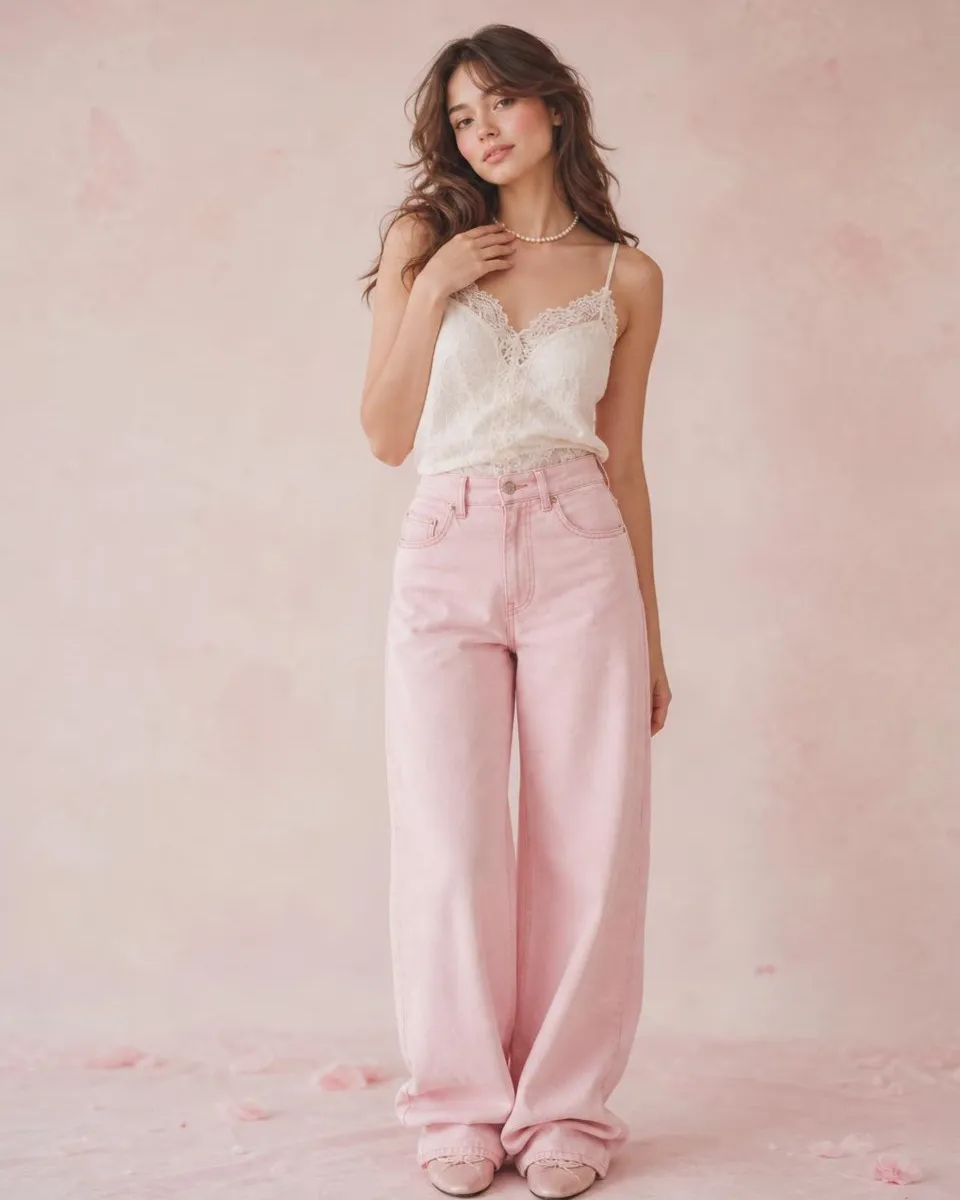
A lace-trimmed cami in soft pink, rose-tinted baggy denim, pearl jewelry, pointed flats in a matching tone. Monochrome dressing is the easiest fix for baggy denim's biggest risk: a colour break between top and bottom draws the eye straight to where the fabric is loosest, so keeping one tone head to toe removes that problem before it starts. The fitted cami bodice does the rest of the work, anchoring the waist so the wide leg reads as drape rather than excess fabric.
Fit note: the cami should sit close to the body through the waist, with the lace trim as decoration rather than structure. If the cami is loose, the whole outfit loses its anchor and the monochrome effect stops working.
Colour pairing: rose wash is warm, and it stays flattering when everything around it is warm — blush, pearl, nude tones — rather than fighting a cool-toned shoe or bag. The pointed flats matter more than they look like they do: a pointed toe extends the leg line under a wide hem, and matching the tone keeps the ankle from becoming a visual stopping point. Pearls are the texture counterweight, hard shine against soft lace, which is what keeps an all-pink outfit from dissolving into one note. Reach for this pairing when the occasion is soft but the jeans still belong — brunch, a gallery afternoon, dinner somewhere a dress would otherwise be the default.
Leather Jacket and Black Wash Baggy Jeans
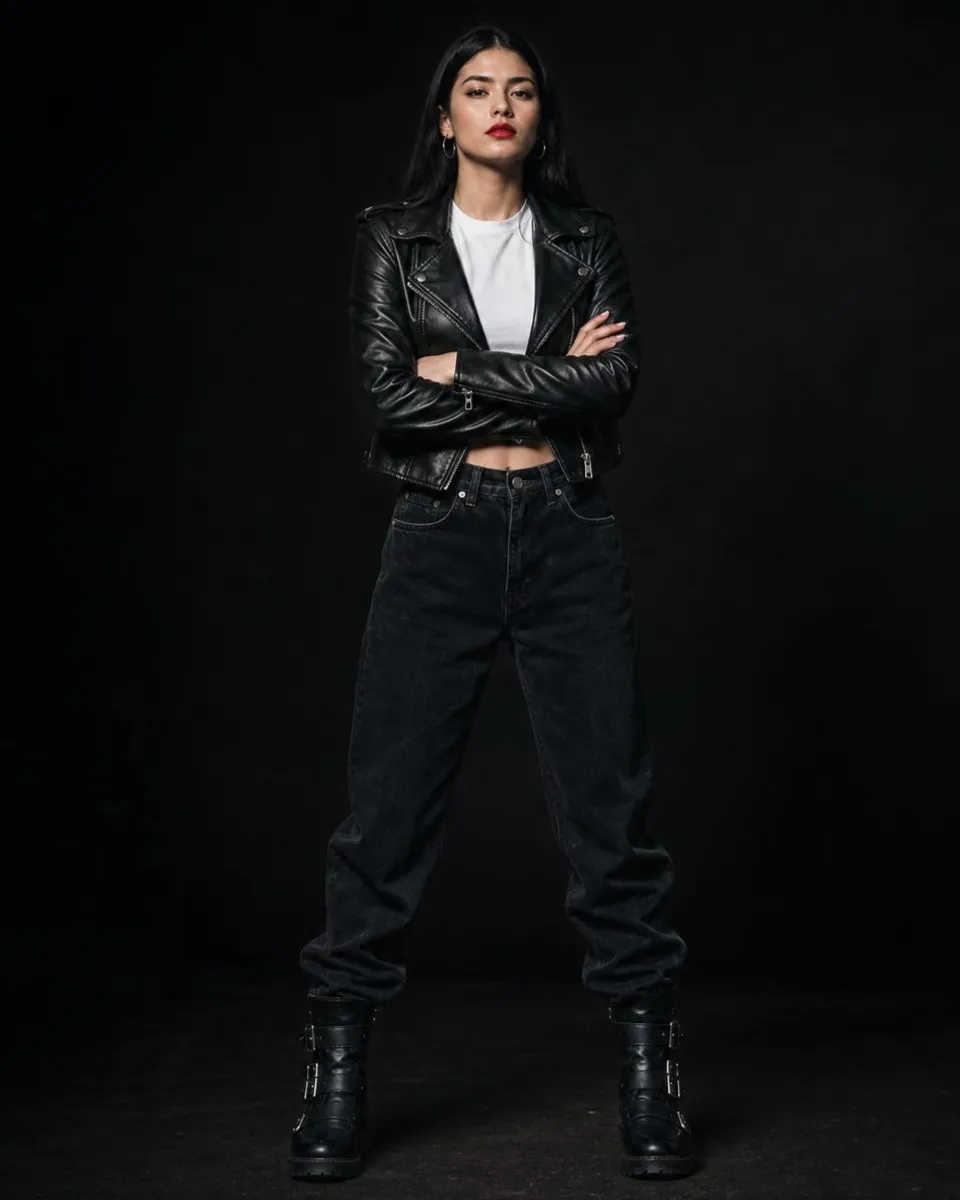
A cropped leather jacket over a plain white top, black wash baggy jeans, buckle boots, red lipstick. Keeping the jacket cropped rather than hip-length is what makes this outfit work — a longer jacket would add its own volume on top of the jeans' volume, and two loose layers stacked on each other is exactly how baggy denim starts to look sloppy instead of styled. Structure stays at the shoulder, comfort stays at the leg.
Fabric note: black wash is doing quiet work here. It reads as the dressiest wash of the twelve — closer to tailoring than to weekend denim — which is why the leather jacket pairing lands as a night-out outfit rather than a biker costume. The white top underneath is the contrast layer: it breaks up the dark mass and, because it is plain, does not compete with the jacket's hardware. Buckle boots echo the jacket's metalwork so the hardware feels deliberate rather than incidental. Cut matters: a slim, short leather jacket keeps the legs looking long despite the loose fit; an oversized one would bury the waist and defeat the whole construction. This is evening territory — concerts, late dinners, anywhere the dress code is ambiguous and slightly over is safer than slightly under.
Cable Knit Sweater and Rust Corduroy Baggy Jeans
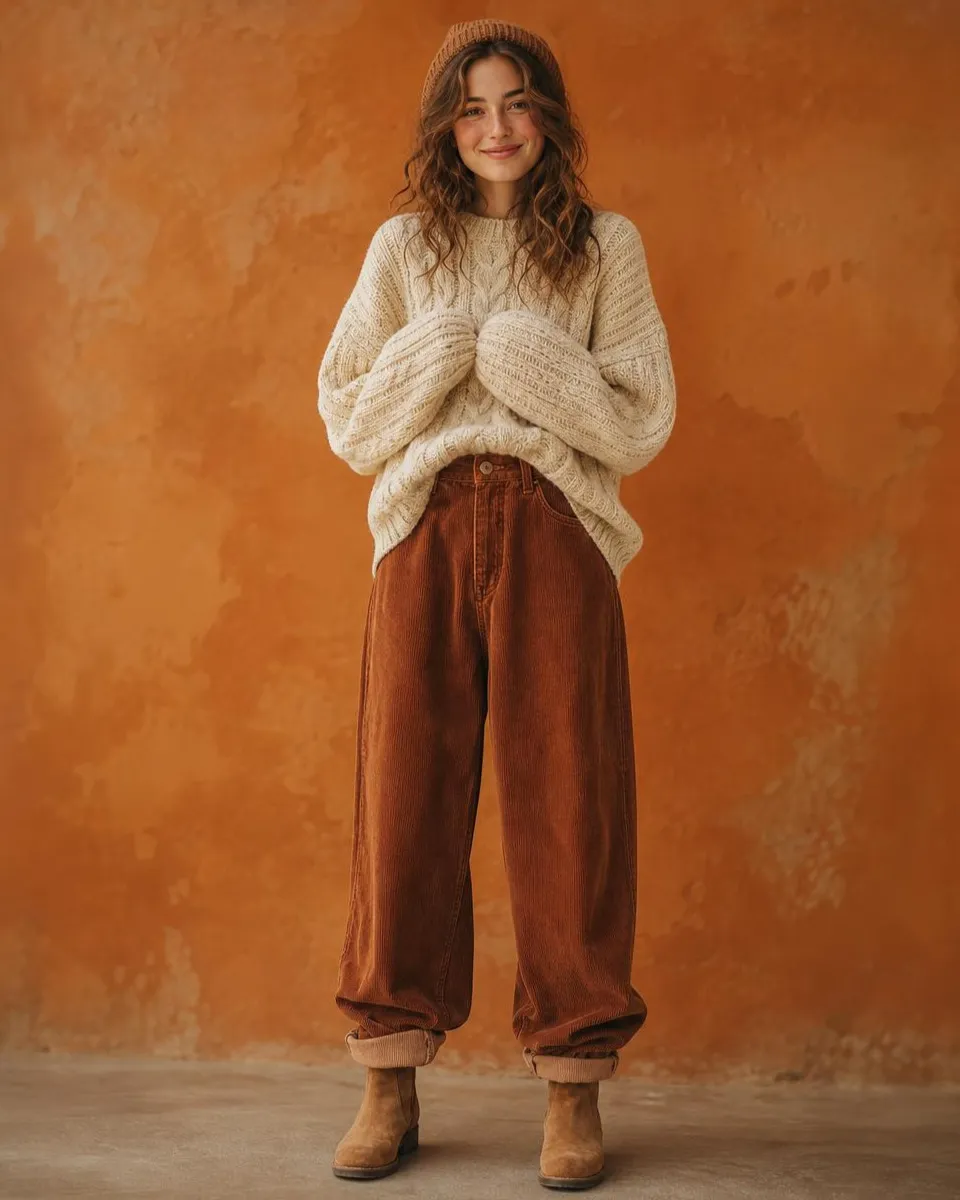
An oversized cable knit sweater, rust corduroy baggy jeans, suede ankle boots, rolled cuffs, a knit beanie. Corduroy's visible wale gives baggy denim a texture that reads as considered rather than just loose — the ridged fabric catches light differently than flat cotton, which is part of why this pairing feels more styled than a plain wash would in the same silhouette. Rolling the cuffs is a small but real fix: it shows the boot, which breaks up the leg length and stops the denim from reading as one uninterrupted block of fabric.
Wear it with: rust, cream, and tan — everything sits on the same side of the colour wheel, which creates cohesion without any single piece having to match. The cable knit earns its keep twice: its raised pattern throws shadows that give an oversized sweater visible structure, and its cream tone keeps the rust from going monochrome-dark. Suede boots are the right texture call because matte pairs with matte; a glossy leather boot would introduce a shine the rest of the outfit does not speak to. Keep the sweater relaxed rather than skin-tight — the volume budget here is spent on the knit, and the corduroy leg is fitted enough in the seat to balance it. This is the outfit for orchards, cabin weekends, and any October Saturday that starts at a farmers market.
Cream Blazer and Dark Wash Baggy Jeans
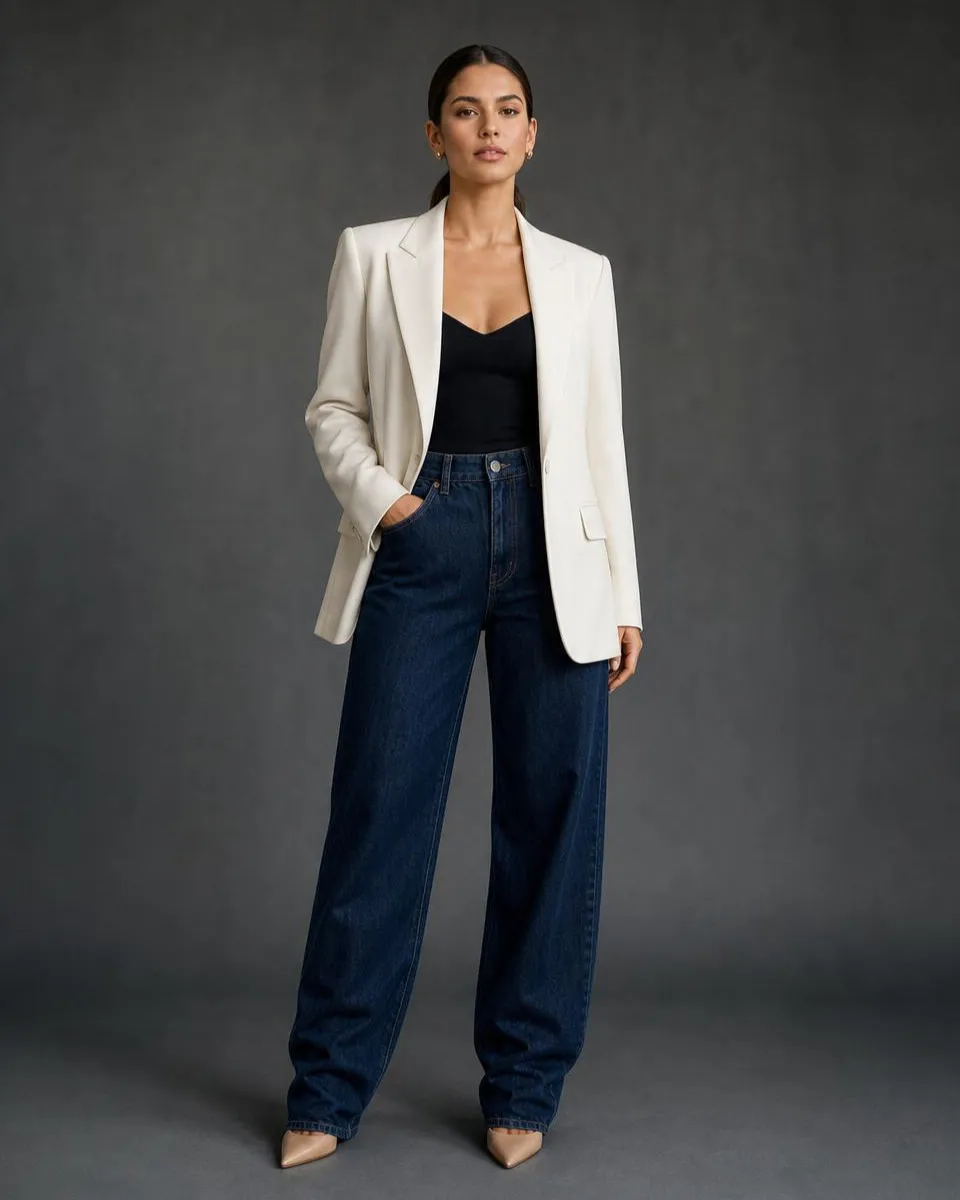
A cream blazer over a black cami, dark wash baggy jeans, nude pointed heels. This is the clearest example of the "structure on top, ease on bottom" rule on this list — the blazer's straight shoulder line and dark denim's fuller cut create contrast on purpose, and that contrast is precisely what reads as office-appropriate rather than weekend-casual. A cropped or unstructured jacket here would blur that contrast and undercut the whole look.
Fit note: dark wash is non-negotiable for this one. A medium or light wash would read as Friday-casual at best; dark indigo, free of distressing, borrows the formality of the blazer and meets it halfway. The blazer should hit at the hip — long enough to cover the waistband, short enough to preserve the leg line — and the shoulders should be clean, not oversized, because shoulder volume plus leg volume is the fastest route to a boxy silhouette. Nude heels do two jobs: they keep the palette light against the dark denim, and the pointed toe extends the leg under the wide hem the same way it does in the pink outfit above. This is the creative-office formula, and it also works for dinners where the goal is to look considered without changing out of jeans.
Metallic Crop Top and Light Wash Baggy Cargo Jeans
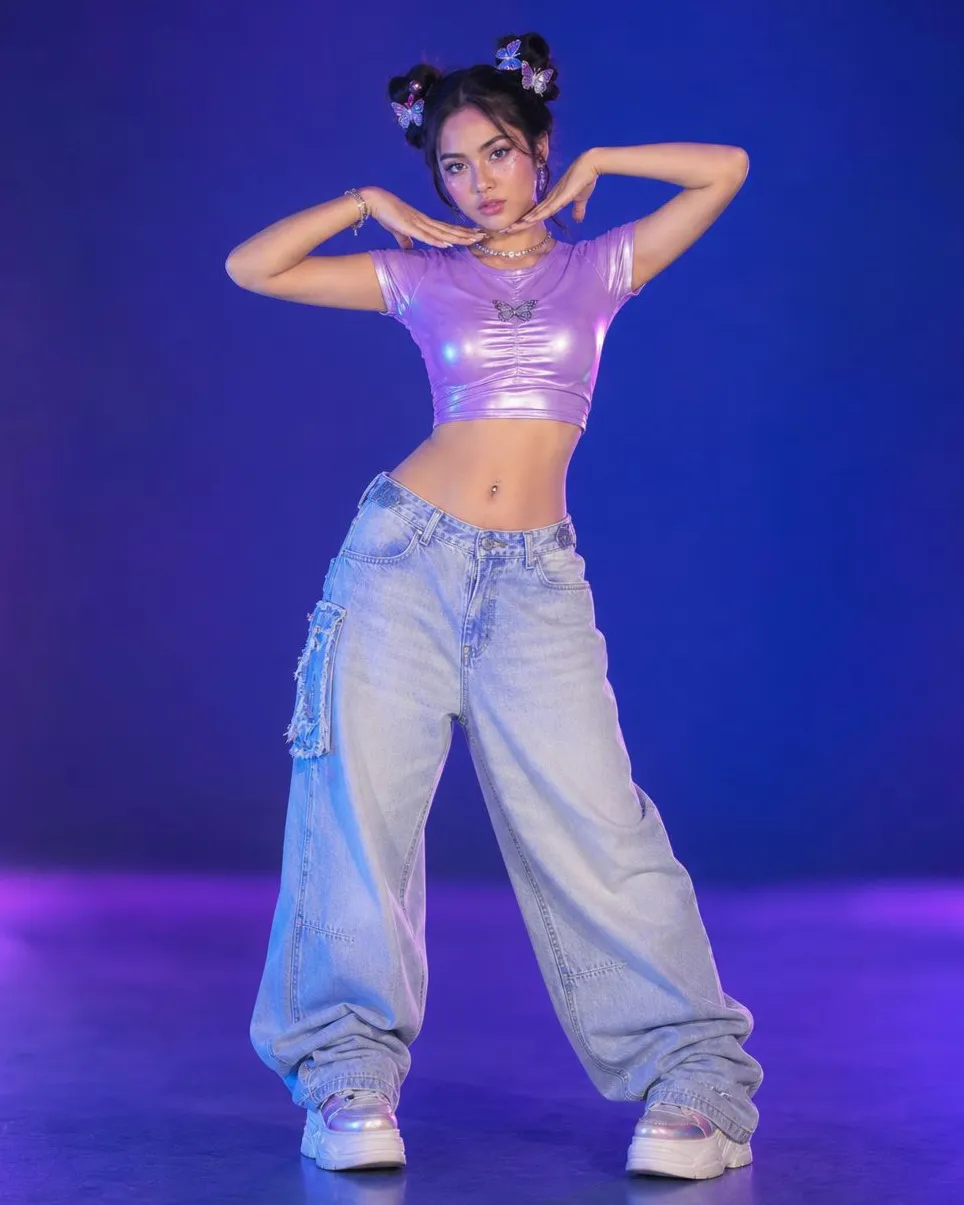
A shiny purple crop top, light wash cargo jeans with patch pockets, space buns, platform sneakers, layered necklaces. Cargo pockets add real bulk to an already-loose silhouette, so this is one case where a genuinely cropped, fitted top is not optional — anything looser on top and the pocket volume plus the leg volume would stack into shapelessness. Platforms matter too: with this much fabric at the ankle, a flat shoe gets visually swallowed.
Fabric note: the metallic top is the texture story. Shine against matte denim creates a contrast that keeps a simple two-piece outfit from looking flat, and purple's cool undertone plays well against light wash's cool blue rather than fighting it. The crop needs to be genuinely cropped — showing the waistband, not just grazing it — because the waist anchor is the only thing separating "styled" from "swimming in fabric" here. Platform sneakers are not a style flourish; they are load-bearing. The extra sole thickness keeps the stacked cargo hems off the ground and adds enough height to balance the added width at the thigh. Keep the accessories light and layered — a few thin necklaces rather than one heavy piece — since the silhouette is already carrying a lot of visual weight. Festival, rooftop, late-summer party: this is the outfit for the loudest setting on the calendar.
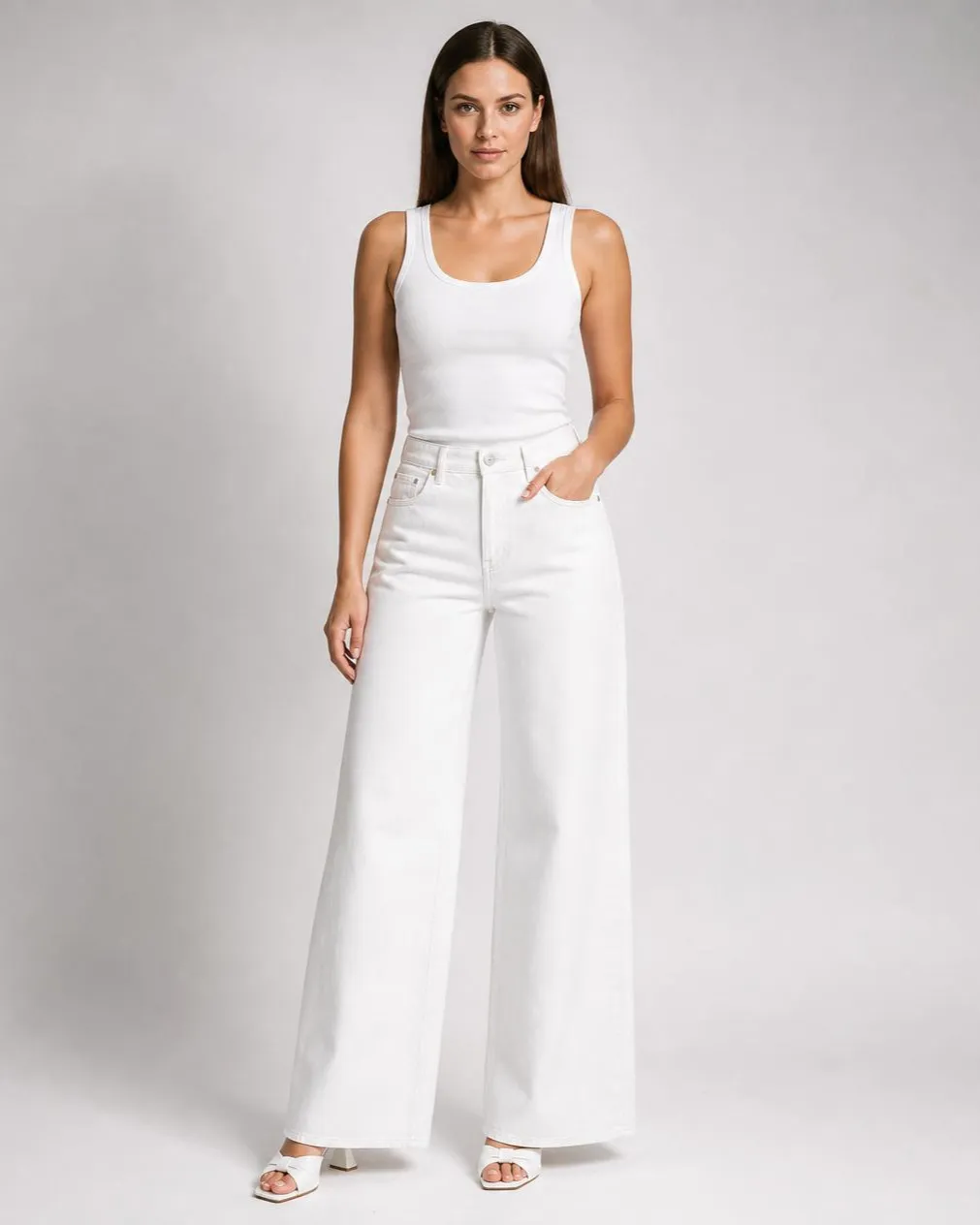
Ribbed Sweater and White Baggy Jeans
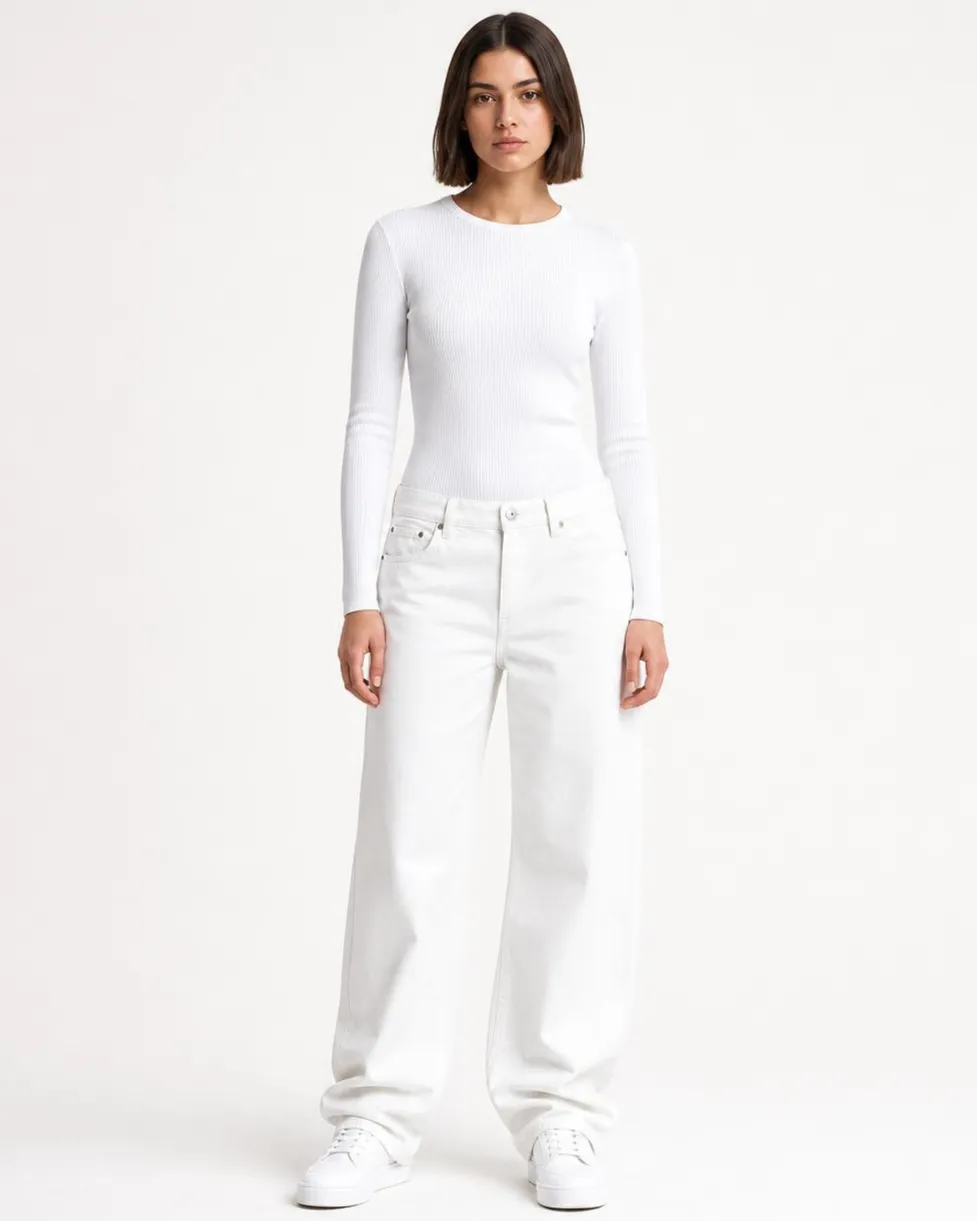
A close-fitting white ribbed sweater, white baggy jeans, white sneakers. All-white monochrome removes any colour break the same way the pink pairing above does, but white specifically is less forgiving — there is no pattern or texture to hide behind, so the fit of the sweater is doing almost all of the shaping work. This is the pairing to copy for proof that a fitted top alone, without a belt or blazer, is enough to keep a wide leg from reading shapeless.
Care tip: the ribbing is the unsung hero. On a white sweater it does what pattern would do on any other outfit — gives the eye something to read, so the monochrome does not flatten into a single white mass. Sneakers keep the whole thing grounded in daytime; swapping them for white pointed flats or heeled boots would tip the same outfit toward evening without changing a single other piece. One caution: white baggy jeans show every line, so the sweater should be genuinely close-fitting and long enough to sit cleanly at the waistband — a sweater that rides up turns the volume budget upside down. This is the weekend-uniform version of the rule, and it works precisely because it is the simplest possible application of it.
Crochet Halter Top and Cream Fringe Hem Baggy Jeans
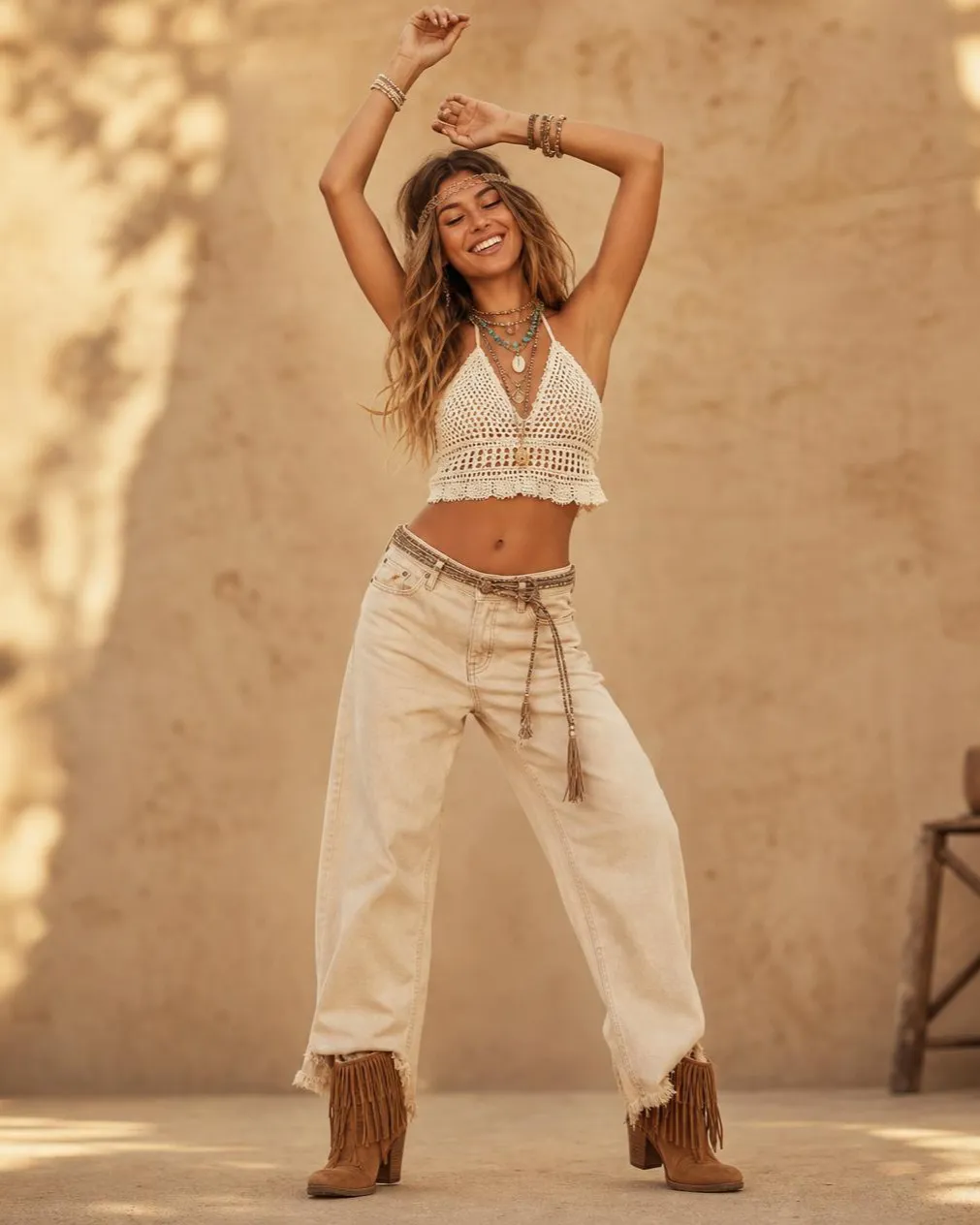
A crochet halter top, cream fringe-hem baggy jeans, fringe suede boots, layered necklaces and a beaded headpiece. This is the one look here that breaks the fitted-top rule on purpose, the same way boho styling does elsewhere on the site — a narrow halter neckline does not add bulk even though the crochet texture itself is loose, so the volume stays concentrated in the jeans rather than competing at both ends.
Fit note: the logic holds because of where the looseness sits. A halter's open sides and narrow neckline mean the actual fabric near the torso is minimal; the crochet reads as airy rather than voluminous, which is a different thing from a boxy tee. The fringe hem on the jeans is texture doing shaping work — movement at the ankle breaks up the denim's mass the way distressing does in the grey outfit below. Fringe suede boots pick up that same fringe language, and suede keeps the palette matte so the whole thing stays earthy rather than costume-like. Layered necklaces fill the open neckline without adding shoulder bulk. This is the outfit for outdoor concerts, desert weekends, and anywhere the dress code is "creative" — it breaks the fitted-top rule, but only because the neckline does the anchoring instead.
Cropped Hoodie and Mid Wash Baggy Jeans
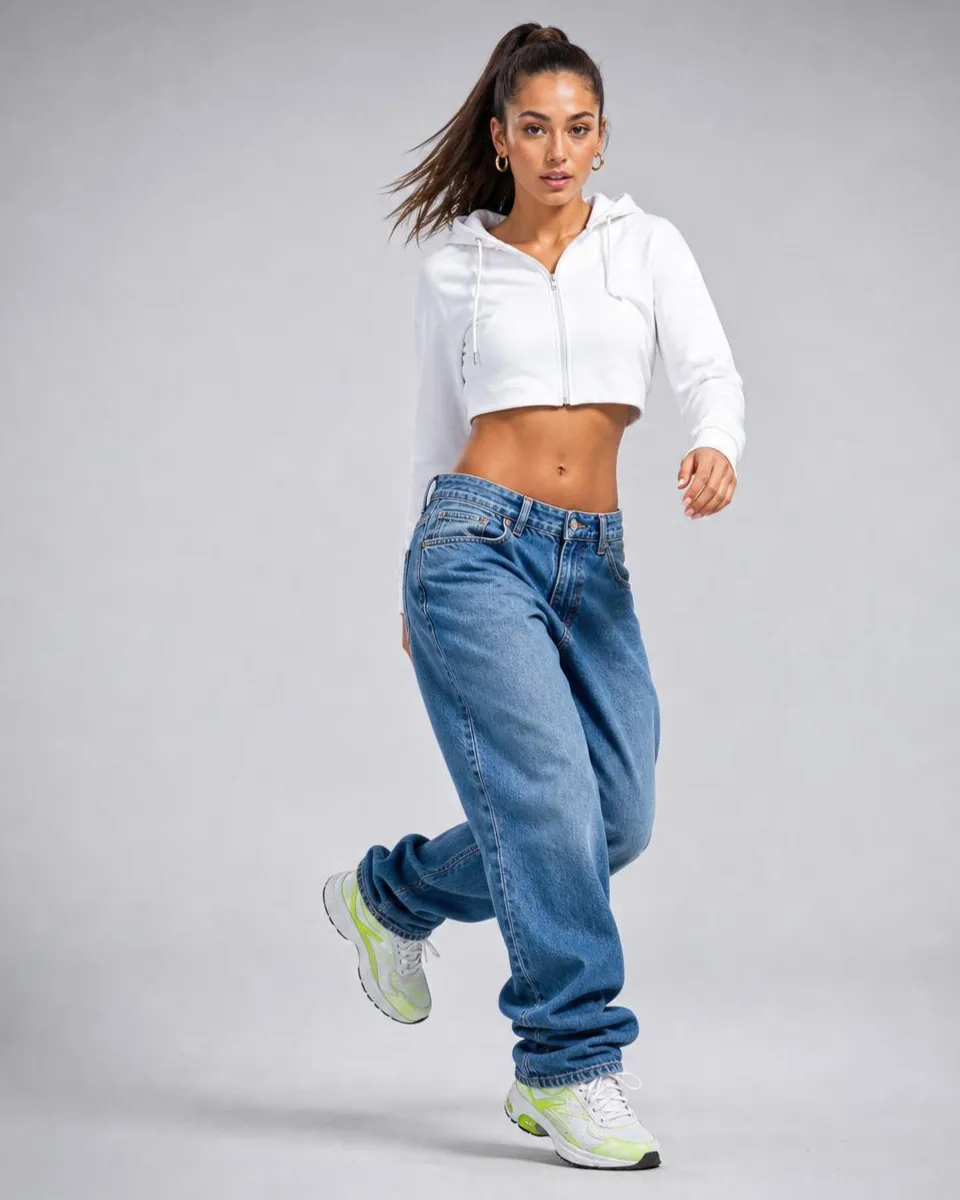
A cropped white hoodie, mid wash baggy jeans, neon-accented sneakers, a high ponytail. Leaving a visible gap between hoodie hem and waistband does the same job a tuck would — it defines where the waist is — without needing to actually tuck anything, which is why this pairing reads sporty rather than sloppy despite two relatively loose pieces.
Wear it with: mid wash is the right call for the sporty register — dark enough to look clean, light enough to stay casual — and neon accents on the sneakers echo the athletic energy without needing a single logo. A high ponytail pulls the eye upward and keeps the neckline clean, which matters when the top half is a hoodie. The gap is the whole outfit. A full-length hoodie over baggy jeans would be the classic sloppy combination; cropping it, even by a few inches, marks the waist and converts the same two garments into a deliberate silhouette. This is the travel-day, errand-run, campus-crossing outfit: comfortable in the ways that count, but built on the same waist-definition rule as everything else here.
Plaid Blazer and Brown Baggy Jeans
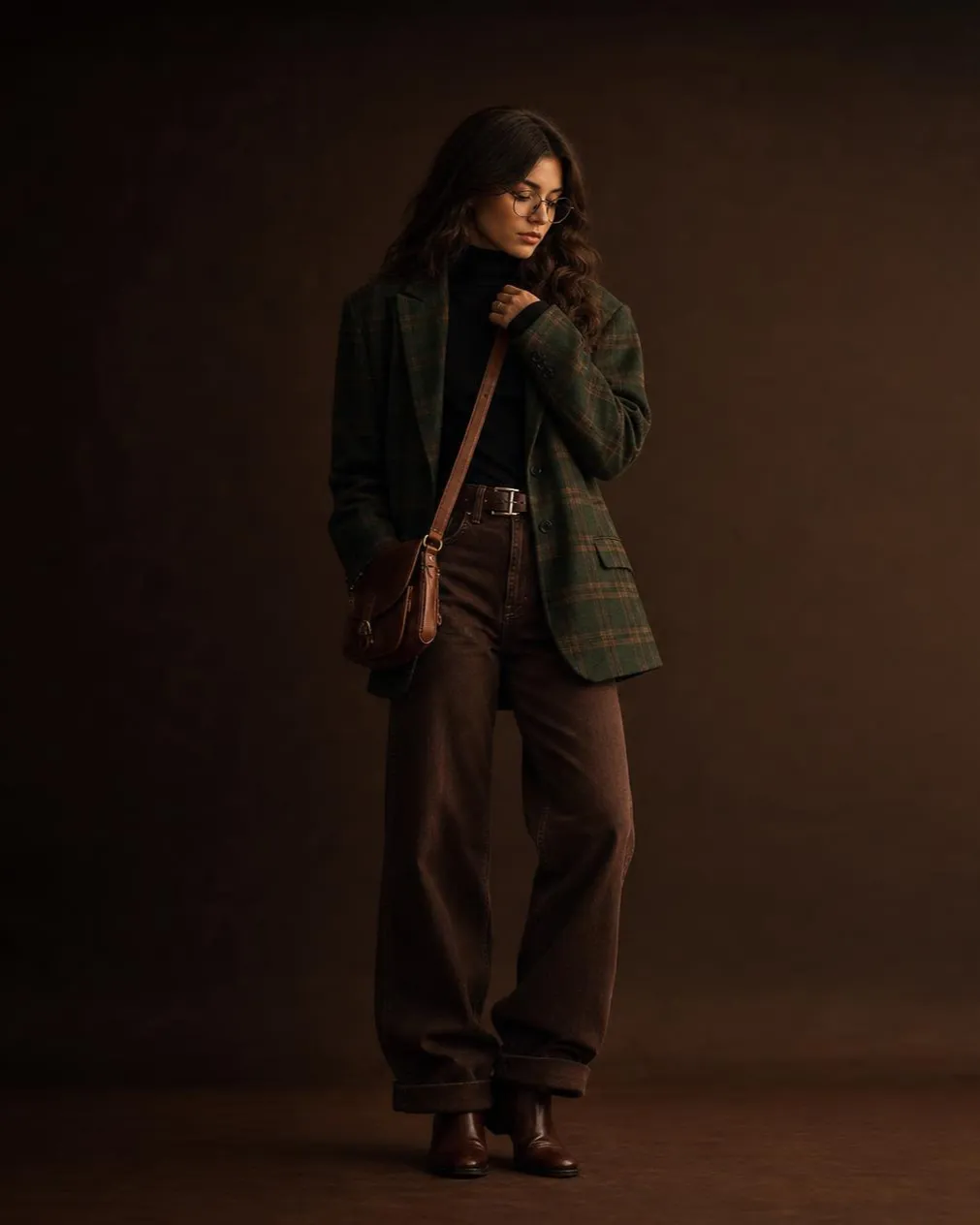
A plaid wool blazer over a black turtleneck, deep brown baggy jeans, a leather crossbody, round glasses, cuffed hems over brown boots. Brown denim reads less casual than blue by default, since it does not carry the same connotation of everyday wear — pairing it with wool tailoring pushes that further, landing somewhere between "scholarly" and "put-together" rather than "jeans and a jacket."
Fabric note: brown denim's formality is underrated. It borrows the language of chinos and corduroys, which means it pairs with tailoring more naturally than blue ever will. The plaid wool blazer adds pattern without bulk — wool drapes close to the body, so the shoulder line stays clean — and the black turtleneck underneath is the slim base layer that keeps the torso streamlined. Cuffed hems over brown boots continue the tonal story: brown on brown on brown, no colour break at the ankle. The crossbody sits high on the hip, which keeps the bag from adding volume at exactly the spot where the jeans are widest. Round glasses and the plaid are doing personality work, not proportion work — but they land because the proportion work is already handled. Bookshops, lectures, cool-weather city days: this is the intellectual end of the baggy-jean spectrum.
Sweater Vest and Light Wash Cuffed Baggy Jeans
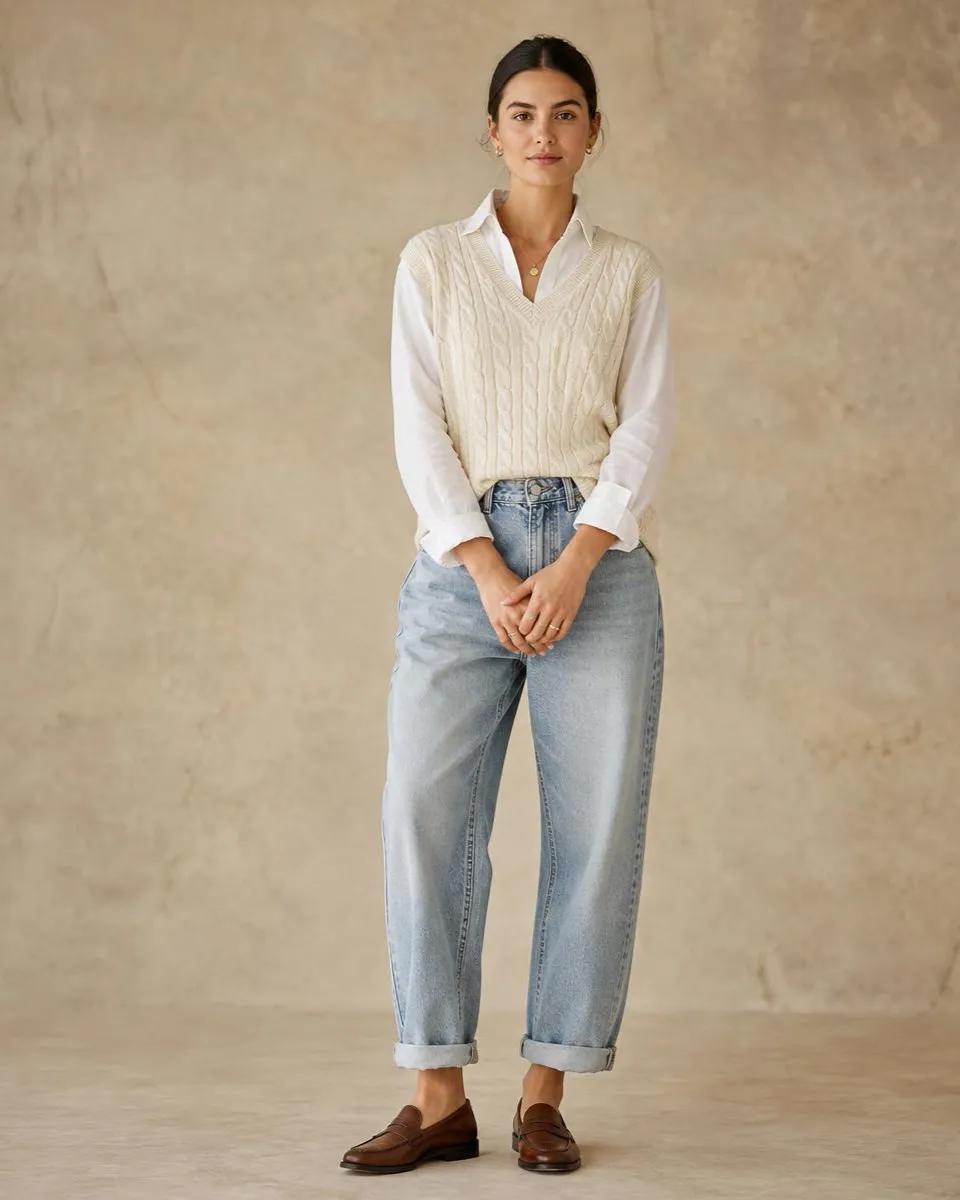
A cable knit sweater vest over a white shirt, light wash cuffed baggy jeans, brown loafers. Layering a vest over a collared shirt adds visual structure at the shoulder and chest without adding bulk, since a vest by definition has no sleeve volume to compete with the jeans below — that is what lets this pairing stay collegiate rather than tipping into oversized.
Fit note: the vest is the cleverest volume trade on this list. A full sweater would add sleeve bulk; a bare shirt would add nothing. The vest splits the difference — structure at the torso, bare arms, collar peeking at the neck — and the cable knit gives it enough texture to hold its own against the wide leg. Let the shirt collar and a sliver of shirttail show; that layering is what makes it read as collegiate rather than just sleeveless. Light wash keeps the register casual enough for daytime, and the cuffs show the loafers, which are the preppiest shoe in the rotation and exactly what this outfit's references demand. For a close cousin of this look, a forest-green varsity cardigan over a cream henley with grey baggy jeans and suede chukka boots plays the same collegiate notes in a slightly warmer, fall-specific key.
Plaid Flannel and Distressed Grey Baggy Jeans
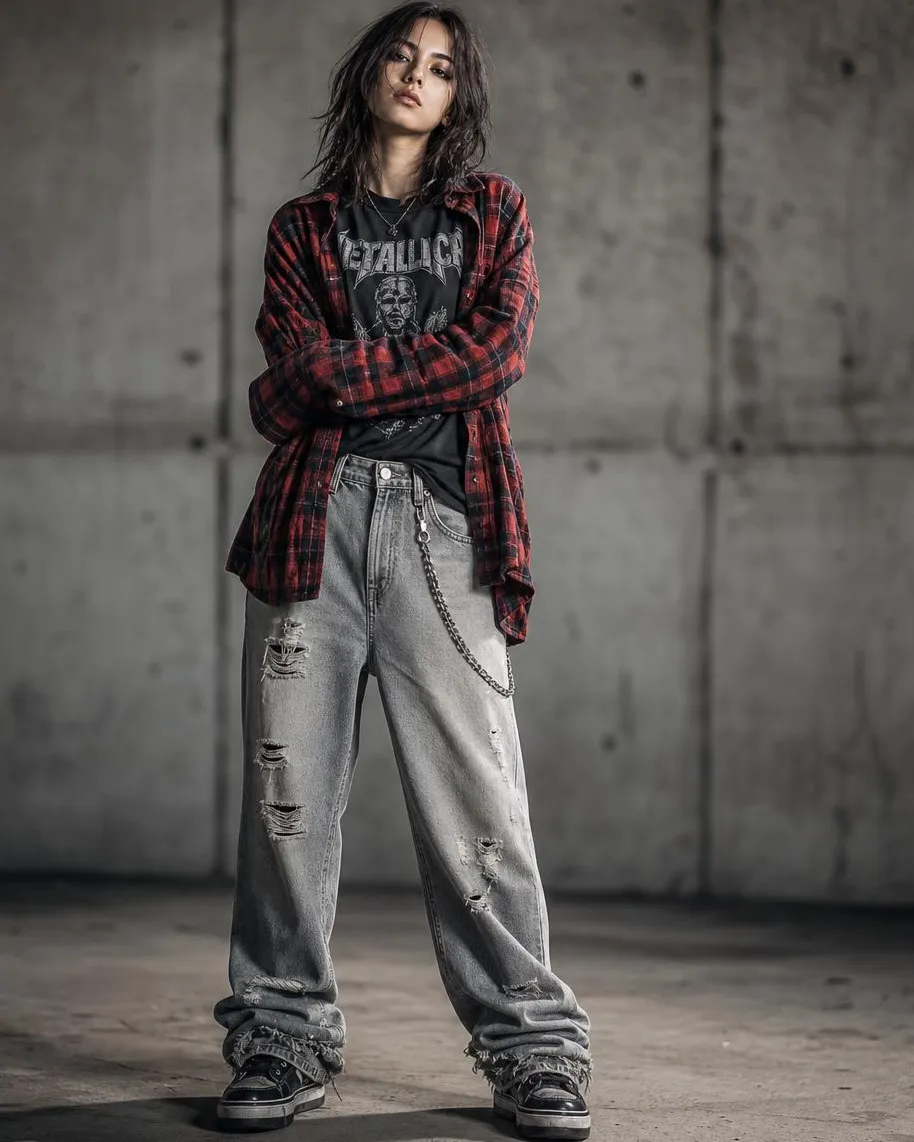
An open red plaid flannel over a graphic tee, distressed grey baggy jeans, a silver chain, scuffed black sneakers. Distressing does real proportion work here, not just a texture effect — rips and frayed patches break up the visual mass of the denim, which is part of why heavily worn baggy jeans can carry more volume without looking as bulky as a clean, unbroken pair in the same cut.
Colour pairing: grey wash is the cool counterpart to the warm palettes elsewhere on this list, and it earns its place: grey reads as the most streetwear of the washes, less heritage than blue, less dressy than black. The red plaid sits on the opposite temperature side, which is the contrast the outfit runs on — warm flannel, cool denim, silver chain bridging the two. Wearing the flannel open over a plain tee keeps the torso from doubling up on volume; buttoned to the top, the same flannel would spend too much of the volume budget. Scuffed black sneakers keep the whole thing in the same worn-in register as the distressed denim — clean white sneakers would introduce a crispness the rest of the outfit does not have. Skate parks, casual Fridays, record stores: this is the outfit that proves distressing is a proportion tool, not just an attitude.
Metallic Bustier and Light Wash Baggy Jeans
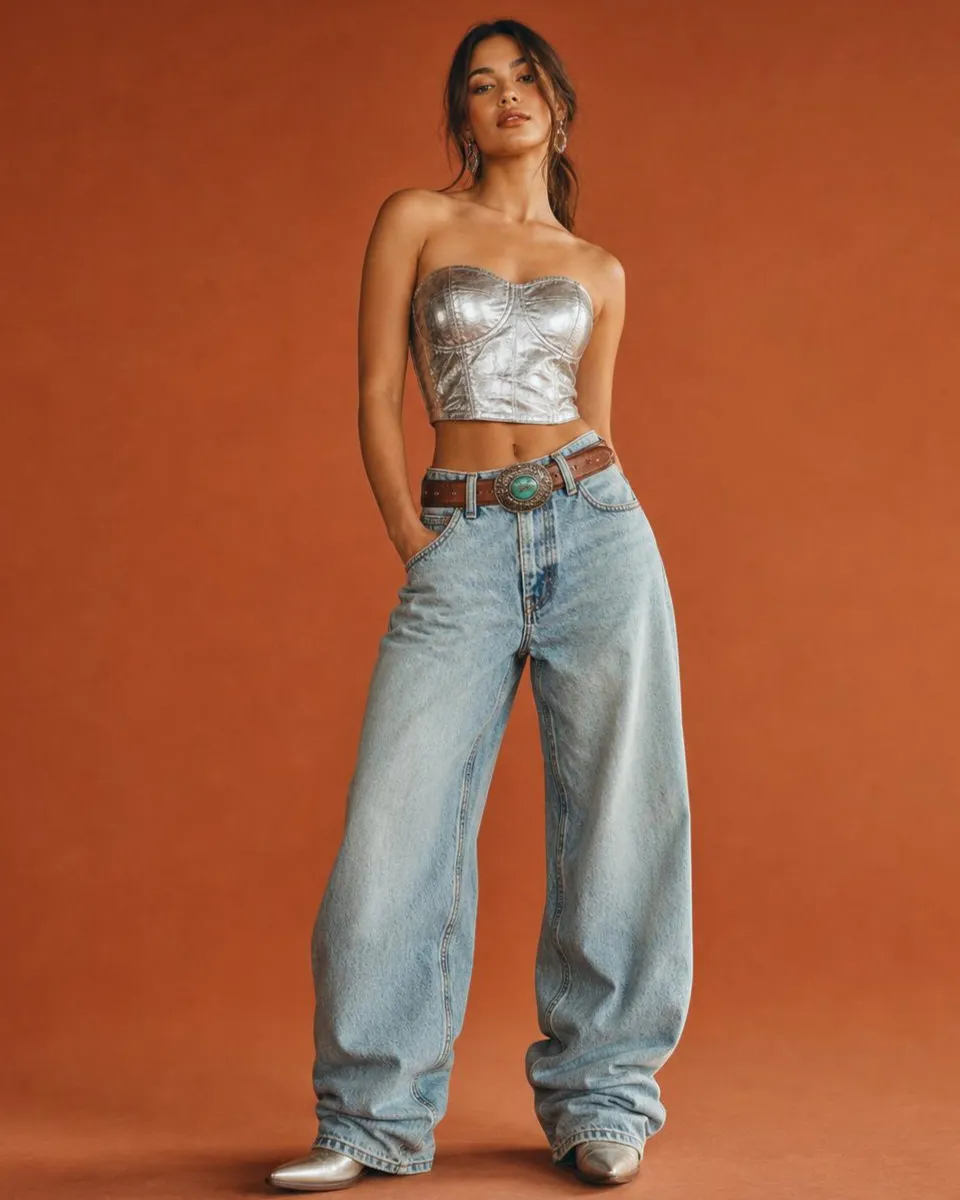
A strapless silver bustier, soft blue baggy jeans, a turquoise buckle belt, metallic boots. The belt is not just a western detail — it is the actual waist anchor for the whole outfit, since a strapless top has no natural point of contact with the jeans the way a tucked shirt would. Take the belt away and the two halves of this outfit stop reading as one look.
Fit note: this is the most literal application of the waist-anchor principle on the list, which makes it the best one to study. A strapless top ends at the ribcage; the jeans begin at the hip; without a belt, there is a no-man's-land between them where the outfit falls apart. The turquoise buckle turns that necessity into the focal point — chunky hardware draws the eye to the natural waistline and makes the wide leg below it read as deliberate. The metallic bustier mirrors the metallic boots, which keeps the shine balanced top to bottom instead of stranded at one end. Soft blue wash is the right denim temperature for silver: cool against cool. Western-leaning, but the formula — fitted strapless top, statement belt, wide leg — works with any hardware that suits the wearer's own references. Nights out, concerts, anywhere the jacket outfit's edgier cousin belongs.
Fall Layering: Warmth Without Bulk
The twelve outfits above work year-round, but fall asks a specific question of baggy jeans: how do you stay warm without spending the whole volume budget on insulation? The answer is texture-first layering — building warmth through fabric character rather than fabric quantity.
1. Quilted Vest & Plaid Flannel — Beginner
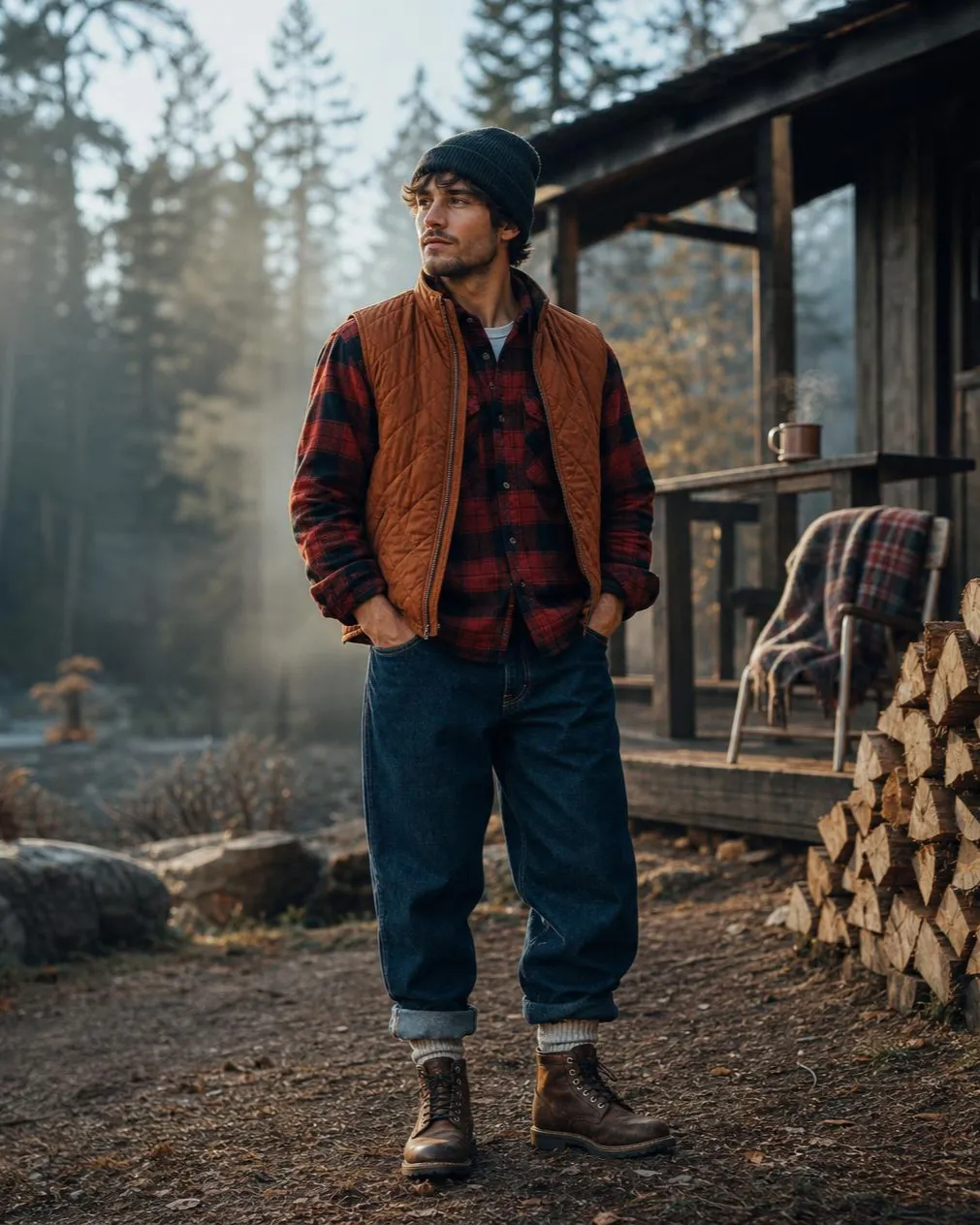
Quilted vest over flannel: real warmth, almost no silhouette bulk.
A rust quilted vest zipped over a red plaid flannel, dark indigo baggy jeans cuffed above leather boots, a ribbed beanie. The vest-over-flannel construction is the key move: quilting adds real warmth, but because it is sleeveless, it adds almost no silhouette bulk — the arms stay in the flannel's relatively slim sleeves. Plaid and rust sit close on the colour wheel, so the palette stays grounded in earth tones without clashing, and the beanie pulls the whole thing together practically rather than decoratively. Cuff the jeans to show the boots, with wool socks peeking out for insulation that doubles as a styling detail. This is the cabin-morning, firewood, cold-market version of the proportion rule: the top half is doing two layers, but only one of them counts toward the volume budget.
2. Corduroy Trucker & Mustard Sweater — Beginner
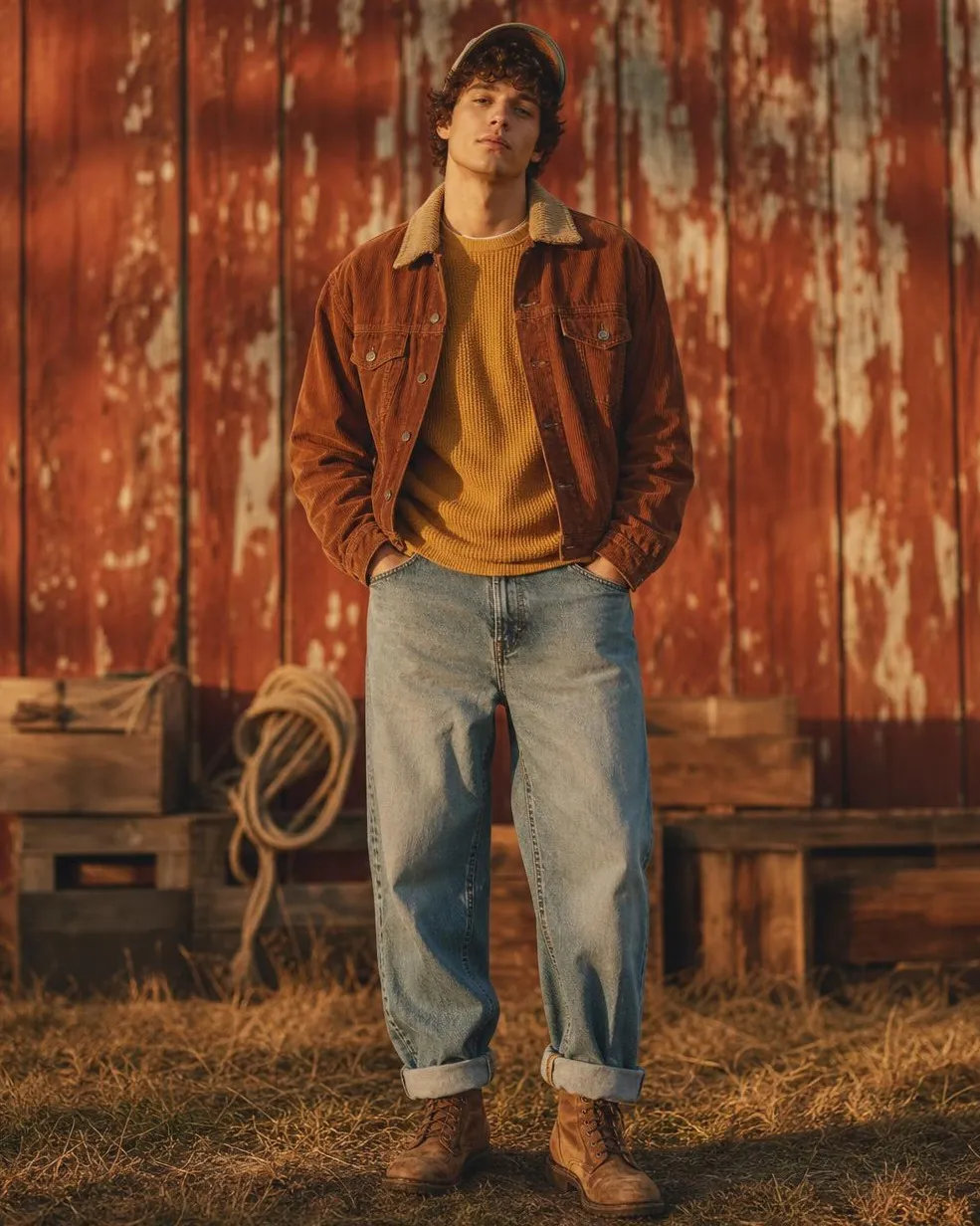
Corduroy trucker over mustard knit: double denim without the costume risk.
A rust corduroy trucker jacket over a mustard ribbed sweater, light wash baggy jeans cuffed at the ankle, worn leather boots, a flat cap. This is denim-on-denim without the costume risk — corduroy reads as a different fabric family from the jeans, so the pairing gets the texture richness of double denim without the tonal matching problem. Mustard and rust are analogous colours, warm against warm, which gives the outfit its cohesion; the ribbed sweater's vertical lines keep the torso visually narrow against the jacket's boxier cut. Worn boots finish it in the same lived-in register. The sweater should be fitted or semi-fitted — the trucker jacket is already the roomy layer, and the rule still holds: one loose element per outfit.
3. Emerald Cardigan & Rust Henley — Beginner
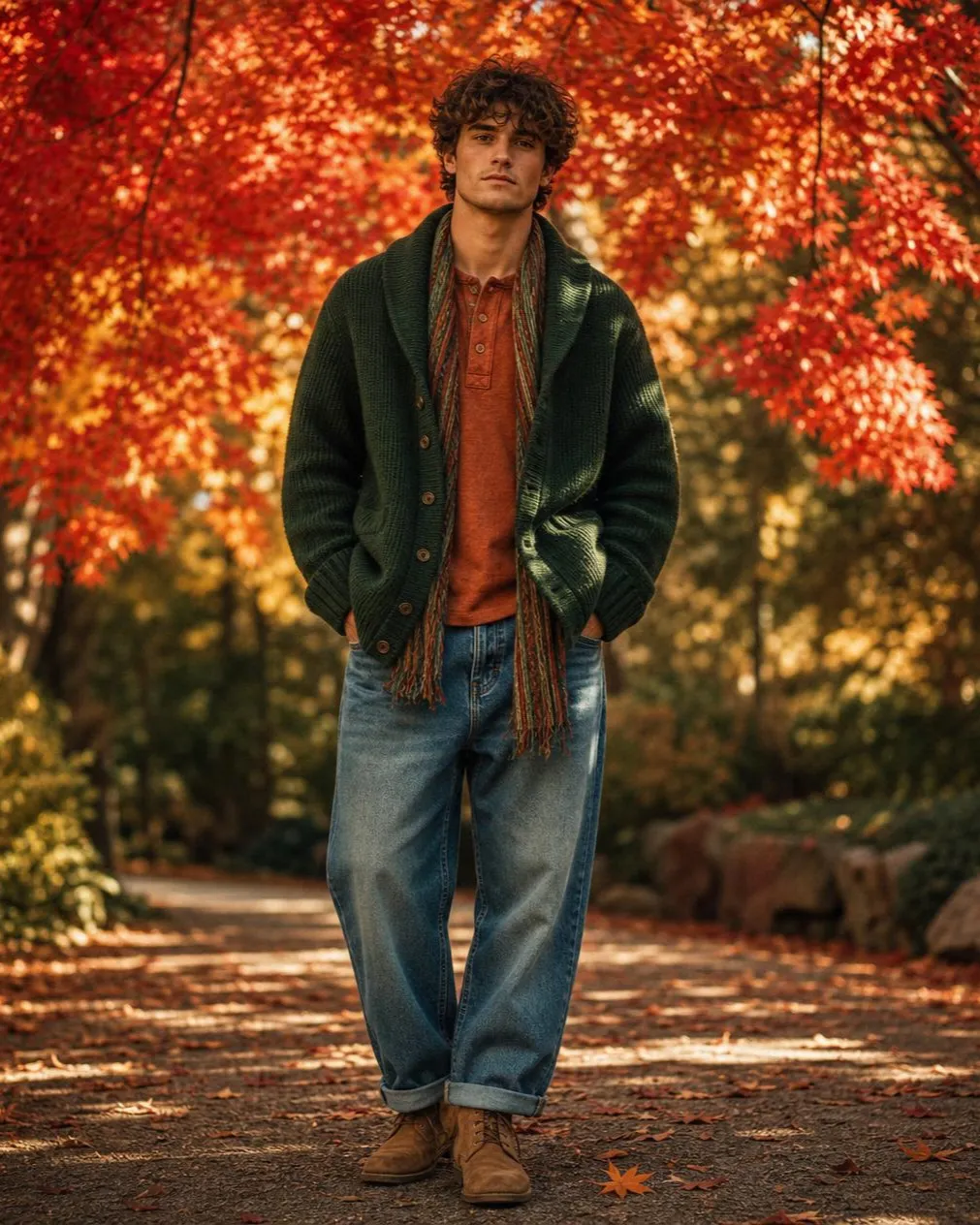
Emerald and rust: near-complement colours doing the styling work.
An emerald cardigan over a rust henley, light wash baggy jeans cuffed at the ankle, suede desert boots, a loosely draped striped scarf. This is colour temperature as a styling tool: emerald and rust are near-complements, and that tension is what makes the pairing feel intentional rather than thrown together. The henley is the slim base layer — its placket and fitted cut define the torso — while the cardigan provides the warmth and the visual interest. The scarf hangs open rather than tied, adding a stripe of pattern without wrapping bulk around the neck. Desert boots ground it in classic autumn territory; their low profile keeps the ankle clean where the cuffed jean ends. For a softer version of the same idea, a copper-toned cardigan over a plain ivory tee with suede loafers trades the colour contrast for tonal warmth — same structure, quieter palette.
4. Camel Shirt Jacket & Black Turtleneck — Beginner
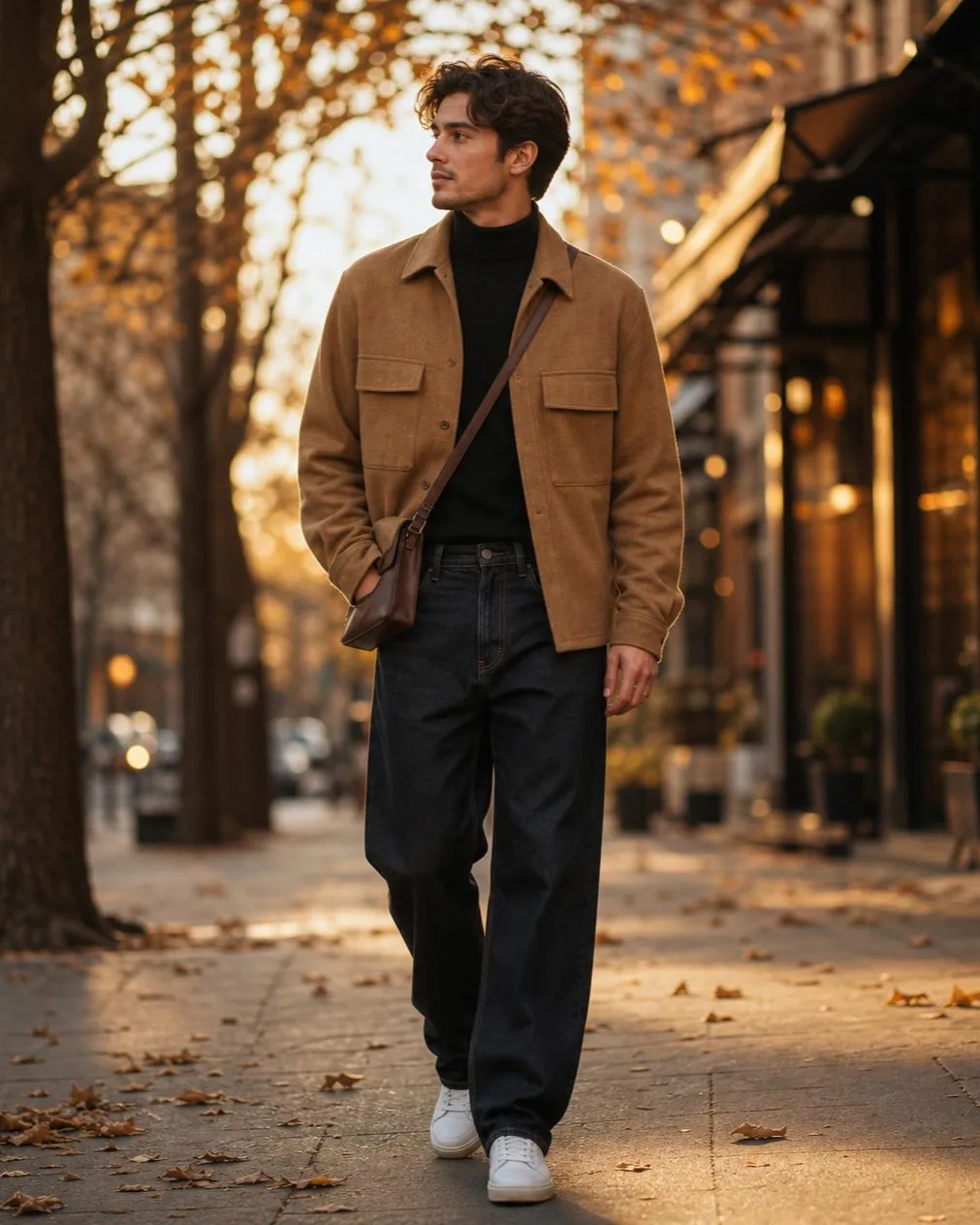
Camel and black: colour blocking that reads sharp from day into evening.
A camel shirt jacket worn open over a fitted black turtleneck, dark wash jeans, white sneakers. The camel-and-black colour blocking creates depth, the turtleneck is the slim anchor, and the white sneakers lighten a palette that could otherwise go heavy. A leather crossbody adds function without cluttering the look, and for colder nights a scarf tucked under the collar works without disrupting the palette. It carries the same logic as the cream-blazer office outfit above, translated into weekend outerwear — clean, structured, and easy to wear from day into evening.
Three Techniques That Fix Most Baggy-Jean Problems
Beyond individual outfits, three repeatable techniques solve the problems baggy jeans create most often. Learn these and the twelve pairings above start to feel like variations on a theme.
1. The bodysuit anchor — Beginner
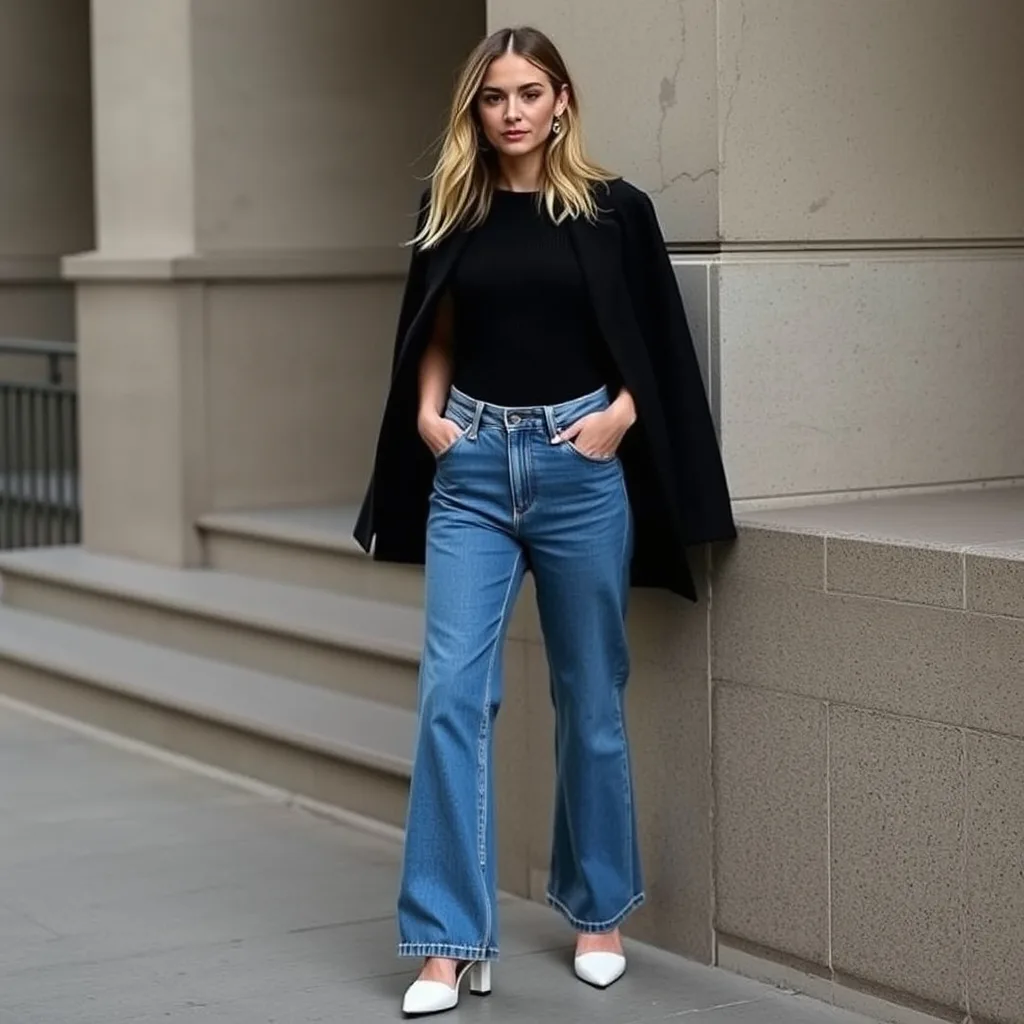
The bodysuit anchor: one smooth, unbroken line from torso to waistband.
A fitted ribbed bodysuit is the most reliable waist anchor in this entire guide. Because it stays tucked by construction, it creates one smooth, unbroken line from torso to waistband — no re-tucking, no fabric creeping out when sitting down. That smoothness is exactly what lets the denim flow wide below it without the outfit losing its shape. If bodysuits feel restrictive, a slim-fit tank tucked deeply into a high waistband gets most of the way there with more flexibility. Either way, the principle is the same one the white ribbed sweater proves above: a single fitted layer is enough to carry a wide leg.
2. The half-tuck — Beginner
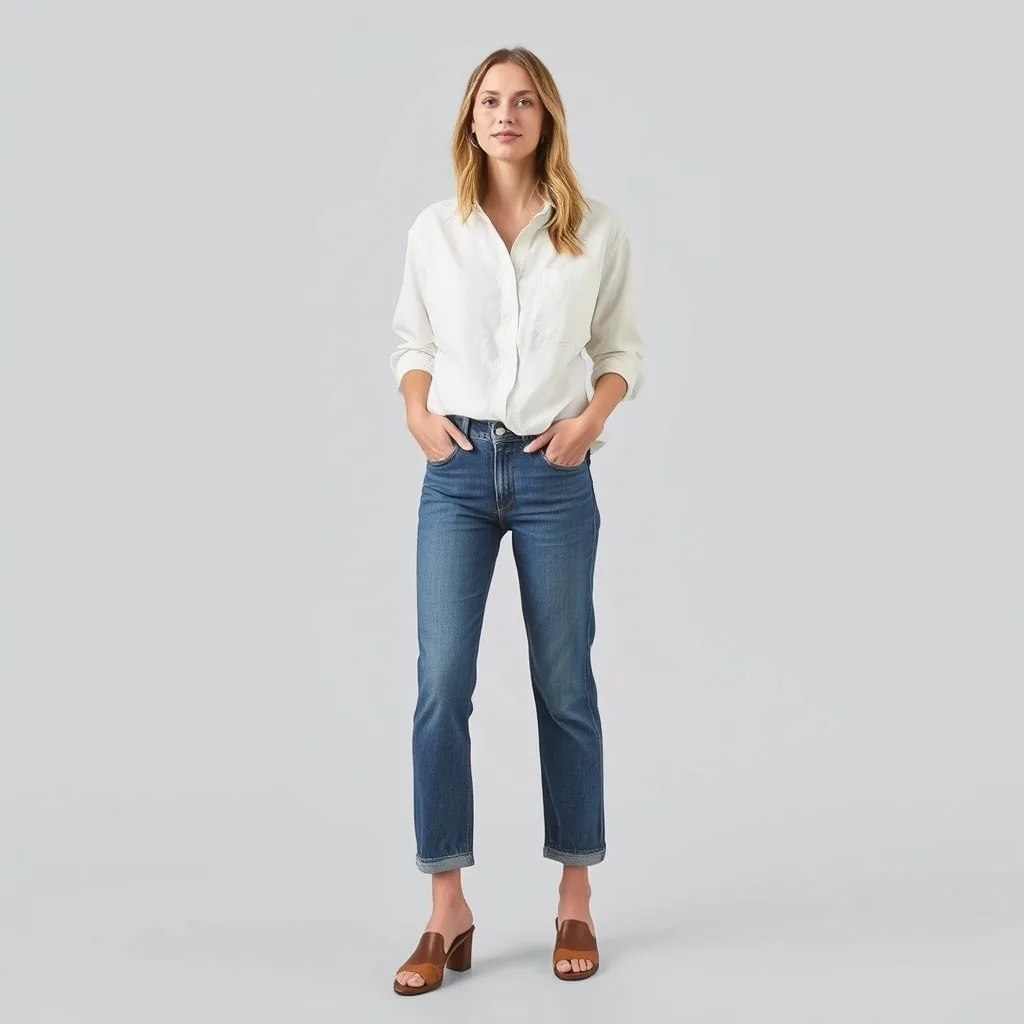
The half-tuck: waist definition without the stiffness.
A crisp button-down — lightweight cotton or linen, so it drapes instead of bunching — tucked at the front and left loose at the back defines the waist while keeping the overall mood relaxed. The front tuck marks the anchor point; the loose back keeps it from reading stiff. It works with the same washes that take a blazer: dark indigo for polish, medium blue for weekends. This is the technique behind the plaid-blazer outfit's ease and the fastest way to make any loose shirt behave with wide-leg denim.
3. The chunky belt — Beginner
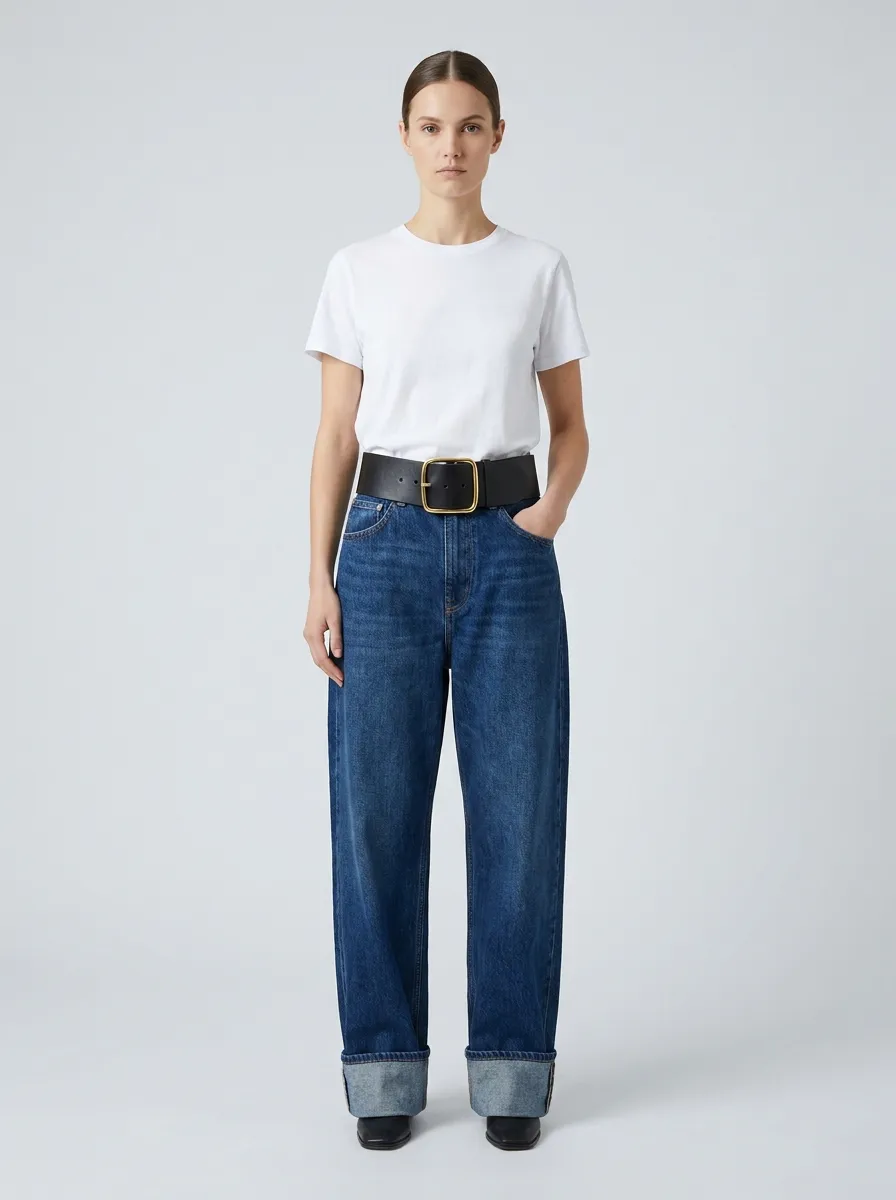
The chunky belt: a horizontal focal point rebuilds the waist.
When the waist threatens to disappear under loose denim, a wide leather belt rebuilds it. The belt creates a horizontal focal point at the natural waist, which is what makes the outfit read as deliberate rather than accidental — the same job the turquoise buckle does in the metallic-bustier outfit. Match the hardware to the jewelry and it looks considered; a vintage or thrifted leather belt adds character that a flat new one does not. This is the fix to reach for whenever the top half cannot provide the anchor on its own — strapless tops, boxy tees, anything that ends without meeting the jeans.
Footwear Decides the Hem
Shoes are the last thing put on and the first thing the eye checks, because the hem is where a wide leg either ends cleanly or gives up. The footwear logic for baggy jeans comes down to one question: does the shoe hold its own against the fabric above it?
1. Pointed-toe boots — Most flattering
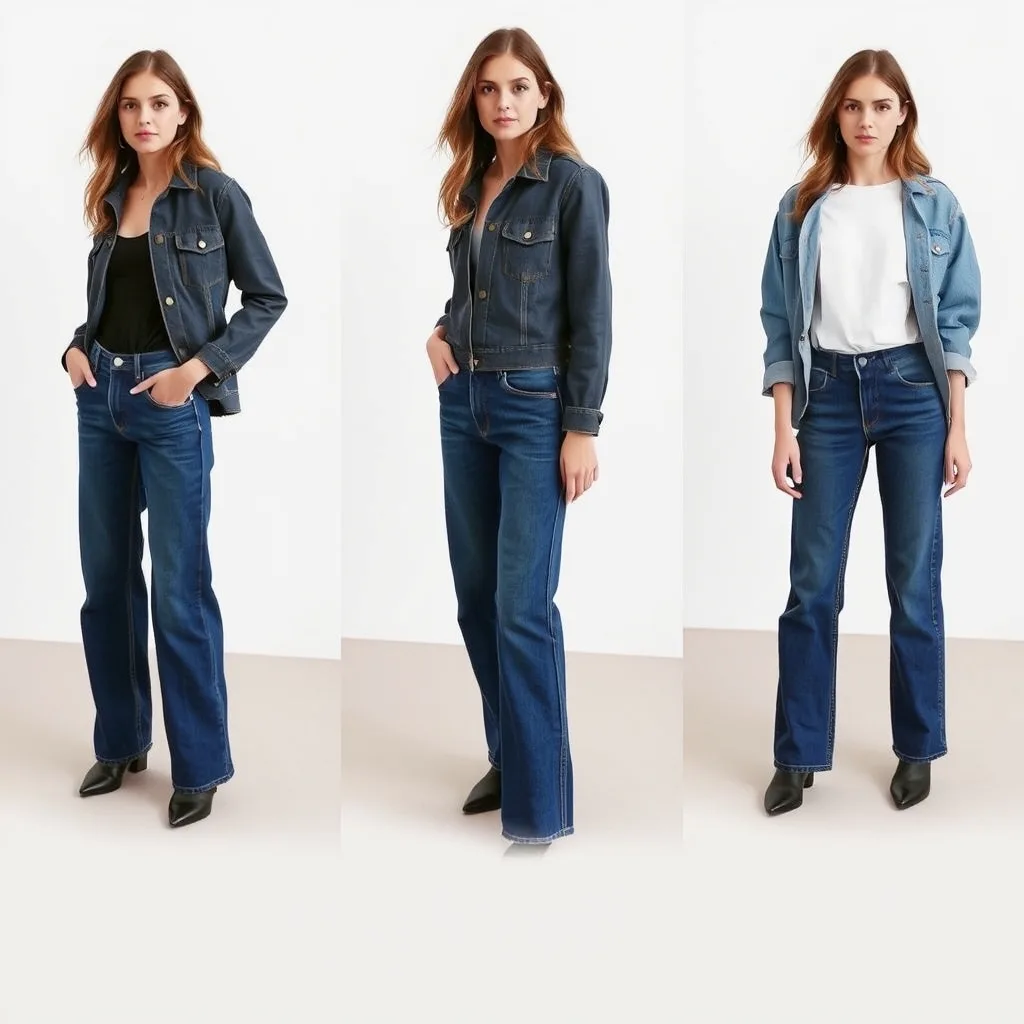
Pointed-toe boots: the visible toe extends the leg past the hem.
Pointed-toe boots are the most flattering answer. The pointed toe creates an elongated line that peeks out from under the hem, which keeps the jeans from reading as if they are dragging — the visible toe extends the leg past where the denim ends. A block heel adds height without the discomfort of a stiletto, which matters because these are shoes for actually walking in. This is the shoe behind the nude heels in the office outfit and the reason that outfit's proportions hold.
2. Platform soles — Most practical
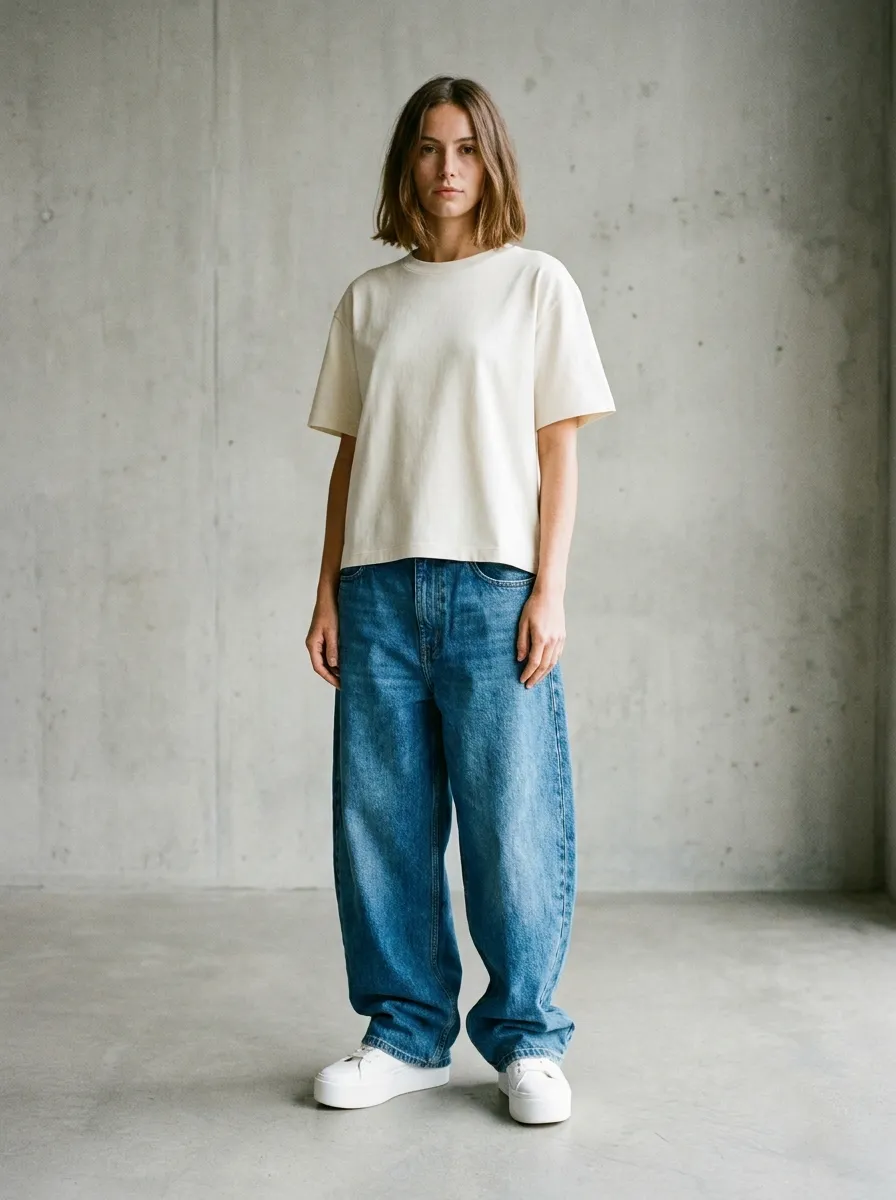
Platform soles: extra thickness keeps hems off the ground.
Platform soles are the practical answer. The extra sole thickness keeps the hem off the ground and stops the fabric from bunching or stacking at the ankle — which is both a proportion fix and a way to keep hems intact. A clean white or black leather platform stays versatile; the platform behind the cargo outfit above is doing exactly this job. Keep the platform slim rather than extreme — an oversized platform starts competing with the denim's volume instead of supporting it.
3. Flats and low sneakers — Needs a cuff
Flats and low sneakers work, but only with a cuff. A flat shoe gets visually swallowed by a wide, uncuffed hem; rolling the cuff once or twice shows the shoe and breaks up the leg length, which is the same fix the corduroy outfit uses with its ankle boots. If the jeans are long enough to drag even cuffed, that is a tailoring question, not a styling one — a hem taken up to sit just above the shoe solves it permanently.
Getting the Proportion Right
1. Fit something, somewhere — Golden rule
Every pairing above keeps at least one point of the silhouette fitted — a cami bodice, a cropped jacket, a belt, a tucked shirt. Baggy jeans with an equally loose top is the one combination that reliably reads as sloppy rather than relaxed.
2. Cuff the hem if you're not wearing a heel — Quick fix
Rolled cuffs shorten the visible leg length and reveal the shoe, which breaks up what would otherwise be one long, uninterrupted column of fabric.
3. Texture and color both do shaping work — Style cue
Distressing, corduroy's wale, and monochrome dressing all change how much visual volume a wide leg appears to carry — none of them change the actual fit, but all of them change the read.
4. Watch what else is loose — Volume check
Pocket detailing, oversized jackets, and boxy tops all add their own volume. Pick one loose element to feature and keep everything else fitted.
Frequently Asked Questions About Styling Baggy Jeans
Which tops balance baggy jeans best?
Fitted tops balance loose denim best. A ribbed sweater, a bodysuit, a cropped hoodie, or a snug cami tucked at the waist all give the wide leg its counterweight. When the top is loose — a flannel, a cardigan — use a half-tuck or a cropped cut so the waist stays defined. Bulky layers on top plus wide legs below is the one combination that reliably swallows the shape.
What is the simplest way to keep baggy jeans from looking sloppy?
Anchor the outfit at the waist and at the hem. Tuck the shirt or add a belt so the waist reads clearly, and cuff the hem or wear a shoe with some presence — a pointed boot, a platform, a clean ankle boot — so the fabric ends deliberately instead of pooling. One fitted element and one structured shoe is usually all it takes.
Can baggy jeans work for a smart-casual office?
Yes, with the right pairing. Choose a dark, undistressed wash, add a blazer with clean shoulders, and swap sneakers for loafers or pointed heels. A tucked blouse or a slim turtleneck underneath keeps the torso streamlined so the denim reads as relaxed tailoring rather than weekend wear. This holds for creative offices; stricter dress codes are a different conversation.
How should shorter frames approach baggy jeans?
They work, but the proportion rules get stricter. Prioritise high-waisted cuts, which lengthen the leg line, and always define the waist — a tuck or a belt is non-negotiable rather than optional. Keep layers minimal up top so the volume does not overwhelm a smaller frame, and consider a pointed-toe shoe or a small heel to extend the leg under the hem. The goal is one clear vertical line, uninterrupted.
What stops baggy jeans from dragging on the ground?
Shoes with some height — a platform sole or a block heel — keep the hem off the pavement and prevent bunching at the ankle. For flats, cuff the hem once or twice to show the shoe. And when the jeans drag regardless of footwear, get the hem tailored to sit just above the shoe; it is a small alteration that permanently fixes the problem.
Before You Walk Out the Door
Run this five-point check in front of the mirror and the outfit is done:
- Waist defined — a tuck, a belt, a cropped hem, or a fitted bodice marks where the waist is.
- One loose element only — the jeans are the volume; everything else stays fitted or structured.
- Colour break checked — top and bottom sit close in tone, or the contrast is deliberate, not accidental.
- Hem ends cleanly — cuffed, or sitting just above a shoe with enough presence to hold its own.
- Texture has a job — distressing, ribbing, corduroy, or shine is doing shaping work, not just decoration.
Baggy jeans read as styled, not sloppy, the moment something else in the outfit is fitted or defined — a waist, a shoulder, a hem. Once that anchor is in place, almost anything above it works, in July or in October.